USAID DEC
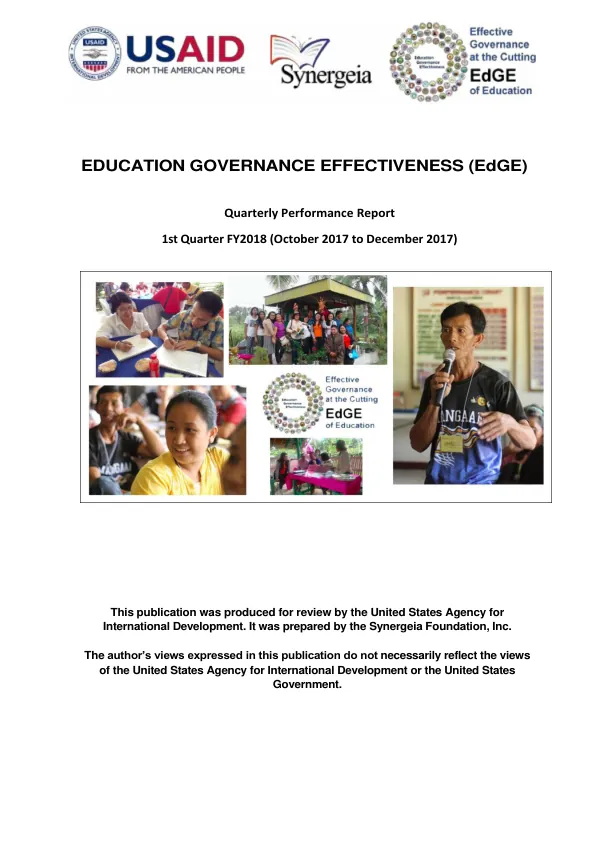
Education Governance Effectiveness (EdGE) Quarterly Performance Report 1st Quarter FY2018
Sign inNATIONAL PLANNING DEPARTMENT
Education Governance Effectiveness (EdGE) Quarterly Performance Report 1st Quarter FY2018
The Education Governance Effectiveness (EdGE) project has reached a significant milestone in its fifth year of implementation.
2018 · 55 pages
Sign in to readA free account is required to download.
Abstract
The project has successfully strengthened planning and management capabilities of Local School Boards (LSBs) and School Governing Councils (SGCs) to improve the education of children, particularly their reading competence. One of the major accomplishments of EdGE is the establishment of a remedial reading program in schools, which has been supported by training 5,534 principals and 7,730 teachers on remedial reading pedagogy. EdGE has invested heavily in remedial reading by providing teaching manuals and reading workbooks to schools. LSBs and SGCs have been influenced to focus on ensuring that children who finish primary schooling can demonstrate reading and comprehension skills. The training program for 4,503 Parent-Teachers Association (PTAs) now incorporates modules on how parents can support reading instruction. EdGE formally supports remedial reading instruction in 2,382 schools, representing 154% of the target. The project has also seen significant progress in increasing transparency and accountability at the local level, with 14 Education Summits conducted. Additionally, 639 PTAs or similar school governance structures have been supported, exceeding the target of 300. New USG-supported public-private partnerships have been formed, with 2 partnerships established. The remedial reading program has shown initial results, with the number of frustrated readers being whittled down to an average of 23.5%. However, there are still communities, especially in rural areas, where the number of non-readers remains high. The challenge remains of how local communities can be steadfast in helping schools and their children even after the completion of the project. The Mayor of General Santos emphasizes the importance of education as a poverty problem that can only be solved if every individual contributes their share. EdGE has made significant progress in strengthening government effectiveness for education at the local level, with 539 administrators and officials successfully trained with USG support. The project has also developed or modified laws, policies, regulations, or guidelines to improve primary grade reading programs or increase equitable access. The project's success can be attributed to the strong partnership between EdGE and local governments, as well as the support of the private sector. The project's firm resolve is to reduce the number of poor readers to at most 20% of the student population. With SGCs gaining momentum in leadership, there is hope that they will find the reason to support programs that will imbue children with the gift of understanding what they read. EdGE has also made significant progress in increasing participation of stakeholders in education policy formulation and implementation. The project has supported 639 PTAs or similar school governance structures, exceeding the target of 300. New USG-supported public-private partnerships have been formed, with 2 partnerships established. The project's monitoring and evaluation (M&E) system has been instrumental in tracking progress and identifying areas for improvement. The results of pre-tests conducted to determine the level of reading skill have been used to design the remedial reading program. Monitoring the conduct of remedial reading program is done through actual visitation of schools, with program officers asking for evidence on the conduct of remedial reading classes. The project's financial summary shows that PHP 7,533,593.43 has been expended for the training of administrators and officials, while PHP 6,349,889.69 has been expended for the support of PTAs or similar school governance structures. The project's success has been recognized by the Mayor of General Santos, who emphasizes the importance of education as a poverty problem that can only be solved if every individual contributes their share. The project's plans for the next quarter include continuing to support remedial reading instruction in schools, increasing transparency and accountability at the local level, and increasing participation of stakeholders in education policy formulation and implementation. The project's firm resolve is to reduce the number of poor readers to at most 20% of the student population. With SGCs gaining momentum in leadership, there is hope that they will find the reason to support programs that will imbue children with the gift of understanding what they read.
Related documents