USAID DEC
Monitoring, Evaluation, Research, and Learning Innovations Program (MERLIN) SPACES MERL Fact Sheet
Sign inLINC LLC
Monitoring, Evaluation, Research, and Learning Innovations Program (MERLIN) SPACES MERL Fact Sheet
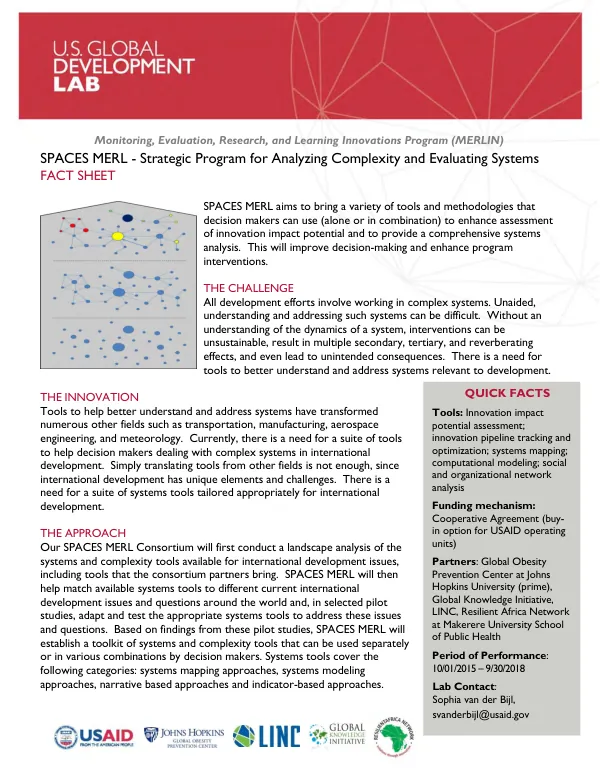
The SPACES MERL program aims to enhance decision-making in international development by providing a suite of tools and methodologies for assessing innovation impact potential and conducting comprehensive systems analysis.
2015 · 1 pages
Sign in to readA free account is required to download.
Abstract
This program is a response to the challenge of working in complex systems, where interventions can be unsustainable and lead to unintended consequences without a thorough understanding of the system dynamics. The program's innovation lies in the development of tailored systems tools for international development, which differ from those used in other fields such as transportation, manufacturing, and aerospace engineering. These tools will be designed to address the unique elements and challenges of international development, including issues related to poverty, health, and economic growth. The SPACES MERL Consortium will conduct a landscape analysis of existing systems and complexity tools available for international development issues. This analysis will identify the tools that the consortium partners bring, as well as other relevant tools that can be adapted and tested for use in international development. The program will then help match these tools to different current international development issues and questions around the world, with a focus on pilot studies that demonstrate the effectiveness of the tools in addressing specific challenges. The toolkit of systems and complexity tools developed by SPACES MERL will cover four categories: systems mapping approaches, systems modeling approaches, narrative-based approaches, and indicator-based approaches. These tools will be designed to be used separately or in various combinations by decision makers, allowing them to select the most appropriate tools for their specific needs and contexts. The SPACES MERL program will be implemented through a Cooperative Agreement with USAID, with a period of performance from October 1, 2015, to September 30, 2018. The program is led by the Global Obesity Prevention Center at Johns Hopkins University, in partnership with the Global Knowledge Initiative, LINC, and the Resilient Africa Network at Makerere University School of Public Health. The program's contact person is Sophia van der Bijl, who can be reached at [email protected].