FUTURES GROUP INTERNATIONAL, LLC
Monitoring HIV Policy Interventions in PEPFAR Partnership Frameworks
The U.S.
2013 · 1 pages
Sign in to readA free account is required to download.
Abstract
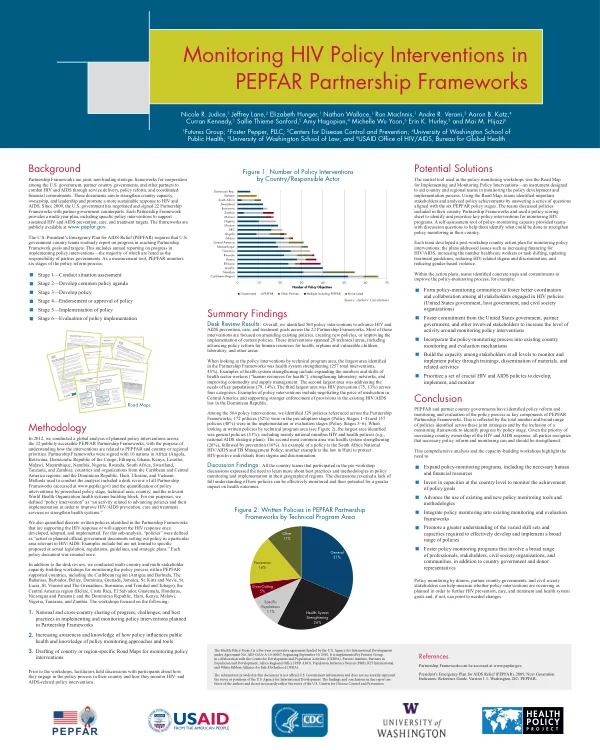
government's Partnership Frameworks with partner countries aim to combat HIV and AIDS through service delivery, policy reform, and coordinated financial commitments. These frameworks are joint, non-binding strategic documents that strengthen country capacity, ownership, and leadership in the HIV and AIDS response. Since 2009, the U.S. government has negotiated and signed 22 Partnership Frameworks with partner government counterparts. The Partnership Frameworks provide a multi-year plan, including specific policy interventions to support sustained HIV and AIDS prevention, care, and treatment targets. The frameworks are publicly available at www.pepfar.gov. The U.S. President's Emergency Plan for AIDS Relief (PEPFAR) requires that U.S. government country teams routinely report on progress in reaching Partnership Framework goals and targets. The PEPFAR policy reform process is monitored through six stages: conducting a situation assessment, developing a common policy agenda, developing policy, endorsement or approval of policy, implementation of policy, and evaluation of policy implementation. A global analysis of planned policy interventions across the 22 Partnership Frameworks was conducted in 2012 to understand how the interventions are related to PEPFAR and country or regional priorities. The analysis identified 564 policy interventions to advance HIV and AIDS prevention, care, and treatment goals across the 22 Partnership Frameworks. Most of these interventions are focused on amending existing policies, creating new policies, or improving the implementation of current policies. These interventions spanned 20 technical areas, including advancing policy reform for human resources for health, orphans and vulnerable children, laboratory, and other areas. Health system strengthening was the largest area identified in the Partnership Frameworks, with 257 total interventions (45%). Examples of health system strengthening include expanding the numbers and skills of health sector workers, strengthening laboratory networks, and improving commodity and supply management. The second largest area was addressing the needs of key populations, with 79 interventions (14%). The third largest area was HIV prevention, with 75 interventions (13%). Among the 564 policy interventions, 329 policies were referenced across the Partnership Frameworks. 172 policies (52%) were in the pre-adoption stages (Policy Stages 1–4), and 157 policies (48%) were in the implementation or evaluation stages (Policy Stages 5–6). The largest area identified was general policies, including mainly national omnibus HIV and health policies. The second most common area was health system strengthening, followed by prevention. The country teams that participated in the policy-monitoring workshops expressed the need to learn more about best practices and methodologies in policy monitoring and implementation in their geographical regions. The discussions revealed a lack of full understanding of how policies can be effectively monitored and their potential for a greater impact on health outcomes. The Road Map for Implementing and Monitoring Policy Interventions was the central tool used in the policy-monitoring workshops. Using the Road Map, teams identified important stakeholders and analyzed policy achievements by answering a series of questions aligned with the six PEPFAR policy stages. Each team developed a post-workshop country action plan for monitoring policy interventions, which addressed issues such as increasing financing for HIV/AIDS, increasing the number of healthcare workers or task shifting, updating treatment guidelines, reducing HIV-related stigma and discrimination, and reducing gender-based violence. The action plans included concrete steps and commitments to improve the policy-monitoring process, such as forming policy-monitoring committees, fostering commitment from stakeholders, incorporating the policy-monitoring process into existing country monitoring and evaluation mechanisms, building capacity among stakeholders, prioritizing crucial HIV and AIDS policies, and developing, implementing, and monitoring these policies. PEPFAR and partner country governments have identified policy reform and monitoring and evaluation of the policy process as key components of PEPFAR Partnership Frameworks. This is reflected by the total number and broad range of policies identified across these joint strategies and by the inclusion of a monitoring framework in the Partnership Frameworks.
Related documents