USAID
Monthly Progress Report as on Jan, 2012 CMEP, AGES
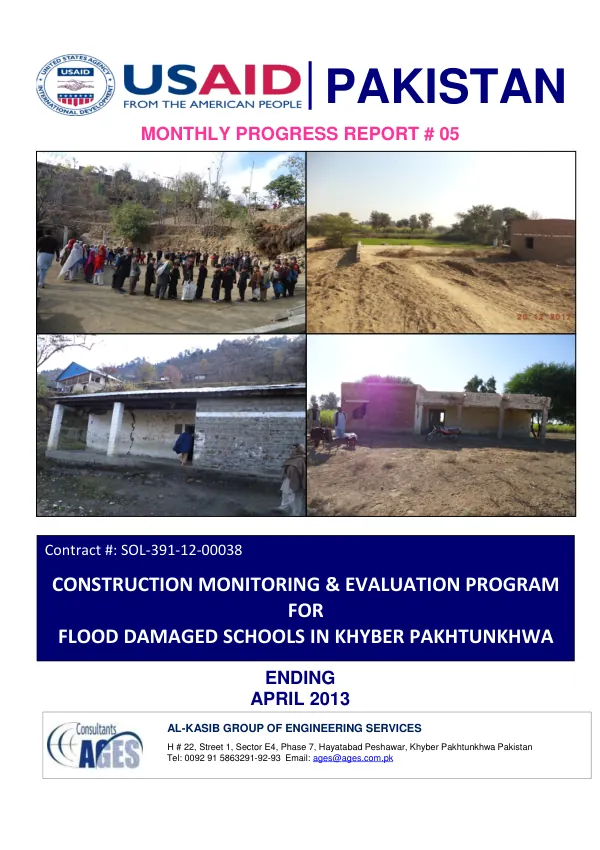
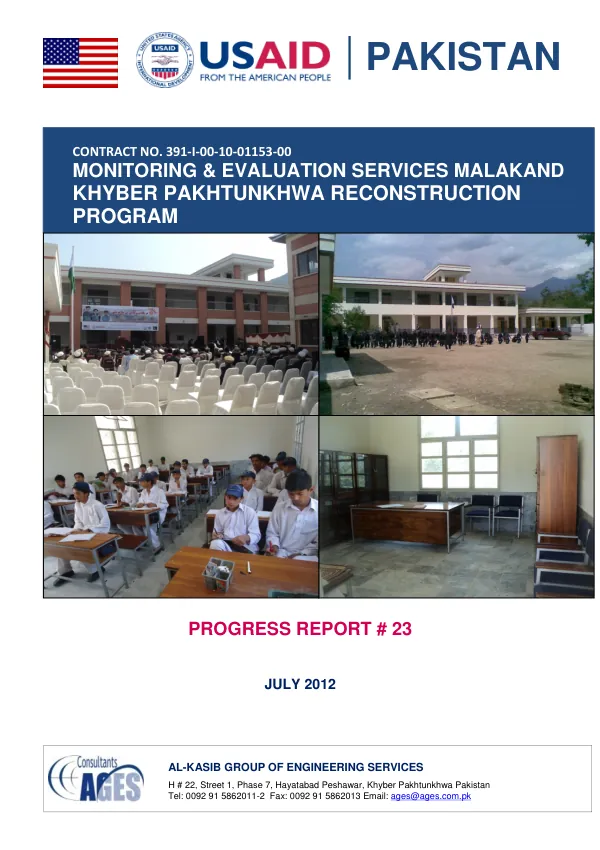
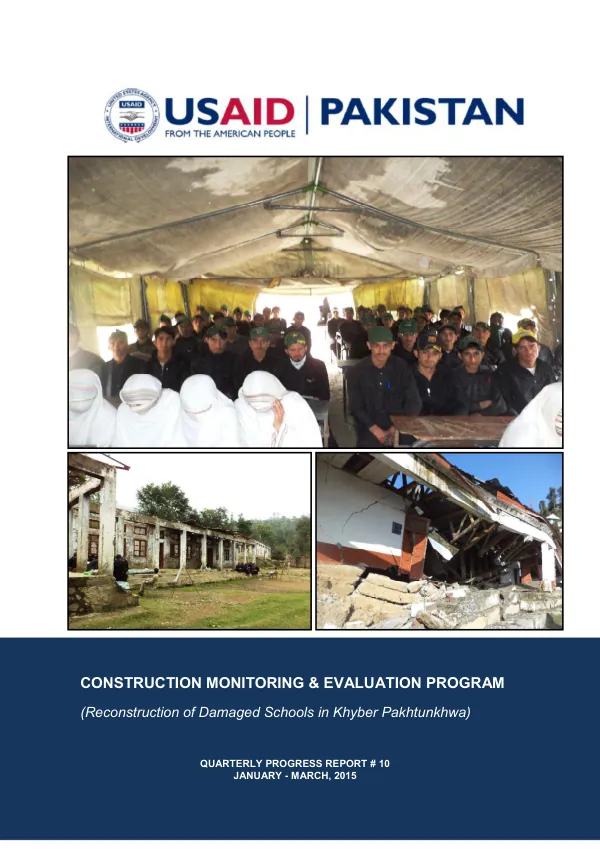
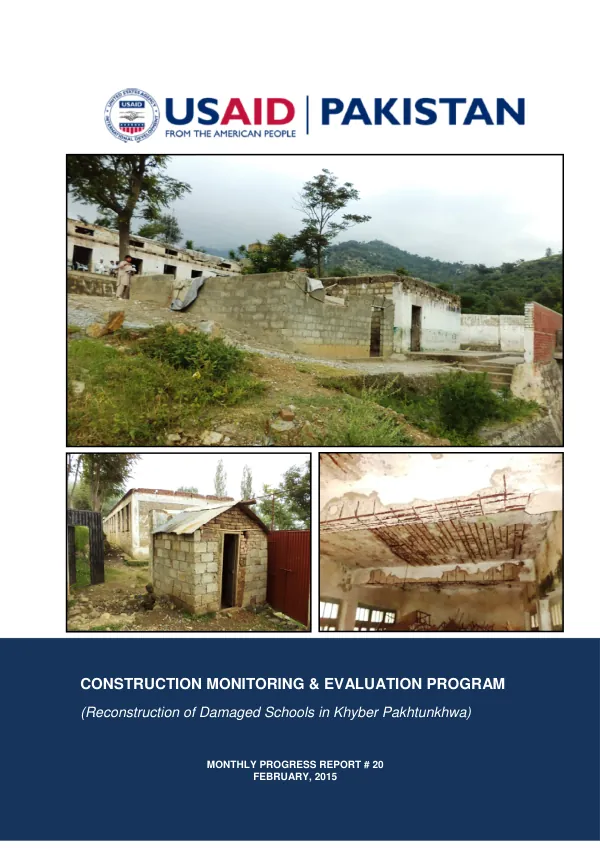
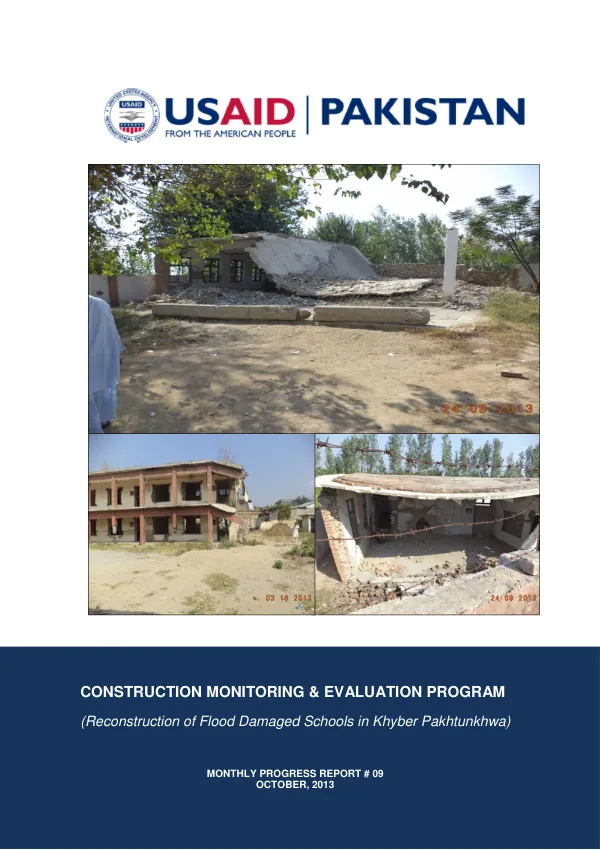
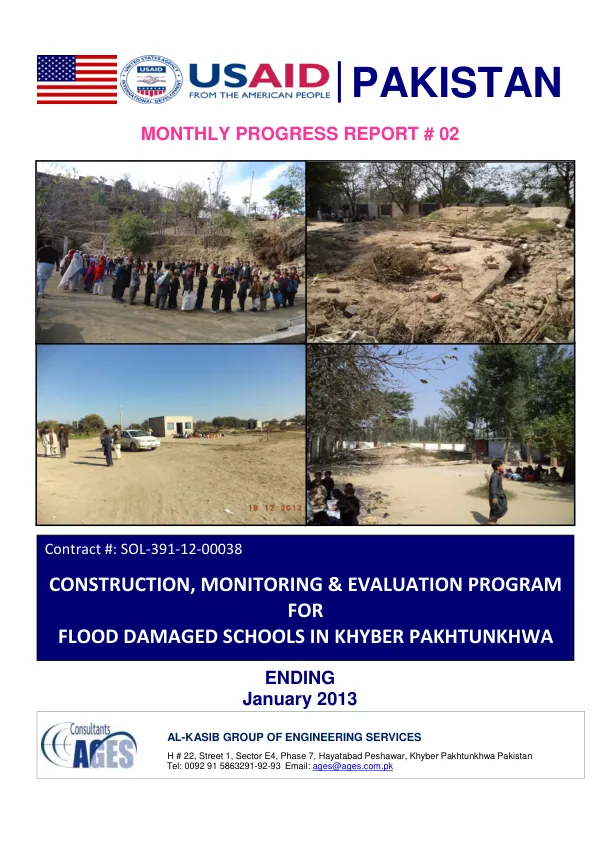
The Construction Monitoring & Evaluation Program (CMEP) for Flood Damaged Schools in Khyber Pakhtunkhwa began in 2010 following the massive and unprecedented 2010 Monsoon Flood.
2012 · 76 pages
Sign in to readA free account is required to download.
Abstract
The disaster deprived local communities of their livelihoods and created an unprotected environment for school-going children in 10 districts of Khyber Pakhtun Khwa (KPK). The affected districts include Peshawar, Nowshera, Charsadda, Tank, D.I Khan, Malakand, Swat, Dir Upper/Lower, and Shangla. The Government of KPK, through its concerned line departments, prepared Damage Need Assessments (DNA) of the flood-affected districts. USAID was already working in Malakand Division on the reconstruction and rehabilitation of schools, health facilities, and Water & Sanitation (WatSan) infrastructures affected during the militancy period of 2009 to 2010. USAID tasked AGES, the M&E consultants for the USAID-funded sub-projects in the Malakand Division, to undertake the additional work of DNA and validation for the partially and fully damaged schools in some of the districts affected by floods. The project has been tasked with the objective to monitor and certify that all the proposed projects are built as per approved designs/drawings, technical specifications, and to ensure environmental compliance as per USAID's and Government of Pakistan's (GoP) regulations and requirements. The project location map is attached as Figure 1.1. The Economic Affairs Division (EAD) designated the Director General (DG) of Provincial Reconstruction, Rehabilitation and Settlement Authority (PaRRSA) as an Additional Representative of the Government of Pakistan (GOP) for the purposes of the implementation of Program Areas. The GoKP has established a Project Steering Committee (PSC) to provide oversight and guidance and approvals required for smooth and timely implementation of the Activities. PaRRSA has the authority to carry out the works to be financed under this Fixed Amount Reimbursement (FAR) Agreement. M/S AGES Consultants of Peshawar have been appointed by USAID as Monitoring & Evaluation Consultants for this project. AGES as M&E Consultants inspect and provide PaRRSA a certification of completion for satisfactorily completed work as a pre-requisite condition for reimbursement of completed works. The project's implementation arrangements are in place, with the Project Steering Committee (PSC) providing oversight and guidance. The PSC is chaired by the DG PaRRSA, and comprised representatives of USAID Pakistan and relevant Provincial Departments involved in the Planning and execution of the activities. A strategy is being debated and formulated by the active participation of all stakeholders to decide/identify an appropriate executing agency to undertake implementation of this project, on behalf of the government of KPK. The CMEP has made significant progress since its inception. The consultant's activities have been focused on monitoring and evaluation services, including Quality Assurance and Environmental Monitoring for the reconstruction project of fully damaged schools in the nine districts of Khyber Pakhtunkhwa Province. The consultant has undertaken various activities, including mobilization of staff, establishment of office/residencies, submission of draft Quality Assurance Plan (QAP), validation/revalidation of school's sites, pre-construction survey, preparation of site/layout plan, and submission of quarterly progress report. The consultant has also undertaken major activities during the reporting period, including layout plans, submission of Quality Assurance Plan (QAP), submission of revised modular drawings, submission of revised BOQs, revision of structural drawings, and M&E setup for D.I.Khan & Malakand Division. The consultant has also deployed staff, established a project office, and established residence for staff. The project has made significant progress in terms of implementation, with the consultant having completed various activities and submitted reports as required. The project's implementation arrangements are in place, with the Project Steering Committee (PSC) providing oversight and guidance. The project's objective is to monitor and certify that all the proposed projects are built as per approved designs/drawings, technical specifications, and to ensure environmental compliance as per USAID's and Government of Pakistan's (GoP) regulations and requirements.