USAID
Monthly Progress Report for October 2013: Building Component-CMEP
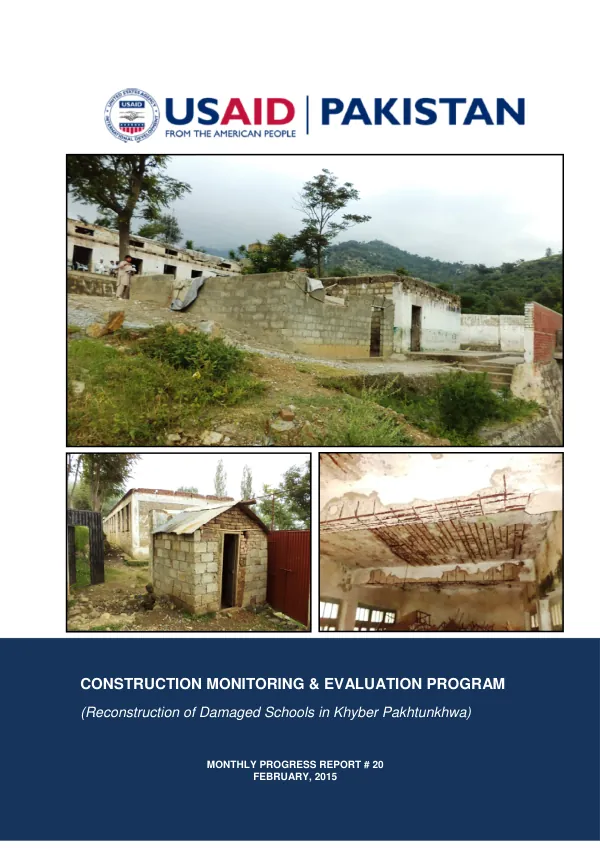
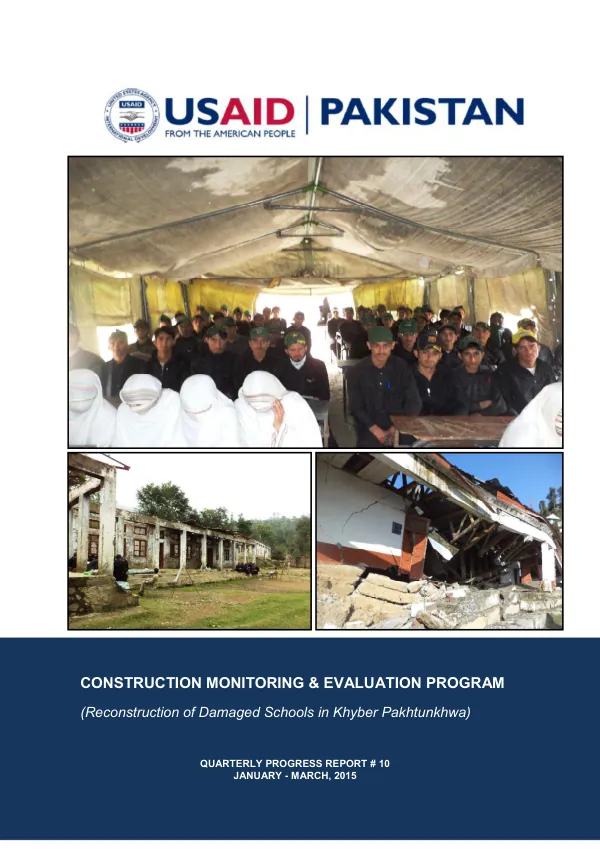
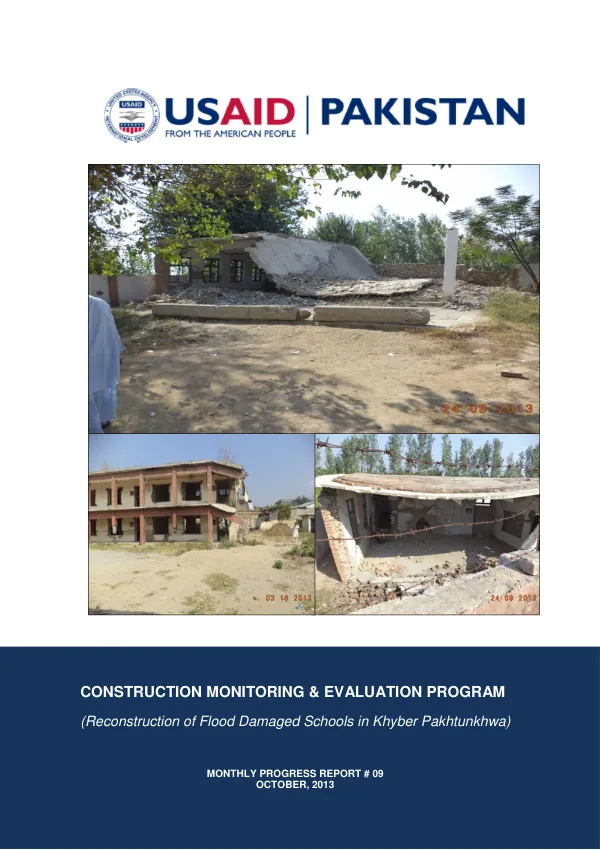
The Province of Khyber Pakhtunkhwa suffered heavy infrastructure damages due to terrorism, militancy, and unprecedented floods in July 2010.
2013 · 54 pages
Sign in to readA free account is required to download.
Abstract
United States Agency for International Development (USAID) supported the rehabilitation and reconstruction activities of damaged schools, health facilities, drinking water supply schemes, and other infrastructure components in Malakand Division by initially obligating funds amounting to USD 36 million under an Activity Agreement signed in September 2009. Expanding its portfolio, USAID provided funds for rehabilitation/reconstruction of other infrastructure components, including irrigation, bridges, and roads, in the calamity-hit areas. In June 2012, USAID sub-obligated additional funds amounting to USD 25 million for reconstruction of rains/floods damaged and bomb-blasted schools in the affected districts of KP under Amended Activity Agreement No. 391-014. M/s AGES Consultants was assigned the task of Monitoring & Evaluation (M&E) services of these reconstruction activities under USAID/Pakistan Construction Monitoring and Evaluation Program (CMEP), for which a formal contract was signed on September 30, 2012. The M&E Consultant has completed validation/revalidation of about more than 200 identified schools. A 1st list of 114 damaged schools was assessed in December 2012, in which 42 schools were found suitable/feasible for reconstruction. Site/layout plans & validation report were shared with the stakeholders. A meeting held on May 17th, 2013, in the office of program manager PaRRSA decided the scope of the first PIL, and a total of 24 out of 42 schools were agreed to be included in PIL. Drawings & engineer's estimates of the aforesaid schools were prepared, reviewed, and finalized. USAID issued a signed PIL-28 to PaRRSA for further appropriate action. Further, design for all modules were revised/improved and new modules were introduced in light of lessons learnt from the practice already in vogue in Malakand. A 2nd list of about 21 damaged schools was provided by PaRRSA, in which 10 schools were found suitable/feasible for reconstruction. The site/layout plans & validation report of the feasible schools were shared with the stakeholders. A 3rd list of 161 damaged schools was provided by PaRRSA, which was discussed with the concerned EDO's in a meeting held on August 27th, 2013, at Saidu Sharif Swat. In light of the said meeting, a revised 3rd list of 150 damaged schools was provided by PaRRSA. Physical survey & assessment of the schools were initiated, and 23 schools in District Lower Dir, 29 schools in District Swat, and 11 schools in District D.I Khan have been assessed by the AGES field team in the reporting month. The assessment of the remaining schools is underway. Physical construction activities will start subject to completion of the requisite prequalification, tendering, and contracting formalities by PaRRSA. An implementation arrangement in light of the experience gained and lessons learnt from the Malakand model needs to be developed on priority so as to pursue the project implementation/physical activities without any loss of time. The disaster of 2010 Monsoon Flood in Khyber Pakhtunkhwa (KP) was massive and unprecedented. The flood not only deprived the local communities of their livelihoods but also created an unprotected and challenging environment for the school-going children in the flood-hit districts of KP. As per data received from the Education Department of the KP, the numbers of schools either partially or fully damaged ranged in hundreds. The Government of KP was faced with the challenging task of reconstruction and restoration of these lost academic facilities at huge construction costs. Realizing the importance of early resumption of academic activities, the Government of KP and USAID collaborated to reconstruct and restore the damaged schools. The reconstruction of damaged schools in KP is a critical component of the USAID-funded Construction Monitoring and Evaluation Program (CMEP). The program aims to support the Government of KP in rebuilding and restoring damaged schools, health facilities, and other infrastructure components in the affected districts. The program has made significant progress in the past few months, with the completion of validation/revalidation of over 200 identified schools and the initiation of physical survey & assessment of the schools. The program is expected to continue making progress in the coming months, with the start of physical construction activities subject to completion of the requisite prequalification, tendering, and contracting formalities by PaRRSA.