USAID
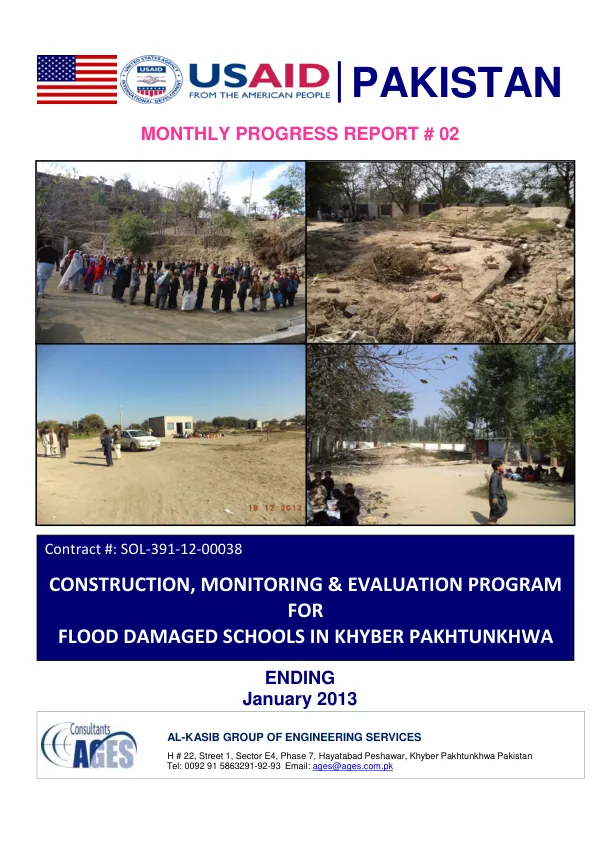
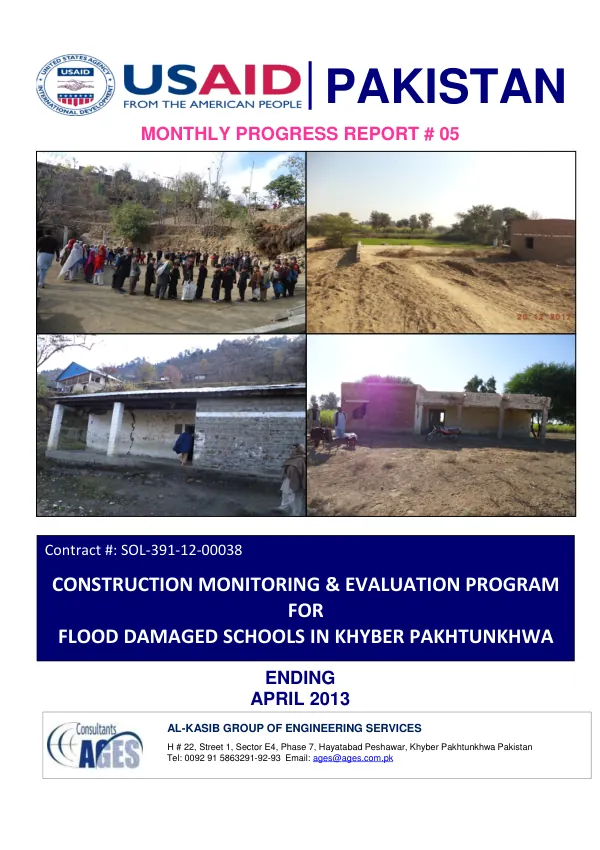
Monthly Progress Report for April 2013: Building Component-CMEP
The Construction Monitoring and Evaluation Program (CMEP) in Khyber Pakhtunkhwa Province, Pakistan, was initiated in response to the 2010 Monsoon Flood disaster.
2013 · 30 pages
Sign in to readA free account is required to download.
Abstract
The flood damaged hundreds of schools in 10 districts of the province, including Peshawar, Nowshera, Charsadda, Tank, D.I Khan, Malakand, Buner, Swat, Dir Upper/Lower, and Shangla. The Government of Khyber Pakhtunkhwa appealed to national and international donors for funds to rectify the situation. USAID, which was already working in Malakand Division on the reconstruction and rehabilitation of schools, health facilities, and Water & Sanitation (WatSan) infrastructures, tasked AGES, the M&E consultants for the USAID-funded sub-projects in the Malakand Division, to undertake the additional work of Damage Need Assessment (DNA) and validation for the partially and fully damaged schools in some of the districts affected by floods. After detailed damage assessment, AGES was assigned the task of monitoring and evaluation services, including Quality Assurance and Environmental Monitoring, for the reconstruction project of fully damaged schools in nine districts of Khyber Pakhtunkhwa Province. The scope of services for the CMEP includes quality and progress reporting of the building and road components. The building component of the project includes 114 flood-damaged schools in the nine districts of Khyber Pakhtunkhwa Province. A 100-200 KM road in the Khyber Pakhtunkhwa Province is also part of the overall contract, which includes Construction Monitoring and Evaluation Services for 46 KM long Peshawar-Torkham road. The project is funded with a USAID grant, and the building component of the project is governed through the Provincial Reconstruction, Rehabilitation, and Settlement Authority (PaRRSA). The revalidation of 114 flood-damaged schools was conducted in December 2012, and 42 schools were found feasible for reconstruction. Feasible schools numbering 27 are situated in District DI Khan, 8 schools in District Shangla, 2 schools in District Swat, 3 schools in District Malakand, and 2 schools in District Lower Dir. Major activities and accomplishments during March 2013 include the decision to provide an Examination Hall of size 40' x 80' in high and higher secondary schools. Due to dimension constraints, an Examination Hall of size 48'-9" x 26'-9" has been provided in the M6 module. Preliminary Structural, Architectural, Electrical, and Typical drawings of M6 module were prepared and shared with stakeholders. The columns in the Examination Hall located in the first floor of Module M-6 have been eliminated to avoid obstruction and provide clear space for Examination and other Educational Activities. Structural analysis of M-6 Module has been carried out by the structure engineer of CMEP. The revised structural drawings have been technically reviewed by the structure specialist. The following activities were carried out: Structural Analysis of M-6 module, Revision of structural drawings of M-6 Module, Technical review of revised structural drawings of M-6 Module by structure specialist, Revision/finalization of Structural, Architectural, Electrical, and Typical drawings of M-6 Module, Submission of final Structural, Architectural, Electrical, and Typical drawings of M-6 Module, and Second Quarterly Progress Report for the quarter ending on March 31, 2013 was shared with USAID/PaRRSA for their review and comments. Site-specific BOQs of 42 sites have already been drafted and will be finalized after the meeting with stakeholders to be conducted shortly as desired by PaRRSA. Recommendations for way-forward include the requirement of a fresh list of alternate schools as a replacement of unsuitable sites to meet the approved scope of 114 schools. Formulation of a strategy for implementation of the schools construction needs to be finalized at the earliest. As a lesson learned from the M&E Project Malakand, geotechnical investigations for determination of bearing capacity for specific sites is a time-consuming activity. Keeping in view its importance, it is suggested that a decision on this activity needs to be taken at the earliest to complete this task well before the commencement of construction activities.
Related documents