USAID
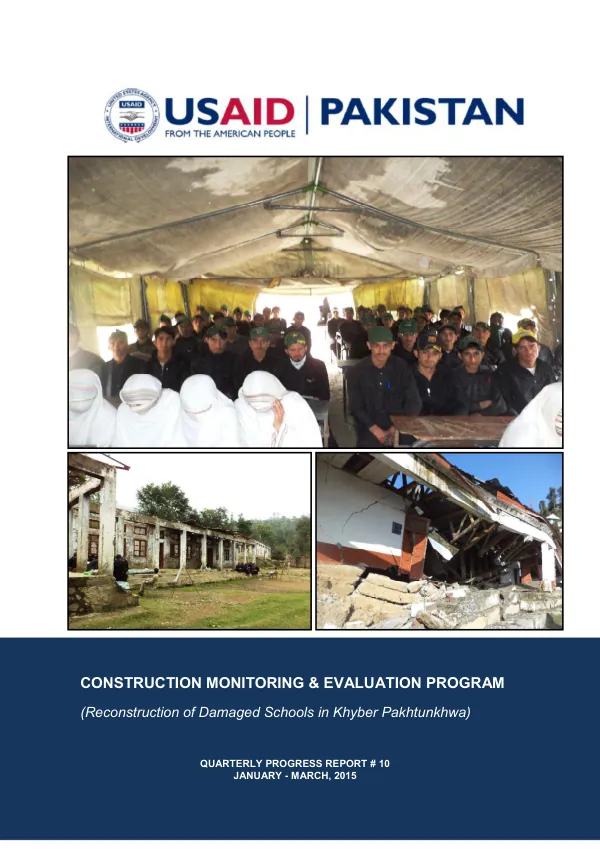
Construction Monitoring & Evaluation Program (CMEP) Quarterly Progress Report #10
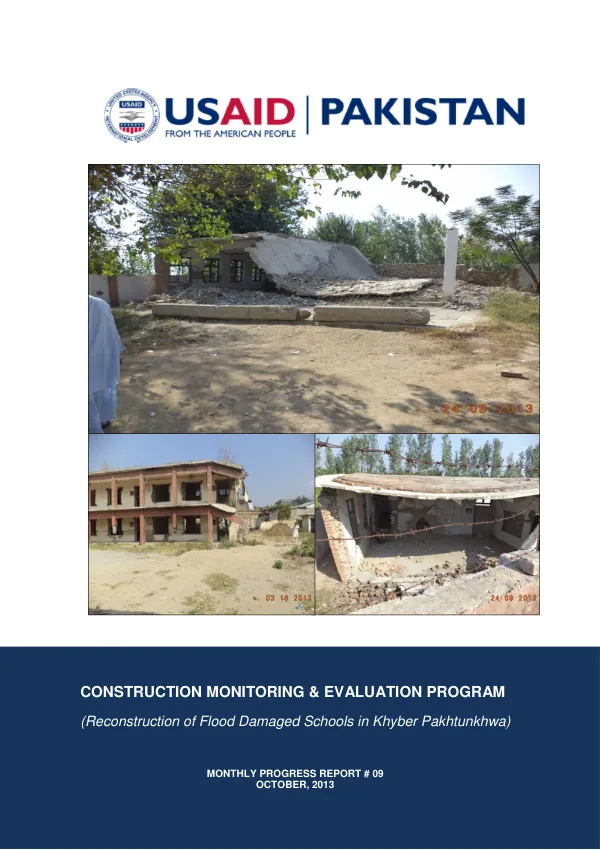
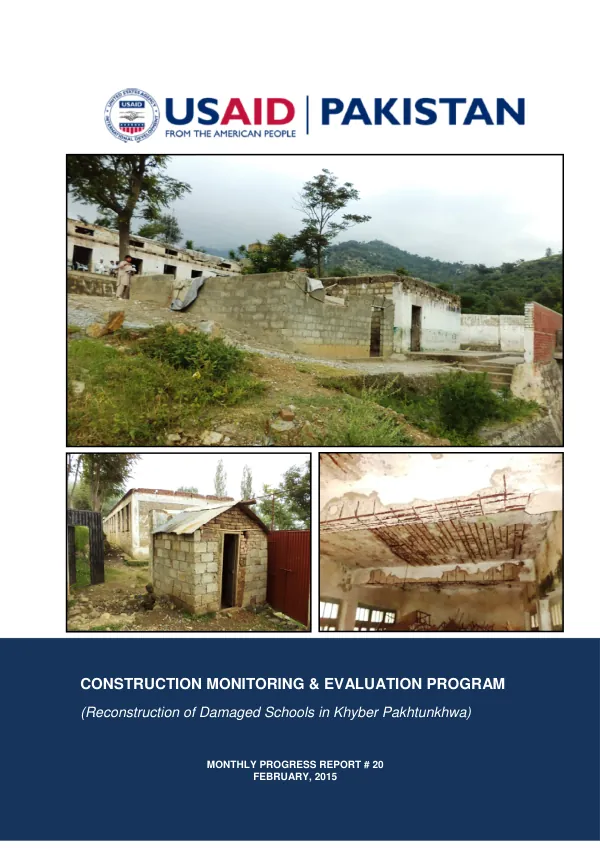
The Province of Khyber Pakhtunkhwa suffered heavy infrastructure damages due to terrorism, militancy, and the 2010 floods.
2015 · 27 pages
Sign in to readA free account is required to download.
Abstract
United States Agency for International Development (USAID) supported the rehabilitation and reconstruction activities of damaged schools, health facilities, drinking water supply schemes, and other infrastructure components in Malakand Division. USAID initially obligated funds amounting to USD 36 million under an Activity Agreement signed in September 2009 between USAID and PaRRSA on behalf of the Government of Pakistan. Additional funds of USD 25 million were sub-obligated in June 2012 for the reconstruction of rains/floods damaged and bomb-blasted schools in affected districts of KP under an Amended Activity Agreement. The Monitoring & Evaluation (M&E) services for these reconstruction activities were assigned to M/s AGES Consultants under USAID/Pakistan Construction Monitoring and Evaluation Program (CMEP). The M&E Consultants have completed validation/assessment of a total of 334 identified schools, with 133 schools found suitable and 201 schools declared unsuitable for reconstruction. Out of the 133 feasible schools, 108 schools have been scrutinized/prioritized and selected for reconstruction, while the remaining schools have been kept in second priority by PaRRSA. For 24 schools, USAID issued a signed Project Implementation Letter (PIL) number 391-014-PIL-28 amounting to Pak Rs. 454.2789 million (USD 4.326466 million) on October 29, 2013. However, commencement of physical activities on these 24 schools is awaited on the part of PaRRSA for the last 17 months, and the PIL expired on December 31, 2014, with no progress on its implementation till date. Site/layout plans, modular designs, and EDFs for 63 more schools have also been finalized/reviewed and shared with USAID in January 2014 for issuing a PIL amounting to Pak Rs. 1,416.9018 million. PaRRSA could still not finalize its Implementation Arrangement for the reconstruction of the 2010 flood-damaged/bomb-blasted schools. In view of the situation, no major activities were carried out during the reporting quarter by the M&E Consultants. The PIL-wise distribution of 108 prioritized schools shows a geographic spread across various districts of KP. Urgent action is required on several points, including the validation of 24 schools for PIL-28, which has already expired, and the signing of PIL for 63 schools. Additionally, the EDFs of 63 schools are under review at USAID, which need to be finalized at the earliest. A joint meeting of all stakeholders is also necessary to apprise them of the updated status of the Implementation Arrangement by PaRRSA, the status of already approved PILs, and the PIL under process. The disaster of the 2010 Monsoon Flood in Khyber Pakhtunkhwa (KP) was massive and unprecedented, depriving local communities of their livelihoods and creating an unprotected and challenging environment for school-going children in flood-hit districts of KP. The Government of KP faced the challenging task of reconstruction and restoration of lost academic facilities. As per data received from the Education Department of the KP, the numbers of schools either partially or fully damaged ranged in hundreds. The implementation of the reconstruction project has been delayed due to various reasons, including the lack of Implementation Arrangement by PaRRSA. The M&E Consultants have been monitoring the progress of the project, but no major activities were carried out during the reporting quarter. The PIL-wise distribution of 108 prioritized schools shows a geographic spread across various districts of KP. The project requires urgent action to move forward with the reconstruction of damaged schools in KP.