GOVERNMENT OF SINDH
Sindh Community Mobilization Program Quarterly Progress Report Year VIII – Q III
Pakistan faces challenges across the nation's education system, with Sindh province experiencing a range of factors hindering progress.
2021 · 35 pages
Sign in to readA free account is required to download.
Abstract
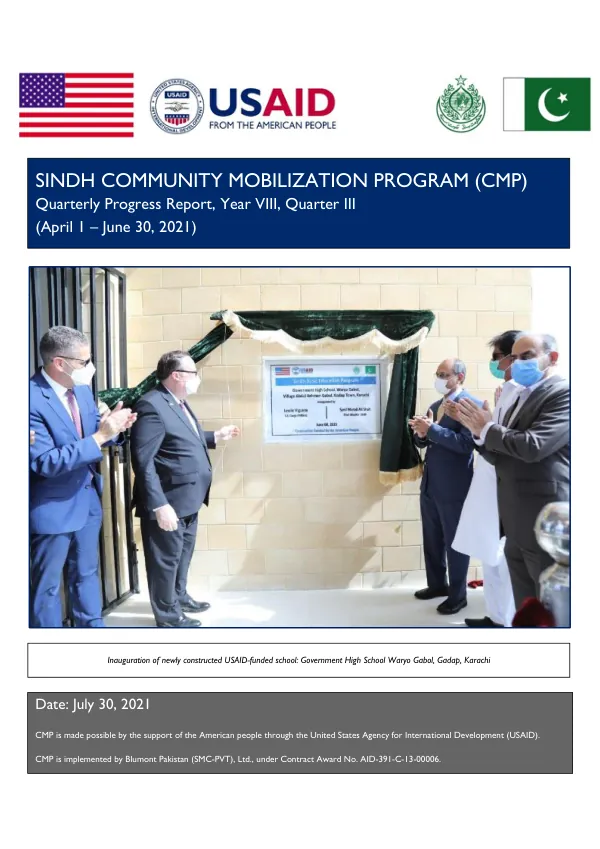
In response, the Government of Pakistan committed to improvements in line with the United Nations Sustainable Development Goals, and the Government of Sindh (GOS) developed the Sindh Education Sector Plan to guide local action. A significant bilateral initiative, the comprehensive Sindh Basic Education Program (SBEP), seeks to advance both the GOS plan and Pakistan's commitment to improving access to quality education for all children. Implemented by the GOS and the U.S. Agency for International Development (USAID), the SBEP aims to increase and sustain student enrollment in primary, elementary, and secondary schools across Sindh. Originally designed as a five-year program in 10 districts in Sindh, the program successfully led reforms in 750 schools in these 10 districts. The Sindh Community Mobilization Program (CMP), implemented by Blumont Pakistan (SMC-PVT) Ltd., is a flagship component of the SBEP. The CMP increases community and private-sector involvement in school reform and strengthens local coordination to improve student retention and opportunities. The program has four key components: (1) increase community involvement in the GOS reform of merging, consolidating, and upgrading schools; (2) improve community and district administrations' coordination for increased girls' enrollment; (3) improve child nutrition in selected communities and government schools; and (4) launch education management organizations (EMOs). Three cross-cutting themes bolster the CMP's components: (1) gender mainstreaming, (2) water and sanitation, and (3) disaster risk reduction. During the third quarter of Year 8, despite the COVID-19 pandemic, the CMP team made great strides toward achieving program objectives. In collaboration with USAID and the GOS-Program Management Implementation Unit (PMIU) and School Education and Literacy Department (SELD), CMP organized two high-profile inauguration ceremonies of government high schools reconstructed with USAID funds. The capacity of more than 1,000 School Management Committee (SMC) members was enhanced through a two-day school-based comprehensive training in selected model and neighboring grouped schools in Dadu, Jacobabad, Kashmore, Larkana, Kambar Shahdadkot, Sukkur, Khairpur, and Karachi. Furthermore, 82 school improvement plans were developed, and more than 200 government officials were trained. To support the SELD EMO reform, CMP provided technical, administrative, legal, and logistical support to advance public-private partnerships. During the reporting period, one remaining USAID reconstructed school was handed over to its EMO in Larkana. CMP collected total enrollment data in targeted model and neighboring schools in all SBEP districts. Local restrictions and lockdowns due to the COVID-19 pandemic disrupted CMP operations and activities. CMP adapted to continue building on previous progress by launching the Care for Community (C4C) initiative to maintain connections while sharing critical information to help people stay healthy. C4C enabled CMP to engage stakeholders proactively through calls, text messages, district-level WhatsApp groups, and videoconferencing. Health awareness handouts and posters were developed, printed, and shared with schools and communities. The feedback from stakeholders was overwhelmingly positive, helping CMP strengthen its reputation as a community builder. In response to pandemic restrictions, C4C shared online communication methods and learning resources with schoolteachers and managers. Inspired and motivated by these examples, teachers started using online teaching methods. The table below shows CMP's progress toward its indicators for the two components with progress in Q3 remaining two components do not have any reporting indicator. The data comes from the USAID Pak Info database. CMP Performance in Year 8, Quarter 3 (April 1, 2021 – June 30, 2021) shows the program's progress toward its indicators, with a focus on sustaining community mobilization and school-based management in Sindh province.