GOVERNMENT OF SINDH
Sindh Community Mobilization Program Quarterly Progress Report Year VIII – Q II
The Sindh Community Mobilization Program (CMP) is a central component of the Sindh Basic Education Program (SBEP), implemented by the Government of Sindh (GOS) and the United States Agency for International Development (USAID).
2021 · 43 pages
Sign in to readA free account is required to download.
Abstract
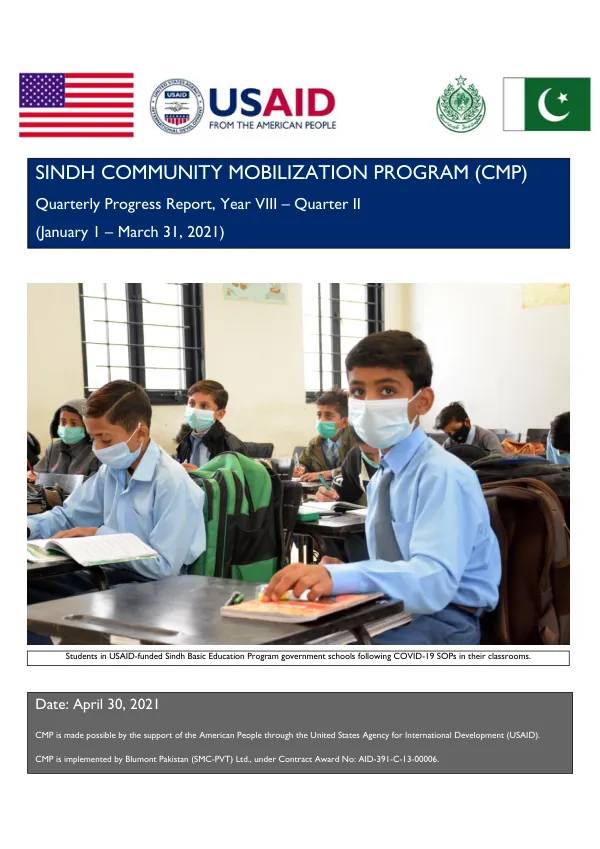
The program aims to increase community and private-sector involvement in school reform and strengthen local coordination to improve student retention and opportunities. The CMP has four key components: 1) Increase community involvement in the GOS reform of merging, consolidating, and upgrading schools; 2) Improve community and district administrations' coordination for increased girls' enrollment; 3) Improve child nutrition in selected communities and government schools; and 4) Launch of Education Management Organizations (EMOs). Three cross-cutting themes bolster the CMP's components: 1) Gender Mainstreaming, 2) Water and Sanitation (WATSAN), and 3) Disaster Risk Reduction (DRR). During the second quarter of year eight program implementation, the CMP supported communities, school administration, and district education officials to increase their scope of intervention to reach the 750 targeted schools. The program included 350 more schools, increasing the school target from 400 to 750. CMP provided technical, administrative, legal, and logistical support to advance public-private partnerships and facilitated 14 school handing over ceremonies in Dadu, Larkana, and Kamber Shahdadkot districts. Under RFP #5, 71 schools (25 newly constructed and 46 grouped) were handed over to five EMOs. Community engagement remains at the center of all CMP activities, including a focus on empowering women in all interventions. Sessions for women on their rights, communication, and leadership helped build skills while enhancing confidence to speak up and present ideas to support schools. The COVID-19 pandemic challenged the CMP, disrupting field activities with local restrictions and lockdowns in place, including the closing of schools in Sindh. The program adapted to continue building on progress and launched the Care for Community (C4C) initiative to maintain connections while sharing critical information to help people stay healthy. Feedback from stakeholders was overwhelmingly positive, helping the CMP strengthen its reputation as a community builder. The CMP team restructured its activities to ensure continuity and effectiveness, leveraging digital platforms to engage stakeholders and maintain momentum. The program continued to support the GOS School Education and Literacy Department's (SELD) Education Management Organization (EMO) reform, providing technical assistance and capacity building support to EMOs. In addition, the CMP facilitated the establishment of School Hygiene and Nutrition Committees (SHNCs) in 150 schools, promoting healthy practices and improving nutrition among students. The program also supported the development of School Improvement Plans (SIPs) in 200 schools, enhancing the quality of education and promoting student retention. The CMP's efforts to improve child nutrition in selected communities and government schools continued, with the program supporting the distribution of nutrition-related materials and providing training to school staff on nutrition and health practices. The program also launched a social mobilization campaign to promote the importance of nutrition and health among communities. The CMP's focus on empowering women continued, with the program supporting sessions on women's rights, communication, and leadership. The program also facilitated the establishment of women's groups in 50 schools, promoting women's participation and leadership in school decision-making processes. Overall, the CMP continued to make progress in its efforts to improve education outcomes in Sindh, despite the challenges posed by the COVID-19 pandemic. The program's adaptability and commitment to community engagement have enabled it to maintain momentum and continue building on its successes.