THE MORGANTIE GROUP, INC.
Monthly Progress Report No. 5: Southwest Jenin Water Project
The Southwest Jenin Water Project is a water supply system upgrade in the southeast part of the Jenin Governorate, located in the northern region of the West Bank.
2016 · 229 pages
Sign in to readA free account is required to download.
Abstract
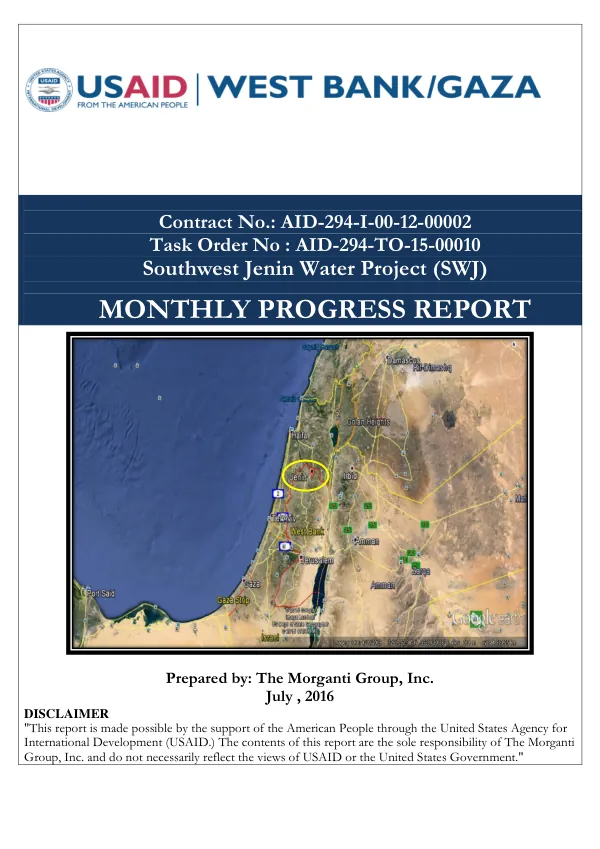
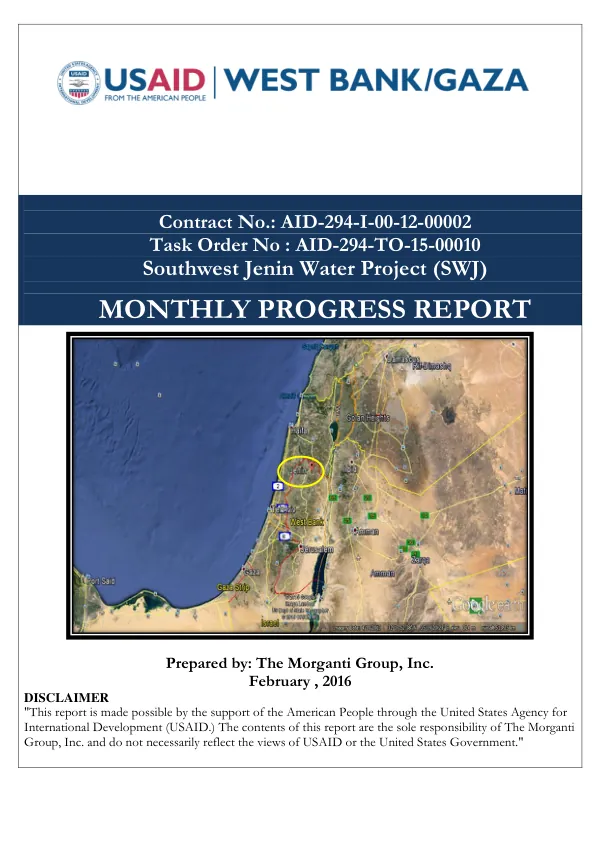
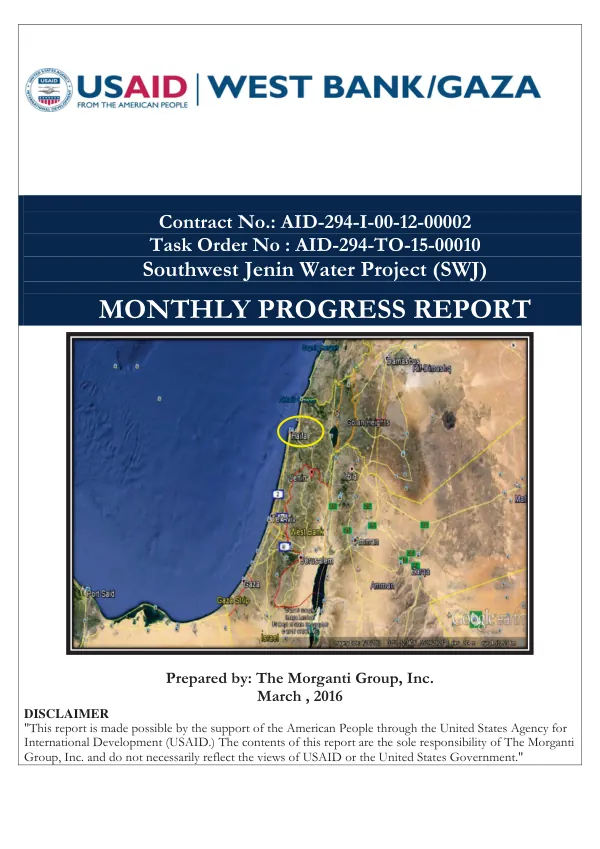
The project aims to improve the transmission of water supply to villages southwest of the Jenin municipality, enhance water storability by constructing new reservoirs, and provide a reliable, safe, and affordable water supply to the project area. The project is part of the USAID Mission Infrastructure Needs Program II (INP II), which focuses on the rehabilitation and construction of roads, schools, water, and wastewater projects. The USAID objective is to help the Palestinian economy by improving Palestinians' access to basic infrastructure and services. The project scope includes the construction of six reservoirs, a booster station, chambers, and the rehabilitation of existing chambers. Additionally, approximately 17 km of steel transmission pipelines and networks will be constructed, with a SCADA system integrated into the project elements. The project will be constructed in the Jenin Governorate, specifically in the areas of Arraba, Kuferit, Ajja, Kafr Rai', Jalqamus, Al Mutilla, Meithalun, and Sanur. The project timeline is as follows: the award date was September 22, 2015, the Notice to Proceed (NTP) date was October 26, 2015, and the completion date is February 16, 2017. The contractual period of performance is 480 calendar days, and the contract value is USD 12,949,433.37. The project's construction activities began on December 27, 2015, and are ongoing. The project's location is in Area A, B, and C of the Jenin Governorate. The project's key map is provided in Figure 1: Southwest Jenin Project (SWJ). The project's scope of work is defined in the Statement of Work (SOW), which includes the construction of six reservoirs, a booster station, chambers, and the rehabilitation of existing chambers. The project elements will be constructed with a SCADA system, and the project will provide a reliable, safe, and affordable water supply to the project area. The project's progress is being monitored and reported on a monthly basis. The monthly progress reports provide information on the project's safety, environmental compliance, traffic control measures, community outreach, gender action plan, coordination and meetings, site visitors, material and equipment delivered on site, progress and scheduling, activities during the reporting period, planned activities for the next month, indicators, working and non-working days, site memos, quality control and test results, inspection requests, non-compliance report log, submittals, request for information, letters and correspondence with USAID, transmittals, payments, variation orders, variation order requests, obstacles and challenges, and progress photos. The project's progress is being tracked through various indicators, including the completion of construction activities, the delivery of materials and equipment, and the implementation of quality control and test results. The project's progress is also being monitored through site visits, meetings, and correspondence with USAID. The project's safety and environmental compliance are being monitored and reported on a regular basis. The project's safety plan includes measures to prevent accidents and injuries, and the project's environmental compliance plan includes measures to minimize the project's impact on the environment. The project's community outreach and gender action plan are being implemented to ensure that the project's benefits are shared equitably among all stakeholders, including women and marginalized communities. The project's coordination and meetings are being held regularly to ensure that all stakeholders are informed and engaged in the project's progress. The project's material and equipment delivery is being tracked through a material receiving report (MRR) system. The project's progress and scheduling are being monitored and reported on a regular basis, and the project's activities during the reporting period are being documented. The project's planned activities for the next month are being identified and reported on a regular basis. The project's indicators are being tracked and reported on a regular basis, and the project's working and non-working days are being monitored and reported on a regular basis. The project's site memos, quality control and test results, inspection requests, non-compliance report log, submittals, request for information, letters and correspondence with USAID, transmittals, payments, variation orders, variation order requests, obstacles and challenges, and progress photos are being documented and reported on a regular basis.
Related documents