BLACK AND VEATCH, INTERNATIONAL
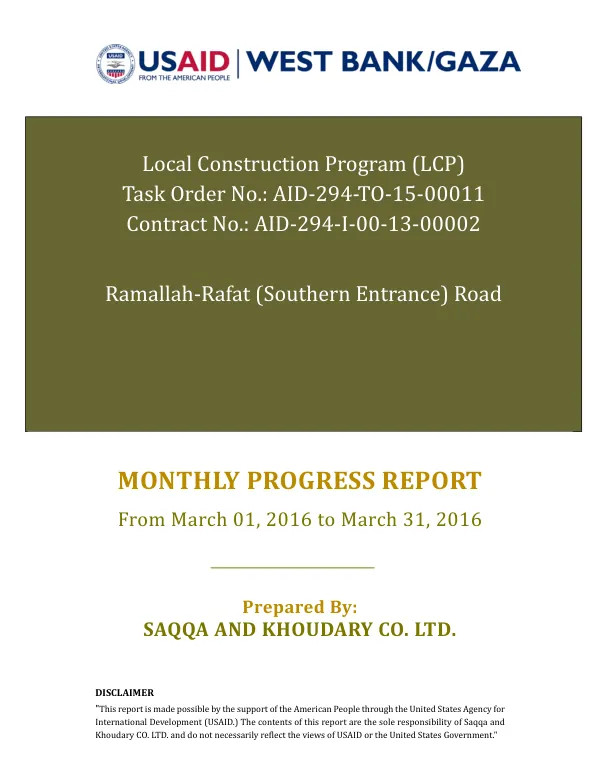
Monthly Progress Report: Ramallah-Rafat (Southern Entrance) Road
The Ramallah-Rafat (Southern Entrance) Road rehabilitation project is a key component of the USAID West Bank and Gaza, Local Construction Program (LCP).
2016 · 131 pages
Sign in to readA free account is required to download.
Abstract
The project aims to improve road infrastructure by rehabilitating and improving sections of a main urban/rural road at the southern entrance to the City of Ramallah. The project serves sixteen local communities beyond Rafat village in addition to all diplomatic cars passing through Al Jeb Checkpoint located near Rafat village. The project involves the reconstruction of 1.7 km of the Ramallah-Rafat southern entrance, including the construction of a two-lane road with shoulders and sidewalks as needed, drainage system upgrades, retaining structures, and required roadway accessories. Additionally, 0.5 km of four-lane divided road with sidewalks and landscaping in Ramallah will be milled and overlaid. The project is being implemented by Saqqa and Khoudary Co. Ltd. (SAK) as the contractor, with Black and Veatch (BV) serving as the Construction Management Contractor (CMC). As of March 31, 2016, the contract had elapsed by 87.5%, with a planned percentage of completion of 71.41% and an actual percentage of completion of 36.50%. The current percentage of completion was 14.78%, with a negative float of 20 days. The project is expected to be completed by April 25, 2016, with a contractual completion date of the same date. Safety is a top priority for the project, with Saqqa and Khoudary Company promulgating a specific Safety Plan to achieve the goal of "Zero Losses". The Safety Plan incorporates the belief that Quality, Production, Efficiency, and Safety shall be planned into each job and each shall have equal importance in the execution of the project. The company has a qualified Safety and Environmental Officer who is responsible for making regular job site safety inspections, enforcing the use of safety gear and equipment, ensuring that all staff are complying with safety requirements, and providing on-going safety training to staff. During the reporting period, two updated Safety plans were submitted and accepted by CMC, and one site memo was received regarding unsafe conditions in the construction area. SAK had also provided safety training to its staff and labors through informal weekly talks (Safety Tool Box Meetings) to discuss and ensure applying safety measures such as Personal Protective Equipment "PPEs" and the importance of keeping the site clean and safe.