USAID DEC
Monthly Report
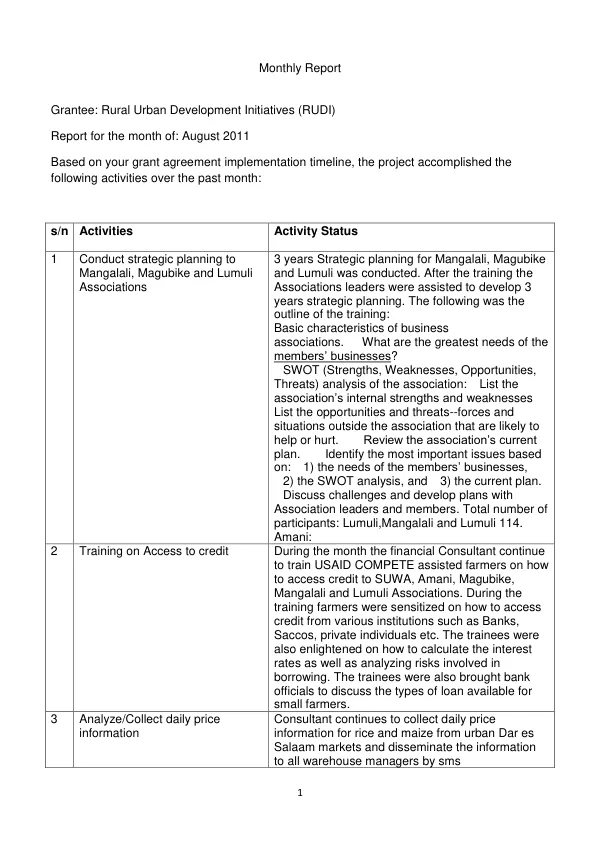
Rural Urban Development Initiatives (RUDI) conducted strategic planning for Mangalali, Magubike, and Lumuli Associations in August 2011.
2011 · 3 pages
Sign in to readA free account is required to download.
Abstract
The training focused on basic characteristics of business associations, identifying the greatest needs of members' businesses, and conducting a SWOT analysis. Association leaders and members discussed challenges and developed plans to address them. A total of 114 participants attended the training. Training on access to credit was also conducted for USAID COMPETE assisted farmers in August 2011. The financial consultant sensitized farmers on how to access credit from various institutions, including banks, Saccos, and private individuals. Trainees were also educated on calculating interest rates and analyzing risks involved in borrowing. Bank officials were brought in to discuss the types of loans available for small farmers. Daily price information for rice and maize was collected from urban Dar es Salaam markets and disseminated to warehouse managers via SMS. This information is crucial for farmers to make informed decisions about selling their produce. The consultant continued to collect and disseminate this information in August 2011. Awareness training on government farmers' support programs was conducted for Suwa Mangalali, Amani, Magubike, and Lumuli Associations. The training aimed to educate farmers about available support programs and how to access them. The status of the installation of milling machines was also reported in August 2011. The machines were installed in various associations, including Mang'ula "A" (rice), Mkasu (rice), Ifakara (rice), Mbingu (rice), Idodi (rice), Mangalali (maize), and Suwa (maize). The commodity status in the warehouse was also reported in August 2011. The associations had varying levels of commodities stored in their warehouses, including rice and maize. The quantities of commodities stored in the warehouses were as follows: Mang'ula "A" (rice) had 500 bags, Mkasu (rice) had 60 bags, Mbasa (rice) had 50 bags, Mbingu (rice) had 200 bags, Idodi (rice) had 360 bags, Mangalali (maize) had 450 bags, Suwa (maize) had 300 bags, Magubike had 50 bags, and Lumuli had 200 bags. Additional comments and results from August 2011 indicated that prices of both rice and maize were high, causing farmers to hesitate to store their crops in the warehouse. However, NMB and Stanbic Bank provided loans to Kilombero Apex and USAID COMPETE Associations, respectively, to pay advances to farmers when they bring their produce to the warehouse.