MOE
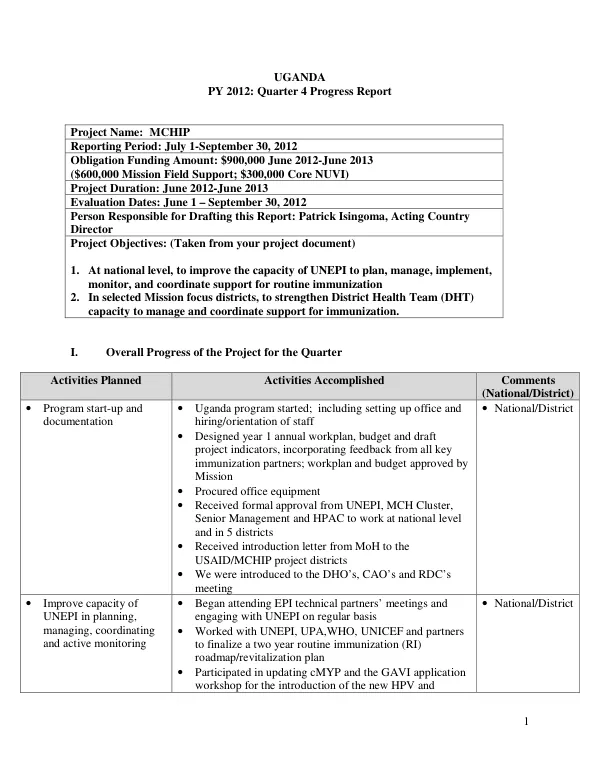
Monthly Report Template for COMPETE Grantees
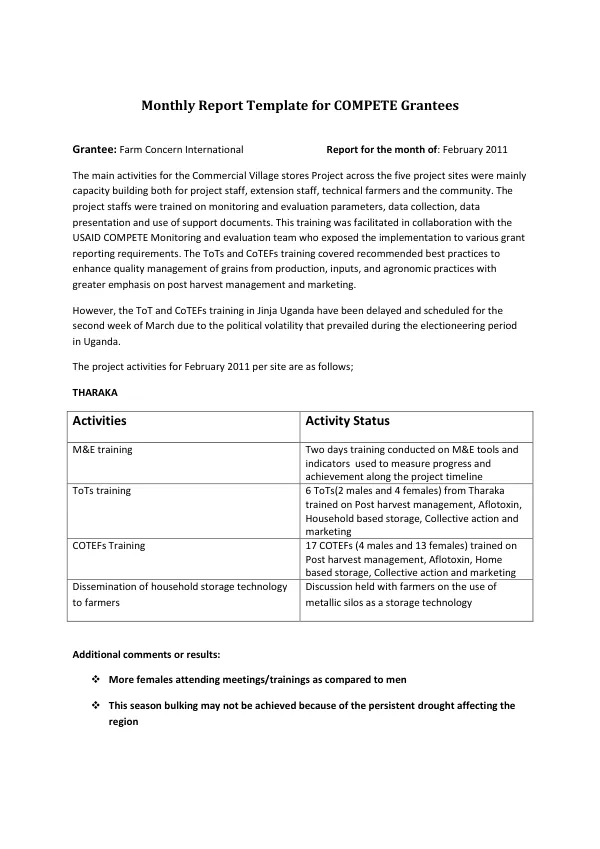
The Commercial Village Stores Project, implemented by Farm Concern International, aimed to enhance the quality management of grains from production to post-harvest management and marketing.
2011 · 5 pages
Sign in to readA free account is required to download.
Abstract
The project was conducted across five sites in Kenya, including Tharaka, Tigania West, Tigania East, Imenti South, and Jinja, Uganda. The project's main activities for the month of February 2011 focused on capacity building for project staff, extension staff, technical farmers, and the community. Capacity building for project staff and extension staff involved training on monitoring and evaluation parameters, data collection, data presentation, and the use of support documents. This training was facilitated in collaboration with the USAID COMPETE Monitoring and Evaluation team, which exposed the implementation to various grant reporting requirements. Additionally, training of trainers (ToTs) and community technical farmers (CoTEFs) was conducted on post-harvest management, aflatoxin control, household-based storage, collective action, and marketing. In Tharaka, 6 ToTs and 17 CoTEFs were trained on post-harvest management, aflatoxin control, household-based storage, collective action, and marketing. A discussion was held with farmers on the use of metallic silos as a storage technology. In Tigania West, 25 CoTEFs were trained on EAC standards and CVM model, and awareness was created on storage options for better quality of grains. A baraza was held at chiefs camp in Nchoro with an attendance of 281 persons, and the community formed groups at village level to sell grains collectively. In Tigania East, partnerships were formed with Agrosolution and Caritus, MOA, and MOH to offer interest-free credit facilities to farmers on agrochemicals, negotiate weekly repayment frameworks, and provide technical backstopping services. Community leaders' capacity building was conducted, and awareness was created on good storage practices and control of aflatoxin. A field day was conducted at Igurune commercial village, where farmers were trained on markets and marketing, quality standards, good storage practices, and aflatoxin-control measures. In Imenti South, 34 CoTEFs were trained on EAC Maize standards and good agronomical practices, and 7 TOTs were trained on EAC maize standards. Dissemination of household storage technology to farmers was conducted, and awareness campaigns were held on the use of various storage technologies, including mud huts, metal silos, and cribs. In Jinja, Uganda, recruitment and grouping of farmers were conducted, and 5 farmer groups were formed in Buyengo Sub-county. Appointing of group leaders and committees was conducted, and 2 stores were confirmed in each sub-county. Identification of sites for the establishment of cocoons was conducted, and 2 sites were confirmed, one in Butagaya and the other in Buyengo.