USAID DEC
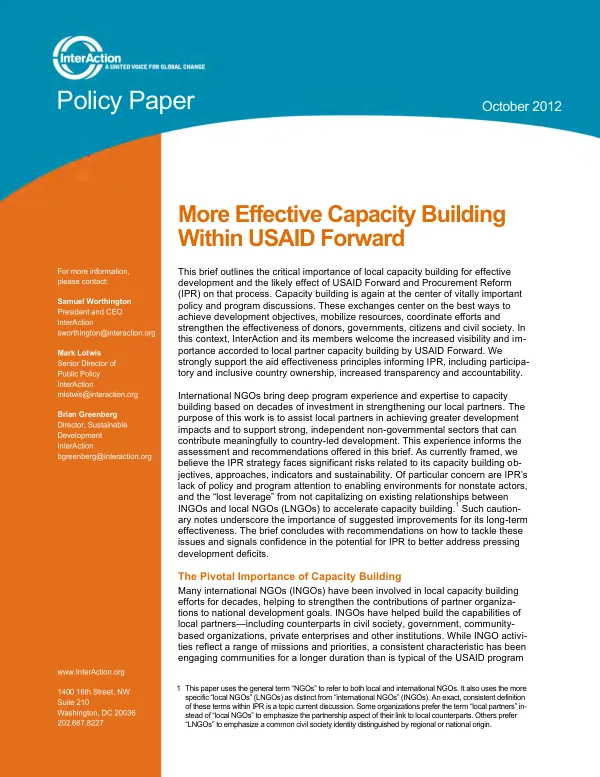
More Effective Capacity Building Within USAID Forward Policy Paper
Capacity building for local organizations is critical for effective development, and the USAID Forward initiative and Procurement Reform (IPR) aim to address this issue.
2012 · 8 pages
Sign in to readA free account is required to download.
Abstract
International NGOs (INGOs) have been involved in local capacity building efforts for decades, helping to strengthen the contributions of partner organizations to national development goals. INGOs have invested billions of dollars in private investment each year in programs that establish lasting relationships with communities and local partner organizations. These staff are familiar with local needs, culture, and development priorities, and INGOs bring deep program experience and expertise to capacity building. The Paris Declaration on Aid Effectiveness, the Accra Agenda for Action, and the Busan framework emphasize the importance of inclusive country ownership, which entails new roles and responsibilities for most development actors. To achieve and sustain development outcomes, local civil society, the private sector, and government entities must acquire the skills, institutional capabilities, resources, and operating space to more directly drive the development process. Country ownership is premised on more than a relocation of strategic vision, policymaking, and program management to local partners. The relationship between donors, host countries, and a wide range of nonstate actors must evolve toward a more genuine partnership. A supportive policy, legal, and regulatory operating environment is essential to empower and activate the full range of local stakeholders. Nonstate actors must have the rights and freedoms to organize, secure resources, voice opinions, contribute to agenda setting, operate effectively, and help hold state institutions accountable for development results. Absent these conditions, capacity building for individual organizations is not an adequate strategy for long-term success. The autonomy and sustainability of local civil society will ultimately depend on local sources of funding or reliable access to external resources. INGOs have funded their local NGO partners through various mechanisms for decades, and so have relatively few qualms about that aspect of IPR. However, funding for local organizations is vastly different from local funding for local organizations. Most countries lack a tradition of philanthropy or adequate public investment in the range of activities provided by civil society. For that reason, dependence on external funding will remain a characteristic of local organizations for the foreseeable future. Yet NGO experience strongly suggests that whether local or external, funding is but one of many dimensions of effective operations and sustained development impact. The USAID Forward approach poses challenges for NGOs related to the roles it prioritizes for civil society, to strategies for effective capacity building, and to the relative lack of attention to the enabling environment for nonstate actors. The following recommendations are steps that USAID could take to revise IPR's priorities and approaches to address these challenges. Promoting the emergence of more capable and self-sufficient local NGOs by balancing capacity building for specific organizations with policies and programs to build a healthy enabling environment for all nonstate actors is essential. This includes addressing the power imbalances often implicit in partnerships between organizations with different connections, capacities, and resource bases. Inclusive country ownership implies the emergence of capable, independent nonstate sectors—communities of organizations that can contribute meaningfully to country-led development. To achieve this, USAID should prioritize building a healthy enabling environment for all nonstate actors, including local NGOs, community-based organizations, private enterprises, and other institutions. This includes promoting a supportive policy, legal, and regulatory operating environment, as well as addressing the power imbalances often implicit in partnerships between organizations with different connections, capacities, and resource bases. By taking these steps, USAID can increase aid effectiveness and promote sustainable development outcomes.
Related documents