CHEMONICS
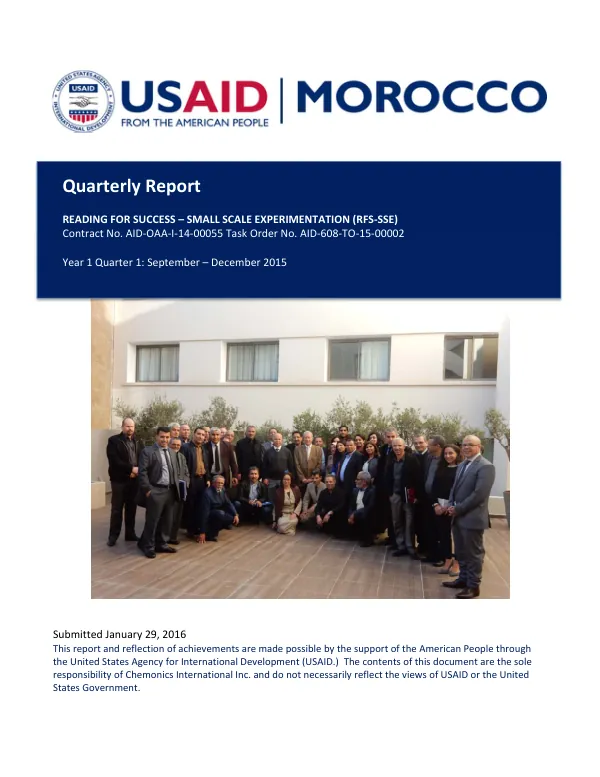
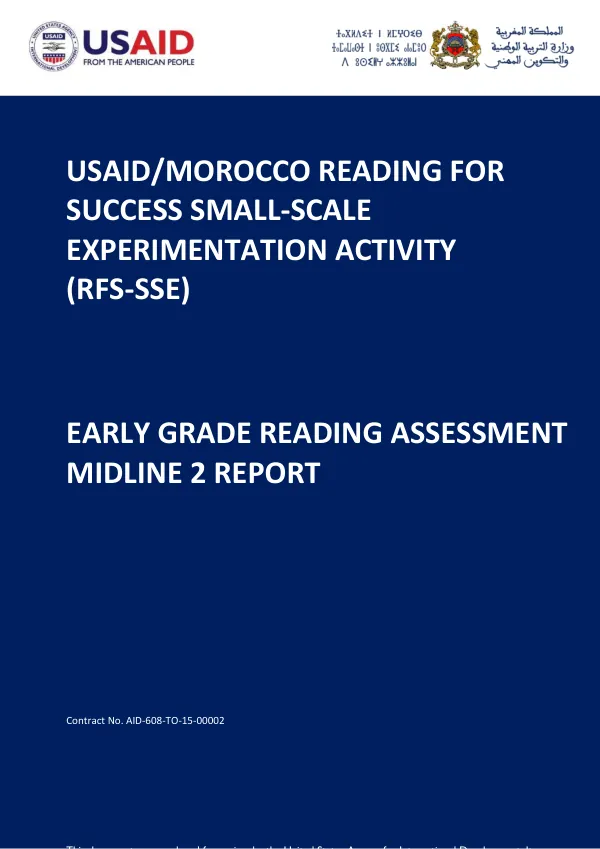
MOROCCO RFS-SSE MIDLINE 2 REPORT
The Reading for Success – Small-Scale Experimentation (RFS-SSE) activity in Morocco aimed to improve early grade reading outcomes.
2016 · 87 pages
Sign in to readA free account is required to download.
Abstract
The initiative was implemented in 2014 and involved 120 schools in the country. The evaluation design consisted of a randomized controlled trial with two cohorts of students, with Cohort 1 consisting of 1,200 students and Cohort 2 consisting of 1,200 students. The Early Grade Reading Assessment (EGRA) and the School and Student Survey for Monitoring and Evaluation (SSME) were used to assess reading skills and collect contextual data. The EGRA tool was developed to measure reading fluency, accuracy, and comprehension, while the SSME tool collected data on student demographics, teacher qualifications, and school resources. The results of the EGRA assessment showed significant improvements in reading skills among students in Cohort 1. The average scores for all EGRA subtasks at Midline 2 were 23.4, indicating a 10.4% increase from the baseline assessment. The proportion of students receiving zero scores for all EGRA subtasks decreased from 24.1% at baseline to 14.5% at Midline 2. The results also showed that students in urban areas performed better than those in rural areas. The SSME results showed that students in Cohort 1 had higher levels of parental education and access to books at home compared to students in Cohort 2. The results also showed that teachers in Cohort 1 had higher levels of education and experience compared to teachers in Cohort 2. The contextual variables analysis showed that student questionnaire responses indicated that students in Cohort 1 had higher levels of motivation and interest in reading compared to students in Cohort 2. The teacher questionnaire responses showed that teachers in Cohort 1 reported higher levels of confidence in teaching reading compared to teachers in Cohort 2. The classroom inventory chart and classroom observation results showed that schools in Cohort 1 had better infrastructure and resources compared to schools in Cohort 2. The parent questionnaire responses showed that parents in Cohort 1 reported higher levels of involvement in their children's education compared to parents in Cohort 2. The overall conclusion of the study was that the RFS-SSE activity had a positive impact on early grade reading outcomes in Morocco. The results showed significant improvements in reading skills among students in Cohort 1, and the contextual variables analysis showed that the intervention had a positive impact on teacher confidence, student motivation, and parental involvement. The study also highlighted the importance of teacher education and training in improving reading outcomes. The results showed that teachers in Cohort 1 had higher levels of education and experience compared to teachers in Cohort 2, and that these teachers reported higher levels of confidence in teaching reading. The study recommended that the RFS-SSE activity be scaled up to reach more schools and students in Morocco. The results also suggested that the intervention be adapted to address the specific needs of rural schools and students. The study also recommended that the Ministry of Education and Vocational Training (MOEVTVT) and the National Center for Evaluations and Exams (CNEE) continue to support the RFS-SSE activity and provide guidance and technical assistance to schools and teachers. The study also recommended that the USAID education office continue to provide funding and support for the RFS-SSE activity. The study concluded that the RFS-SSE activity had a positive impact on early grade reading outcomes in Morocco and that the intervention had the potential to improve reading outcomes in other countries.