USAID DEC
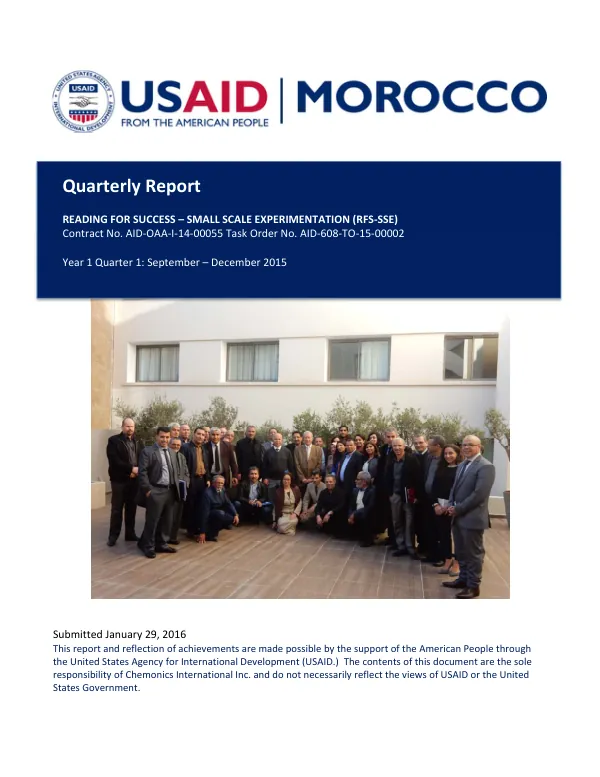
Quarterly Report: Reading for Success – Small Scale Experimentation (RFS-SSE) Project in Morocco
Sign inCHEMONICS
Quarterly Report: Reading for Success – Small Scale Experimentation (RFS-SSE) Project in Morocco
The RFS-SSE project is a learning activity that aims to improve reading skills in early grades in Morocco.
2016 · 16 pages
Sign in to readA free account is required to download.
Abstract
The project is implemented by Chemonics International in partnership with School-to-School International (STS), Association Al Jisr, and ALCO Alternative Consultants, and works in close collaboration with the Ministry of Education (MOE) and USAID. The project's goal is to test activities and strengthen stakeholder engagement to improve reading skills in early grades. The project will develop Modern Standard Arabic (MSA) reading lessons based on a phonetic approach combined with vocabulary enhancement techniques that will ameliorate reading comprehension and communication for primary school students in grades 1 and 2. The aim of the project is for the results to feed into the planned MOE curriculum reforms that are linked to the Interim Measures for 2015-2020. MOE staff will be engaged in the design, training, implementation, and evaluation of the lessons at all levels. The project will initiate a range of assessments related to improving early grade reading competencies among Moroccan primary school students. In practice, the project will develop lesson plans based on two parallel and interlinked strands: lessons that provide a greater focus on phonology and phonics; and lessons involving oral listening and discussion of engaging, well-known Moroccan stories, which will lead exercises that will increase vocabulary and reading comprehension. The new lessons will replace the current Arabic reading curriculum in grades 1 and 2, and will follow a unit-based structure based on the current three-week syllabus structure. The project will engage Civil Society Organizations (CSOs) and support and test their efforts to reduce reading loss over the summer months through enrichment activities. The project has had a successful first quarter, despite administrative and operational hurdles. The team has made significant progress in the development of the project objectives, and has successfully completed several technical workshops. The project has also begun a series of preparation and validation meetings with the MOE Curriculum Directorate and the National Center for Evaluation and Examinations. The main accomplishments of the quarter include project mobilization, with most staff hired and moved into permanent office space; the submission of the Year 1 Work Plan and MELP to USAID for review and approval; the successful EGRA tool adaptation and validation workshop held; the EGRA Data Collection Pilot test completed; and the pivotal Arabic Reading Lessons Development Workshop completed. The project's major objectives are to improve the teaching of reading in grades 1 and 2 of primary education; to improve the level of reading in grades 1 and 2 of primary education; and to use the project's results to contribute to the reform of the school system. The project's activity/results include cross-cutting design and implementation of Early Grade Reading Assessment (EGRA); Result 1: Developing Arabic Reading Materials for 1st and 2nd Grades; and Result 2: Summer Reading Enrichment Activities Tested for Reducing Learning Loss among 1st and 2nd Grade Students.