USAID DEC
Morphological and molecular variation in Tylototriton (Caudata: Salamandridae) in Laos, with description of a new species
Sign inKASETSART UNIVERSITY
Morphological and molecular variation in Tylototriton (Caudata: Salamandridae) in Laos, with description of a new species
The salamandrid genus Tylototriton is poorly known in Laos, with one described species and unverified reports of two others.
2013 · 1 pages
Sign in to readA free account is required to download.
Abstract
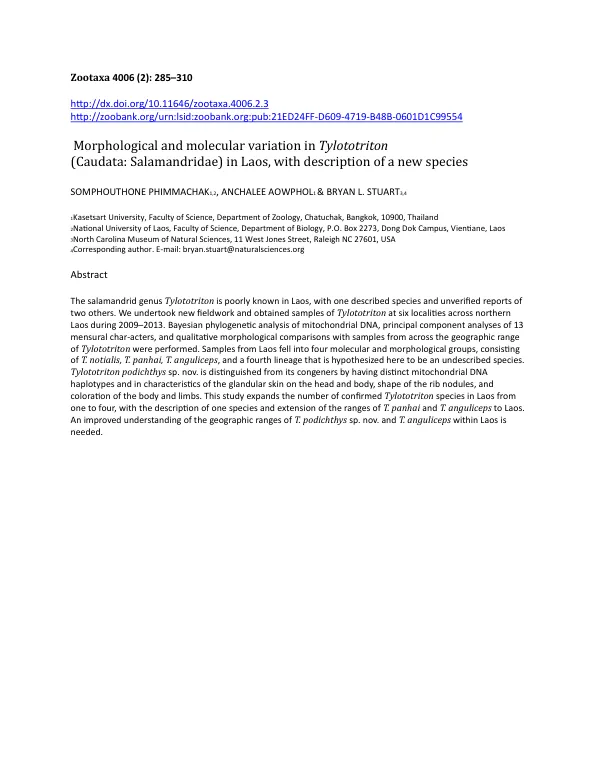
New fieldwork was conducted in northern Laos during 2009-2013, resulting in the collection of Tylototriton samples from six localities. Bayesian phylogenetic analysis of mitochondrial DNA, principal component analysis of 13 mensural characters, and qualitative morphological comparisons were performed to examine the genetic and morphological diversity of Tylototriton in Laos. The results of the analysis revealed four distinct molecular and morphological groups, consisting of T. notialis, T. panhai, T. anguliceps, and a fourth lineage that is hypothesized to be an undescribed species. This new species, Tylototriton podichthys, is distinguished from its congeners by having distinct mitochondrial DNA haplotypes and characteristics of the glandular skin on the head and body, shape of the rib nodules, and coloration of the body and limbs. Tylototriton podichthys is described as a new species, expanding the number of confirmed Tylototriton species in Laos from one to four. The geographic ranges of T. podichthys and T. anguliceps within Laos require further investigation to determine their distribution and habitat preferences. The study highlights the need for continued research on the taxonomy and ecology of Tylototriton in Laos. The analysis of mitochondrial DNA and morphological characters revealed distinct genetic and morphological differences between the four groups of Tylototriton in Laos. The results of the study provide a foundation for future research on the systematics and conservation of Tylototriton in Laos, and highlight the importance of continued fieldwork and analysis to improve our understanding of the diversity of this genus in the region. The discovery of Tylototriton podichthys and the extension of the ranges of T. panhai and T. anguliceps to Laos contribute to our understanding of the distribution and diversity of Tylototriton in Laos. The study emphasizes the need for further research on the taxonomy and ecology of Tylototriton in Laos, and highlights the importance of continued conservation efforts to protect the habitats and populations of these species.
Related documents