USAID DEC
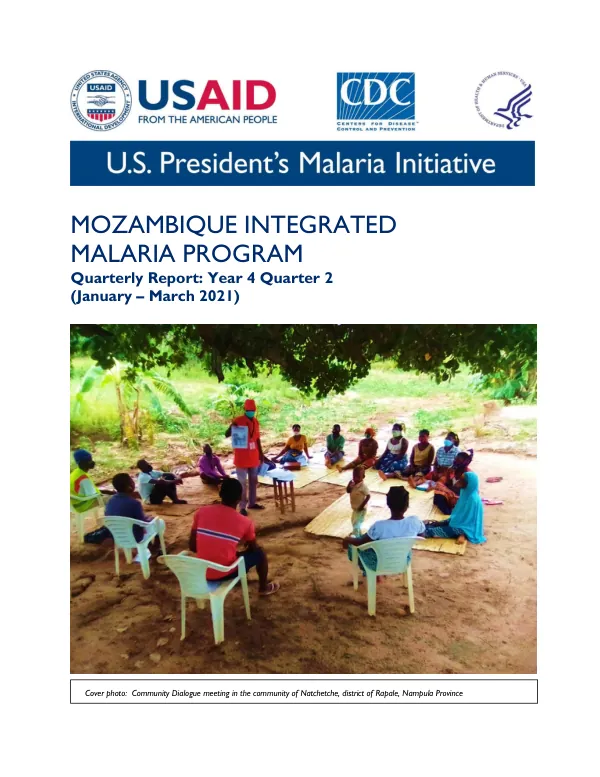
Mozambique Integrated Malaria Program Quarterly Report: Year 4 Quarter 2 (January – March 2021)
Sign inCHEMONICS
Mozambique Integrated Malaria Program Quarterly Report: Year 4 Quarter 2 (January – March 2021)
The Mozambique Integrated Malaria Program (IMaP) continued to support the National Malaria Control Program (NMCP) at the central and provincial levels in the fight against malaria during Quarter 2 of Year 4.
2021 · 74 pages
Sign in to readA free account is required to download.
Abstract
IMaP's activities were carried out in partnership with the Provincial Health Directorate (DPS) and were in compliance with COVID-19 restrictions. IMaP supported the implementation of proven malaria interventions at community and facility levels. The program participated in three technical working group (TWG) meetings on the social and behavior change communication (SBC) component of the program. These meetings included analyses of activities carried out in 2020, presentation of the NMCP SBC 2021 activity plan, preparation for World Malaria Day, defining instruments of the SBC component to integrate into the Integrated Malaria Information System Storage (IMISS), and presenting the proposal for the development of the SBC guide to the head of the NMCP for decision-making. IMaP continued to provide technical support through integrated supervision in accordance with the Supervision Manual. The program conducted integrated supervision visits in all four provinces, with a total of 42 planned visits and 48 achieved visits. The results of the supervisory visits showed an improvement in case management in most health facilities, including more than 90% of febrile cases being tested for malaria and their results recorded in clinical files. IMaP also supported laboratories in the provinces of Zambézia and Nampula. The program supported Zambézia province with the 8th panel of blind reobservation of routine slides, which covered 21 laboratories. IMaP also provided support to seven labs that had low performance in the 7th panel in the provincial quality assessment (PQA). The comparative analysis in relation to panel 7 showed a positive trend in the general performance of laboratories with an increase from 33% to 43% in panel 8. To support SBC, IMaP collaborated with District Women's Health and Social Action Services (SDSMAS), key stakeholders, community leaders and structures, and APEs to hold 919 district SBC meetings in all four provinces. The meetings reached 12,947 participants and community activities reached 425,961 beneficiaries. IMaP also trained four community-based organizations (CBOs) for the application of SBC monitoring and evaluation (M&E) routine data collection within the scope of the routine evaluation of the SBC indicators. IMaP supervised and provided in-person technical support to CBOs in the districts of Nacala Porto, Mossuril, and Ilha de Moçambique in Nampula and Quelimane in Zambézia. The program also conducted technical support visits to eight community radios: three in Nampula and five in Zambézia. The results of the supervisory visits, case and death discussion meetings, and laboratory assessments showed an improvement in case management and laboratory performance. However, there are still some challenges, such as the performance of rapid diagnostic tests (RDT) and the recording of patients' history of malaria less than 28 days ago. IMaP's activities in Quarter 2 of Year 4 contributed to the improvement of malaria control in Mozambique. The program's support to the NMCP, laboratories, and community-based organizations helped to strengthen the management capacity of the provincial and district levels and improve the implementation of proven malaria interventions.