USAID DEC
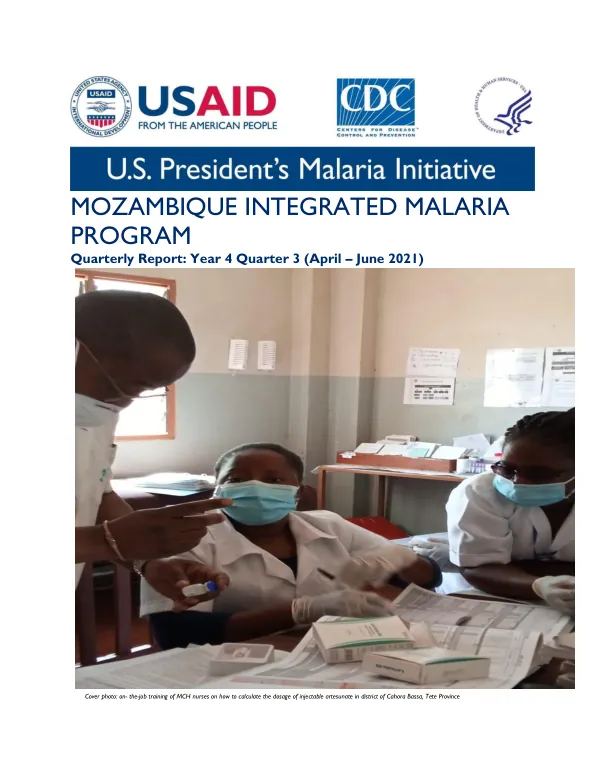
Mozambique Integrated Malaria Program Annual Technical Progress Report: Year 4 (October 2020 – September 2021)
Sign inCHEMONICS
Mozambique Integrated Malaria Program Annual Technical Progress Report: Year 4 (October 2020 – September 2021)
The Integrated Malaria Program (IMaP) in Mozambique is a five-year initiative led by Chemonics International with support from Family Health International 360 and Vanderbilt University Medical Center–Friends in Global Health (VUMC-FGH).
2021 · 79 pages
Sign in to readA free account is required to download.
Abstract
The program aims to strengthen implementation of the National Malaria Strategic Plan (NMSP) and the identified needs of the National Malaria Control Program (NMCP). IMaP works at the national, provincial, and district levels to strengthen capacity and facilitate systemic improvements for better decision-making, planning, and guidance. IMaP's overall goal is to contribute to reducing malaria-associated mortality, morbidity, and parasitemia in four high-malaria provinces (Nampula, Zambézia, Tete, and Cabo Delgado). The program will achieve this goal by fulfilling three objectives: supporting the implementation of proven malaria interventions at community and facility levels, strengthening management capacity of the provincial and district MISAU personnel, and improving health management information system (HMIS) data reporting, analysis, and use. During Year 4, IMaP continued to support the National Malaria Program (NMCP) in the fight against malaria. Key achievements were realized across objectives, particularly in the areas of laboratory services strengthening, case management, data quality, and social and behavior change communication (SBCC) work in communities. Laboratory service strengthening activities were performed through various trainings, operationalization of standard operating procedures (SOPs) and job aids, and proficiency panels for malaria provincial quality assurance, leading to improved laboratory results. IMaP provided central technical support to the case management technical working group (TWG) in the elaboration of the terms of reference (ToR) for National Severe Malaria Cases and Deaths Committee and a Death Discussion Guide. The program also participated in the training, implementation, and monitoring of the iMISS platform as part of the case management component. In partnership with the Provincial Health Directorate (DPS), IMaP provided technical support to 168 districts covering 355 health facilities through integrated supervision in the four provinces. The integrated supervision visits conducted by IMaP resulted in improved health worker performance, particularly in the number of health care workers (HCW) complying with standards of care (SOC) for malaria case management. Data quality improvement activities, including monthly data analysis discussions, Data Quality Assessment (DQA) trainings and implementation, and on-the-job trainings, saw a marked improvement in data quality, particularly in Nampula. IMaP also increased its community reach by engaging additional community-based organizations (CBOs) and radio stations to expand the impact of community-level malaria prevention and treatment messaging. The program's efforts in laboratory services strengthening, case management, data quality, and SBCC work in communities contributed to improved health outcomes in the four high-malaria provinces. IMaP's achievements in Year 4 demonstrate the program's commitment to reducing malaria-associated mortality, morbidity, and parasitemia in Mozambique. The program's lessons learned will be carried into Year 5 to further improve implementation and achieve greater impact.