USAID DEC
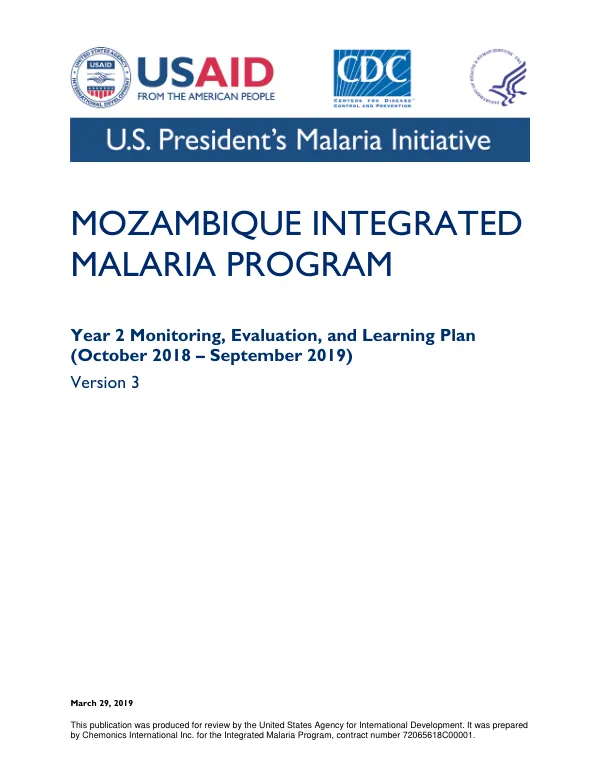
Year 2 Monitoring, Evaluation, and Learning Plan for the Mozambique Integrated Malaria Program
Sign inCHEMONICS
Year 2 Monitoring, Evaluation, and Learning Plan for the Mozambique Integrated Malaria Program
The Integrated Malaria Program (IMaP) in Mozambique aims to contribute to the reduction of malaria-associated mortality, morbidity, and parasitemia in four high malaria burden provinces (Zambézia, Nampula, Cabo Delgado, and Tete) by the end of five years of implementation.
2019 · 89 pages
Sign in to readA free account is required to download.
Abstract
The program's overall goal is to support the implementation of proven malaria interventions at community and facility levels, in alignment with the National Malaria Strategic Plan (NMSP). IMaP's methodology for activity monitoring, evaluation, and learning (MEL) involves data collection, analysis, data management, and reporting. The program will use information attained from work planning sessions and follow-up meetings held at the provincial level to guide the development of the MEL plan. IMaP's MEL plan will be used to plan and manage the collection of performance data related to the implementation of the work plan and its achievement in contribution to reduction in malaria-associated mortality, morbidity, and parasitemia. The program's theory of change is based on the idea that communities supported through a combination of interventions focusing on improving the case management system and changing key social and behavioral factors will engage in preventative behavior, seek care when needed, and receive improved, evidence-based case management. IMaP's intervention model specifically seeks to reduce morbidity and mortality caused by malaria by addressing critical factors in the two key areas of increasing prevention and improving case management and treatment. IMaP will increase prevention by utilizing social behavior change methods such as radio programming, health talks, interpersonal communication, and community dialogues to increase knowledge, improve motivation, strengthen skills, address social and gender norms, and create a supportive environment for the adoption of priority malaria prevention and treatment behaviors. These priority behaviors include sleeping under an insecticide-treated bed net (ITN) every night, accessing and taking intermittent preventive treatment in pregnancy (IPTp) during ANC visits, seeking prompt and appropriate care for symptoms of malaria within 24 hours, and providing quality care for malaria prevention and treatment. The program will also work from the health supplier side to provide integrated support at the facility, district, and province level, focusing primarily on ensuring case management works, ensuring that diagnostic staff have the requisite skills to correctly diagnose and treat malaria, and ensuring that district and provincial supervision staff can correctly conduct monitoring visits and support facilities in making necessary changes. IMaP will equip people and communities with the right tools, skills, and knowledge to empower them to demand and use evidence-based solutions by addressing key barriers to adopting behaviors and targeting both beneficiaries as well as influencers in their community environment. The IMaP MEL plan will be used to track progress towards the program's goals and objectives, and to identify areas for improvement. The plan will also be used to inform decision-making and resource allocation, and to ensure that the program is meeting its intended outcomes. The program's performance indicators, data sources, collection methods, frequency of data collection, disaggregation, and units of measure are outlined in the Performance Indicator Reference Sheets (PIRS) for each indicator. The program's budget for Year 2 is outlined in the MEL Plan Budget for Year 2 (Exhibit 12, Annex C). The program's calendar of tasks is outlined in the Calendar of Tasks (Exhibit 11, Annex B). The program's learning plan matrix is outlined in the Learning Plan Matrix (Exhibit 9, Annex A).
Related documents