USAID DEC
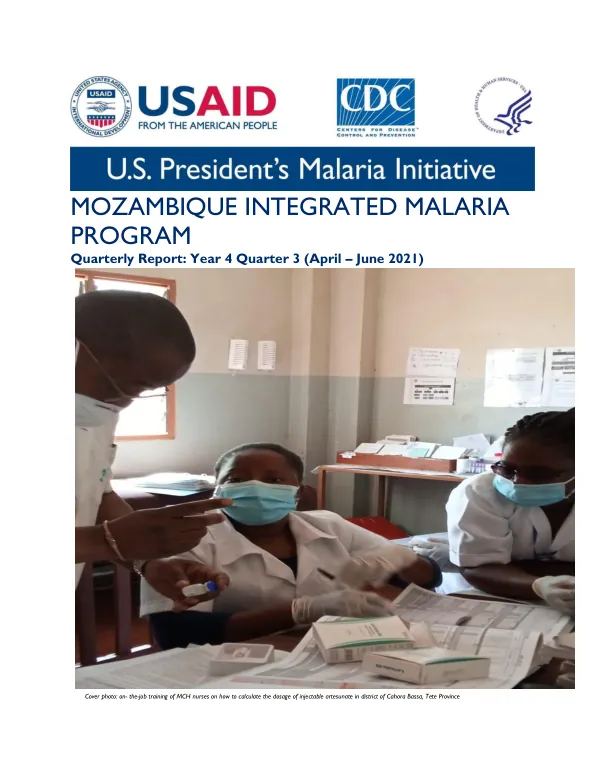
Mozambique Integrated Malaria Program Quarterly Report: Year 4 Quarter 3 (April – June 2021)
Sign inCHEMONICS
Mozambique Integrated Malaria Program Quarterly Report: Year 4 Quarter 3 (April – June 2021)
The Integrated Malaria Program (IMaP) in Mozambique continued to support the National Malaria Control Program (NMCP) in the fight against malaria during Quarter 3 of Year 4.
2021 · 87 pages
Sign in to readA free account is required to download.
Abstract
IMaP's overall goal is to contribute to reducing malaria-associated mortality, morbidity, and parasitemia in four high-malaria provinces: Nampula, Zambézia, Tete, and Cabo Delgado. To achieve this goal, IMaP focuses on three objectives: supporting the implementation of proven malaria interventions at community and facility levels, strengthening management capacity of provincial and district MISAU personnel, and improving health management information system (HMIS) data reporting, analysis, and use. IMaP supported the Case Management technical working group (TWG) to conduct a discussion and analysis of antimalarials, rapid diagnostic tests (RDT), and microscopy in the country. The TWG observed that health facilities throughout Mozambique faced widespread shortages of RDTs, which were attributed to limited numbers of RDT suppliers and shortcomings with existing suppliers. The NMCP clarified that the availability of Sulfadoxine-pyrimethamine (SP) in the provinces of Manica and Tete was also a concern. IMaP provided technical and logistical support to the NMCP in supervising the Integrated Malaria Information System Storage (IMISS) activities in Nampula, Zambézia, Tete, and Cabo Delgado. In partnership with the Provincial Health Directorate (DPS), IMaP provided technical support to 45 districts and 101 health facilities through integrated supervision in the four provinces supported by IMaP. The results of the integrated supervision visits showed that 117% of the target number of district-level visits were achieved, and 120% of the target number of health facility-level visits were achieved. During the quarter, IMaP also provided technical support to quality improvement interventions and activities to strengthen laboratory capacity for malaria diagnosis in the four focal provinces. IMaP supported provincial-level External Quality Assessment through the blind recheck method of routine slides in the Nampula and Zambezia provinces, technical support visits to low-performing laboratories in the Cabo Delgado and Tete provinces, and in-person training of 27 laboratory technicians on malaria diagnosis, focusing on areas with poor performance as identified through the Provincial Quality Assessment (PQA) program. The results of the supervision visits showed that 98% of febrile cases were tested for malaria, and 80% (n=81/101) of the health facilities visited performed the RDT according to the manufacturer's standards. However, health facilities now face nationwide supply shortages of RDTs. IMaP will continue to support the NMCP in addressing these challenges and improving the implementation of malaria interventions in the four high-malaria provinces. The results of IMaP's efforts to strengthen the laboratory capacity for malaria diagnosis in the four focal provinces showed that 27 laboratory technicians received training on malaria diagnosis, and 27 SOPs were printed to be distributed to laboratories in Nampula province. IMaP's support to the NMCP in supervising the IMISS activities in Nampula, Zambézia, Tete, and Cabo Delgado also contributed to improving the implementation of malaria interventions in the four high-malaria provinces. IMaP's overall goal is to contribute to reducing malaria-associated mortality, morbidity, and parasitemia in the four high-malaria provinces. To achieve this goal, IMaP will continue to support the NMCP in addressing the challenges and improving the implementation of malaria interventions in the four provinces. IMaP's efforts to strengthen the laboratory capacity for malaria diagnosis in the four focal provinces will also continue, with a focus on improving the quality of malaria diagnosis and treatment in the provinces.