ENCOMPASS, LLC
DEEP Year 3 Quarter 1 Report
The Data and Evidence for Education Programs (DEEP) contract was awarded to EnCompass LLC in August 2018 by the United States Agency for International Development (USAID) Bureau for Development, Democracy, and Innovation (DDI).
2021 · 30 pages
Sign in to readA free account is required to download.
Abstract
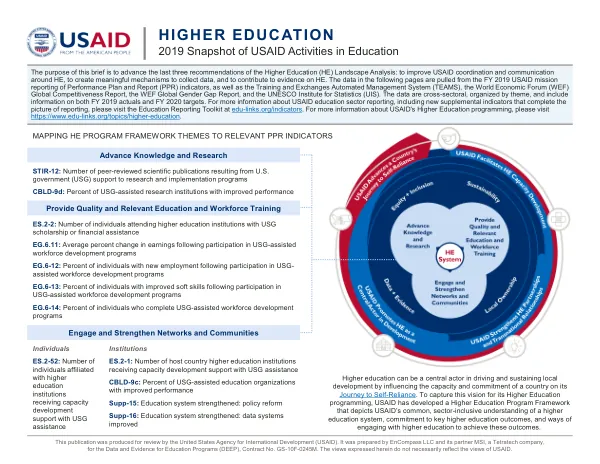
The contract aims to improve the quality, relevance, availability, and use of education data. DEEP uses a multi-pronged approach to address challenges to data use, fostering a shift in data culture to improve and make education programs. The DEEP theory of change is encapsulated in its five-pronged approach: quality and relevant data are readily available, research is applied and there is a better understanding of contributors and barriers to achieving strategic goals, dissemination is increased, and evidence on sector priorities is widely disseminated and accessed, data users are enabled, and demand for and use of data is increased, and coordination in USG basic education programming is increased. During the first quarter of project technical implementation, DEEP achieved several successes and faced challenges. The team wrapped up work on thematic briefs that raised awareness of Performance Plan and Report (PPR) data within USAID and helped technical experts identify gaps and practices within their portfolio. DEEP also produced a cost reporting manual template to improve the quality of cost reporting manuals and simplify the process of creating manuals for partners. The team enhanced the capacity of the Center for Education to increase awareness and application of the Global Proficiency Framework and Key Linking through the development of a Communication and Knowledge Management (CKM) strategy and campaign. DEEP also developed an informational brief to inform USAID Africa Bureau staff on the impact of the COVID-19 pandemic on education and how to reduce its negative effects. The DEEP team hosted multiple USG working group meetings, proposed, and voted to approve three indicators for workforce development. The team presented key findings from an Education Sector Analysis as part of a seminar with the Government of Nepal, USAID/Nepal, and other donors in the education sector in Nepal. DEEP also developed an action plan to guide the Jordan Ministry of Education's plans on addressing findings of the PPR analysis. DEEP's leadership team continues to strengthen internal processes and increase efficiency. The team updated the consultant tracking system to track the level of effort spent and monitor period of performance and the need for extensions. The DEEP team has also uploaded public-facing documents to the Development Experience Clearing House. The DEEP team is working on several task orders, including ongoing data support, ongoing cost measurement and support, communication and knowledge management, USG indicator harmonization, DEEP in Sub-Saharan Africa, higher learning agenda, strengthening monitoring and learning of the Ministry of Education and Ministry of Youth in Jordan, Africa disability data program, evidence in education course, mission guidance to setting for learning outcomes, supplemental indicators, USAID response to COVID-19, workforce outcomes reporting questionnaire, social and emotional learning, and lessons learned from USAID-funded reading programs. Task 2: Ongoing Data Support aims to conduct ongoing analyses and documentation of USAID education programming to support USAID reporting on strategic objectives. The DEEP team has continued to help expand the universe of high-quality education data, curating 31 submissions (109 datasets) to the Development Data Library (DDL). The team has also supported the planning and content development of the Policy Progress Report and completed the development, posting, and updating of EduLinks for the Education Reporting Guide/Toolkit to support the 2021 PPR.
Related documents