USAID DEC
Multi-Use Water Systems in Food Security Programs: A summary of key issues impacting sustainability and resilience
Sign inADRA
Multi-Use Water Systems in Food Security Programs: A summary of key issues impacting sustainability and resilience
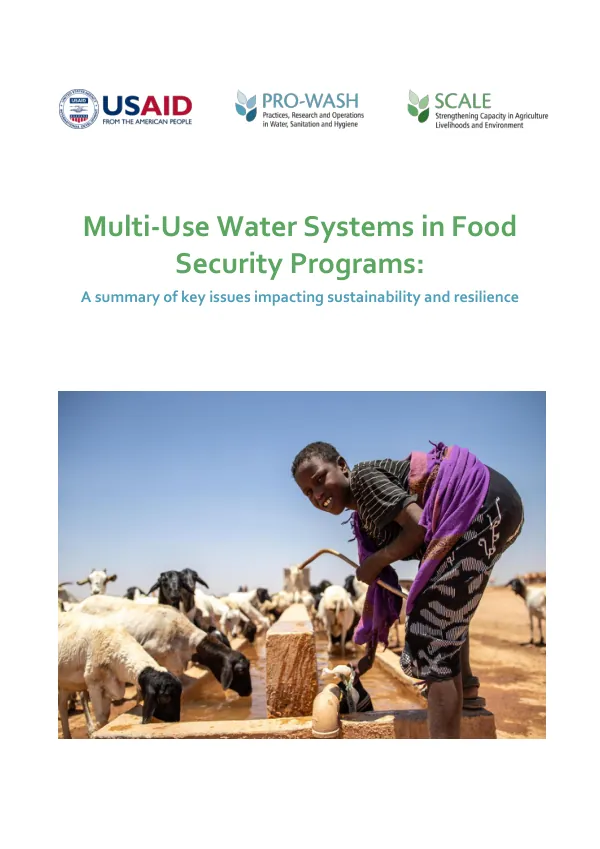
Multi-Use Water Systems in Food Security Programs: A Summary of Key Issues Impacting Sustainability and Resilience Multi-Use Water Systems (MUS) is an approach to water service delivery that considers the needs of both WASH and agriculture activities.
2021 · 8 pages
Sign in to readA free account is required to download.
Abstract
A MUS is designed to supply domestic water as well as water for productive uses, such as irrigating a garden or operating a small business. By providing reliable water access to communities or households, MUS can boost users' resilience to shocks and stresses, improve food security, and support livelihoods and economic activities. The PRO-WASH initiative, funded by the U.S. Agency for International Development's (USAID's) Bureau for Humanitarian Assistance (BHA), aims to strengthen the quality of WASH interventions through capacity strengthening, knowledge-sharing, and applied WASH research opportunities. PRO-WASH is collaborating with the SCALE Award to jointly initiate and fund research into key issues in MUS, in collaboration with Resilience Food Security Activities (RFSA) partners. A survey and interviews were conducted to understand key issues impacting MUS sustainability. The survey, which received 42 responses from RFSA and MUS experts in countries around the world, showed that respondents were drawn from around the world, with a higher concentration from sub-Saharan Africa. The survey respondents came from more than twenty organizations, with Catholic Relief Services and Mercy Corps providing the most responses. The survey results highlighted several key issues impacting MUS sustainability, including the need for a partnership approach to operation and maintenance (O&M), financial sustainability, and the importance of community ownership and responsibility. The survey also raised concerns with "community only" O&M, as MUS requirements for O&M are typically higher than for domestic-only sources. The one-on-one interviews did raise concerns with "community only" O & M, as MUS requirements for O&M are typically higher than for domestic-only sources. Most respondents (71%) saw a partnership of some kind (a "joint effort," as one respondent put it) as the ideal approach. This view is echoed in the survey, in which most respondents (11) favored some combination of community, government, private sector, and non-profits working together. Financial sustainability was also an issue raised by several survey respondents and interviewees. The amount that users pay, who they pay it to, and whether certain uses (e.g., domestic) are charged at higher rates than other uses (e.g., irrigation) are all questions that depend on the local context and on existing institutions. All agreed, however, that having sufficient income to cover routine expenses and running costs, as well as less frequent replacement of worn parts, was an essential element in overall system sustainability. The survey results also highlighted the need for better MUS operation and management as the climate changes. Respondents suggested that having access to information on climate change, such as rainfall patterns and water availability, would allow for better utilization and management of MUS. This information would enable users to adapt their MUS to changing climate conditions, ensuring continued access to water for both domestic and productive uses. The main research issues that need investigating, related to MUS, were also identified through the survey. Respondents suggested that research should focus on improving the operation and maintenance of MUS, reducing the risk of contamination, and increasing the financial sustainability of MUS. They also emphasized the need for more research on the impact of climate change on MUS and the development of tools and guidance to support the implementation of MUS. Overall, the survey and interviews highlighted the importance of a partnership approach to MUS O&M, financial sustainability, and community ownership and responsibility. They also emphasized the need for better MUS operation and management as the climate changes and for more research on the impact of climate change on MUS.