DELOITTE CONSULTING, LLP
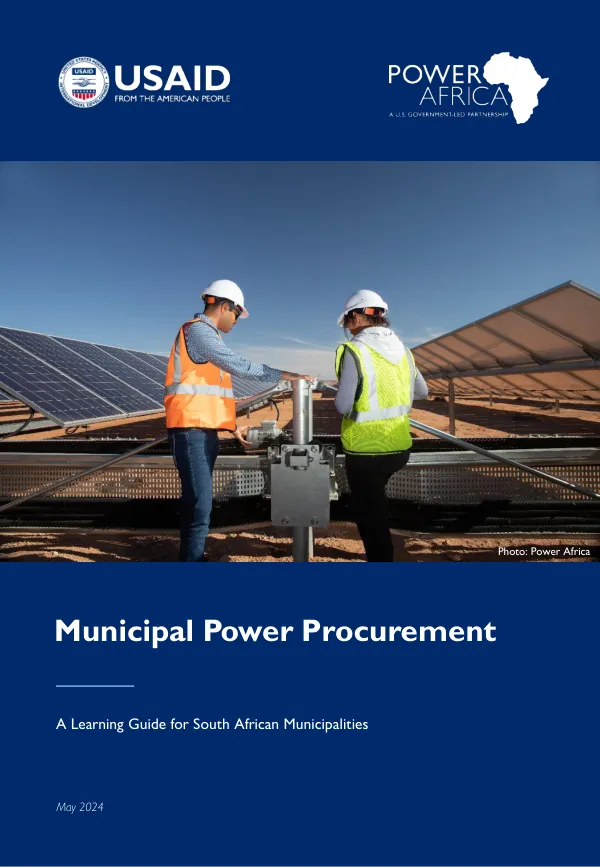
Municipal Power Procurement A Learning Guide for South African Municipalities
Municipal Power Procurement in South Africa is a complex process that involves multiple stakeholders and regulatory requirements.
2024 · 27 pages
Sign in to readA free account is required to download.
Abstract
The process began in 2020 with the amendment to the Electricity Regulation Act, which allowed municipalities to buy and/or procure new generation capacity. This amendment was made possible by the Minister of the Department of Mineral Resources and Energy (DMRE) and has direct references to the Municipal Systems Act (MSA) Section 76 (a) and (b), Municipal Finance Management Act (MFMA) Section 120, and the Municipal PPP Regulations to the MFMA. The Municipal Public-Private Partnership (PPP) Project Cycle is a critical component of the municipal power procurement process. This cycle involves various phases and stages, including project inception and registration, stakeholder identification, transaction advisors, and project preparation funding. The cycle is designed to ensure that municipalities comply with the MSA and MFMA, as well as the Municipal PPP Regulations. Transaction advisors play a crucial role in the municipal project preparation process. They are responsible for providing guidance and support to municipalities in navigating the complex regulatory requirements and ensuring that projects are developed and procured in a compliant manner. The transaction advisors also assist municipalities in identifying potential project risks and developing mitigation strategies. The energy project feasibility study is a critical component of the municipal power procurement process. This study involves assessing the technical, financial, and environmental viability of a proposed energy project. The study is typically conducted by a team of experts, including engineers, economists, and environmental specialists. The study provides a comprehensive analysis of the project's potential risks and benefits, as well as its potential impact on the local community. The Section 34 Ministerial Determination is a critical regulatory requirement for municipal power procurement projects. This determination is made by the Minister of the DMRE and involves assessing the project's compliance with the Electricity Regulation Act and other relevant legislation. The determination is typically made after a thorough review of the project's feasibility study and other supporting documentation. The procurement process to financial close is a critical component of the municipal power procurement process. This process involves the selection of a preferred bidder, the negotiation of a Power Purchase Agreement (PPA), and the finalization of the project's financial close. The procurement process is typically conducted in accordance with the Municipal PPP Regulations and other relevant legislation. A Power Purchase Agreement (PPA) is a critical component of the municipal power procurement process. The PPA is a contract between the municipality and the Independent Power Producer (IPP) that outlines the terms and conditions of the power purchase. The PPA typically includes provisions related to the price of the power, the duration of the contract, and the payment terms. The municipal power procurement process in South Africa is complex and involves multiple stakeholders and regulatory requirements. The process requires careful planning, coordination, and execution to ensure that projects are developed and procured in a compliant manner. The municipal power procurement process is critical to achieving the country's Just Energy Transition (JET) Partnership and advancing the country's JET Investment Plan.
Related documents