USAID DEC
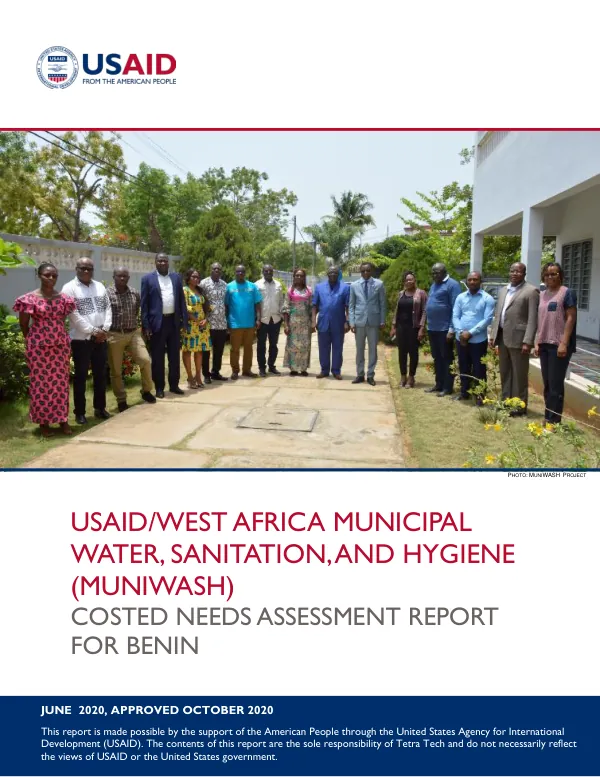
MuniWASH Costed Needs Assessment for Planning Water and Sanitation Interventions for Municipalities in Benin
Sign inUSAID DEC
MuniWASH Costed Needs Assessment for Planning Water and Sanitation Interventions for Municipalities in Benin
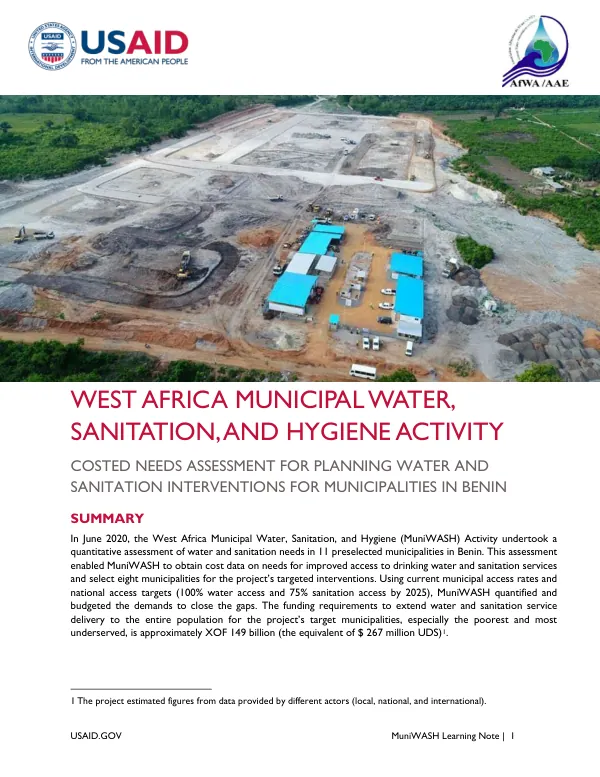
The West Africa Municipal Water, Sanitation, and Hygiene (MuniWASH) Activity undertook a quantitative assessment of water and sanitation needs in 11 preselected municipalities in Benin in June 2020.
2020 · 5 pages
Sign in to readA free account is required to download.
Abstract
This assessment enabled MuniWASH to obtain cost data on needs for improved access to drinking water and sanitation services and select eight municipalities for the project's targeted interventions. Using current municipal access rates and national access targets (100% water access and 75% sanitation access by 2025), MuniWASH quantified and budgeted the demands to close the gaps. The Benin assessment provided opportunities for future actions, and the compiled data is summarized in Table 1. The team used the following variables to measure municipal actions in service provision: existence of water and sanitation reference documents, presence of financial institutions in the municipality, and experience in financing water and sanitation. The team evaluated the potential of these municipalities to achieve the objectives. All the municipalities included in the study have experience in developing and implementing service provision activities based on reference documents, including communal development plans and multi-year water and sanitation action plans. Avrankou and Cotonou municipalities have on-going water projects, and Abomey-Calavi, Bohicon, Cotonou, and Ouidah have on-going sanitation projects. In terms of mobilized funding, water sector projects are underway in all communes except Avrankou and Cotonou. In the sanitation sector, only Ouidah, Cotonou, and Abomey-Calavi have not had any initiatives in the last two years. Possibilities for collaboration with financial institutions, particularly commercial banks, are greatest in Cotonou, Abomey-Calavi, and Aplahoue. The cost needs for water and sanitation in the eight municipalities are summarized in Table 2. Cost needs for sanitation show a significant demand for toilets and a corresponding demand for vacuum trucks in the various municipalities. Investment needs in the Benin water sector are based on the company project portfolio of the Société Nationale des Eaux du Bénin (SONEB). The figures are consistent with the government's strategic vision. The total need for water and sanitation projects that cover MuniWASH municipalities is XOF 149 billion ($267 million UDS). These funds are needed to achieve water access in the eight target municipalities, with the largest components of funding required for Cotonou and Abomey-Calavi, the two biggest municipalities in Benin. MuniWASH started from the hypothesis that the water and sanitation cost needs assessments can assess municipalities' WASH planning and implementation capacity using key questions. The team learned the following: Water and Sanitation Framework Document Enhanced municipal planning capacity in drinking water supply and sanitation has enabled the municipalities to develop strategic actions to achieve the important objectives in this sector. By developing a framework document that is easily referenced, the municipalities can articulate their short- or medium-term strategic visions. However, along with such a document, they must update or define a new strategic direction before any investments are made. Experience in Mobilizing Funds The water and sanitation cost needs assessment of the municipalities revealed that municipalities do not have enough experience to mobilize funds, and therefore, there is a need to use innovative forms of financing in view of the immense demand. Promoting public-private partnerships could be a reliable alternative to traditional public sector funding. Prerequisites for implementing such a financing approach include an explicit definition of the roles and responsibilities of the different stakeholders (government services and private providers) as well as the choice of efficient, socially acceptable, and economically viable technology options. Presence of Commercial Banks In medium-sized municipalities in Benin, the possibilities of collaboration with commercial banks are limited. Generally, there is only one commercial bank in these localities. It would be appropriate for WASH projects interested in financing water and sanitation infrastructures or equipment to consider different financing models (community, lines of credit, or other models) that facilitate investments. This may reduce the risks of potentially coercive conditions from a single funding actor in reference. Cost Needs for Underserved Populations Infrastructure investment and financing initiatives typically have not targeted the poor and underserved. Despite the challenge of raising funds for this segment of the population, there is an opportunity to establish sustainable infrastructure for the benefit of poor and underserved. In MuniWASH's target municipalities, investment needs for the water and sanitation sector inclusive of underserved populations are estimated at around XOF 149 billion ($267 million UDS).
Related documents