USAID DEC
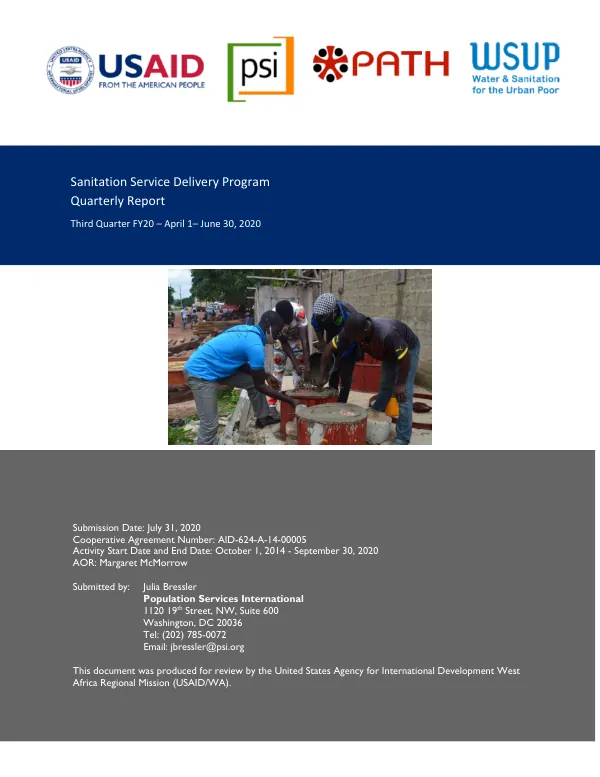
Sanitation Service Delivery Program Quarterly Report Third Quarter FY20 – April 1– June 30, 2020
Sign inPATH
Sanitation Service Delivery Program Quarterly Report Third Quarter FY20 – April 1– June 30, 2020
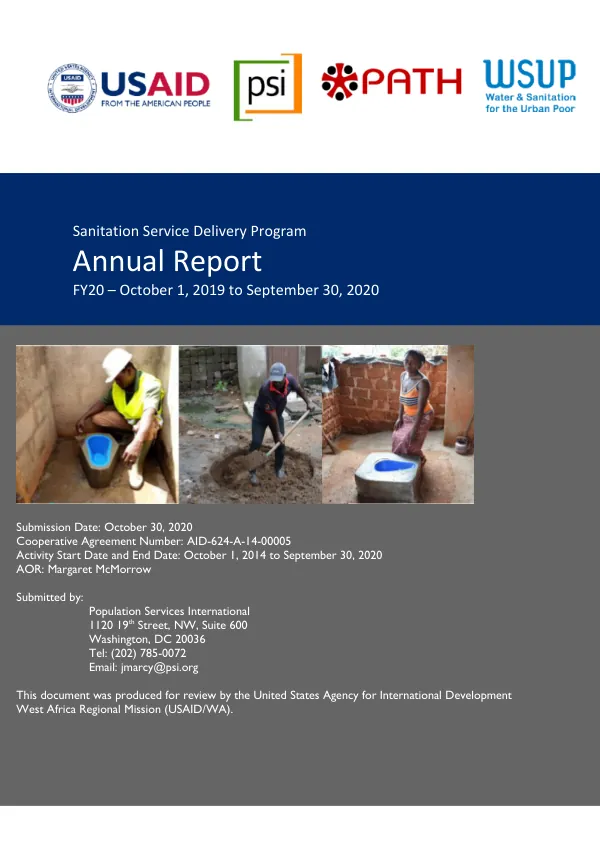
The Sanitation Service Delivery Program is a USAID/West Africa regional urban sanitation project implemented by Population Services International (PSI) in collaboration with PATH and Water & Sanitation for the Urban Poor (WSUP).
2020 · 42 pages
Sign in to readA free account is required to download.
Abstract
The project aims to create a more effective, efficient, and inclusive sanitation market for the urban poor in Benin, Côte d'Ivoire, and Ghana. The program works toward achieving this goal through developing and testing scalable, market-based models that directly contribute to improving sanitation outcomes. The project serves as a market catalyst to identify and address conditions that prohibit and facilitate the growth of local markets for sanitation. The program puts the customer (landlords, tenants, and households) at the center of strategies and actions, with donor funding used as a catalytic investment to develop a thriving marketplace. This results in customers gaining access to basic sanitation and maintenance and emptying services that are easier to access, more affordable, and of higher quality. The project has achieved significant results since its inception. In the third quarter of FY20, the program faced challenges due to the COVID-19 pandemic, which greatly affected project activities. Field activities were severely hampered in Côte d'Ivoire and Benin, with both governments implementing restrictive measures to stop the spread of the outbreak. Despite these challenges, the program implemented a telecoaching plan and continued to make progress. As of the end of the third quarter of FY20, the project has sold a total of 34,705 latrine products, representing a 100.92% achievement of the overall project goal. The program has also reached 412,480 people with improved sanitation service quality, representing 79.16% of the overall project target. These results demonstrate the project's effectiveness in creating a more effective, efficient, and inclusive sanitation market for the urban poor in the region. The project's success can be attributed to its market-based approach, which puts the customer at the center of strategies and actions. The program's focus on developing and testing scalable models has enabled it to achieve significant results, despite the challenges posed by the COVID-19 pandemic. The project's continued progress and achievements demonstrate its potential to create a thriving sanitation marketplace in the region. The Sanitation Service Delivery Program has made significant progress in achieving its goals, particularly in terms of increasing access to improved sanitation and safe containment, transport, and disposal of fecal waste. The program's market-based approach has enabled it to create a more effective, efficient, and inclusive sanitation market for the urban poor in Benin, Côte d'Ivoire, and Ghana. The project's continued progress and achievements demonstrate its potential to create a thriving sanitation marketplace in the region. The project's success can be attributed to its focus on developing and testing scalable models, as well as its market-based approach, which puts the customer at the center of strategies and actions. The program's continued progress and achievements demonstrate its potential to create a more effective, efficient, and inclusive sanitation market for the urban poor in the region.
Related documents