USAID DEC
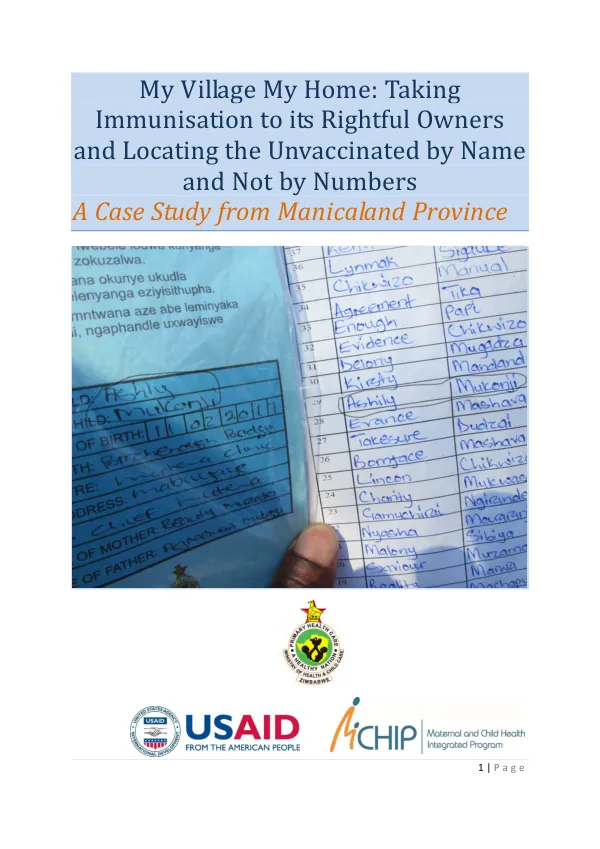
My Village My Home: Taking Immunisation to its Rightful Owners and Locating the Unvaccinated by Name and Not by Numbers A Case Study from Manicaland Province
Sign inJSI
My Village My Home: Taking Immunisation to its Rightful Owners and Locating the Unvaccinated by Name and Not by Numbers A Case Study from Manicaland Province
Manicaland Province in Zimbabwe has historically struggled with low immunisation coverage, particularly in the 2005 and 2011 Zimbabwe Demographic and Health Surveys (ZDHS).
2017 · 16 pages
Sign in to readA free account is required to download.
Abstract
The province ranked among the three lowest-performing provinces in terms of fully immunised child (FIC) indicators, with coverage rates of 41% and 46% respectively. However, following the implementation of the Reaching Every District/Child (RED/REC) strategy in 2011, supported by USAID/MCHIP, Manicaland Province saw a significant increase in FIC indicators to 71% by 2015. The RED/REC strategy consists of five operational components: planning and management of resources, supportive supervision, reaching the target populations, linking services with communities, and monitoring data for action. While substantial efforts were made to support the first three components, the latter two received relatively less attention. To address the observed gaps, Manicaland Province decided to pilot the "My Village My Home" (MVMH) approach in 10 health facilities in Chipinge and Makoni Districts. The MVMH concept is a tool for linking communities with immunisation services offered by local health facilities. It is designed as a village head's house with blocks or bricks representing each vaccine dose that each child in the village will receive. As all infants become fully immunised, the strength of the house increases, making the village a safe place for children to live in. Each block in the house contributes to the strength of the building, and in the event of missing blocks, the structure weakens, eventually leading to collapse. The intervention involved the selection of health facilities, training of facility health workers, village health workers, community leaders, defining roles and responsibilities of each group of stakeholders, providing them with tools and guidelines, and follow-up supportive supervisory visits. Ten health facilities were selected for the pilot, including facilities with low immunisation coverage or high drop-out rates, and high-volume sites. A situational analysis was conducted in the 10 health facilities to assess the extent of community involvement in EPI and use of data capturing tools. The analysis revealed limited understanding of the value of the child health card by all users, infrequent recording of return dates on the card, and health facility EPI registers not capturing all the children in the catchment area. Village health workers' EPI registers were not regularly updated, and community leaders were not involved in routine immunisation or child health issues except during African Vaccination Week. To address these gaps, the Provincial Health Executive was sensitised on MVMH, and health worker training was conducted. Village health workers and village heads were trained on the MVMH model of community child tracking for immunisation and vitamin A supplementation. Child registration was conducted, and village immunisation charts and MVMH guidelines were adapted to take into account inputs from health workers. Supportive supervision was conducted to all the 10 health facilities, including visits to village head homesteads to review immunisation charts and interview them on progress and challenges. Review meetings were conducted where health workers, selected village health workers, and village heads shared best practices and discussed challenges. A short video was recorded by the USAID/MCHIP Senior Immunisation Technical Advisor where village heads and village health workers representatives articulated the MVMH concept. The MVMH chart is used to track the immunisation status of children in a village. The source of data recorded on the chart is the village health worker's register, which is updated monthly. The chart is used to identify children who are missing doses of vaccination and to monitor the progress of immunisation in the village.
Related documents