JSI
Routine Immunization Coverage Trends in Senegal
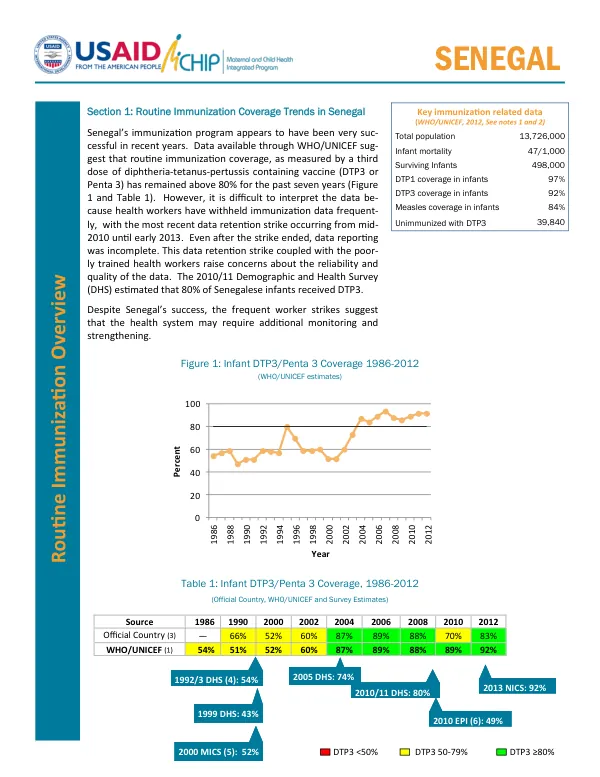
Routine Immunization Coverage Trends in Senegal have been successful in recent years, with data indicating that routine immunization coverage, as measured by a third dose of diphtheria-tetanus-pertussis containing vaccine (DTP3 or Penta 3), has remained above 80% for the past seven years.
2014 · 4 pages
Sign in to readA free account is required to download.
Abstract
According to WHO/UNICEF estimates, DTP3 coverage has been consistently high, with a few fluctuations. The 2010/11 Demographic and Health Survey (DHS) estimated that 80% of Senegalese infants received DTP3. Despite the success, concerns have been raised about the reliability and quality of the data due to frequent worker strikes and poorly trained health workers. The data retention strike from mid-2010 until early 2013, and incomplete data reporting after the strike, have raised concerns about the accuracy of the data. The 2010/11 DHS estimated that 80% of Senegalese infants received DTP3, but the data retention strike and incomplete data reporting may have affected the accuracy of this estimate. Geographic variation in coverage is another area of concern. National coverage estimates often mask sub-national differences in performance. Disaggregation of national immunization coverage data can reveal areas with low access to and utilization of immunization services. In 2012, most districts in Senegal reported DTP3 coverage above 80%, but there were still areas with uneven access to and use of immunization services. Analysis of equity in immunization is also an important aspect of evaluating the performance of the immunization program. National estimates of immunization coverage often conceal socioeconomic variations in immunization performance. Analyses of equity in immunization, comparing coverage in highest and lowest wealth quintiles, rely on data from population-based surveys such as DHS and MICS. The 2005 DHS indicated that immunization coverage for children in the highest wealth quintile was 12.1 percentage points higher than that for children in the lowest wealth quintile. The 2010/11 DHS showed a growing equity gap, with DTP3 coverage among children in the lower wealth quintile increasing by 1.8 percentage points, but the gap between the lowest and highest wealth quintiles growing to 14.1 percentage points. The GAVI Alliance has provided significant support to Senegal's immunization program, with cumulative total approved support of almost $63 million as of September 2013. GAVI has supported the introduction of monovalent hepatitis B, pentavalent, and meningitis A vaccines in 2004, 2005, and 2012, respectively. The measles-rubella and pneumococcal vaccines were introduced in 2013. GAVI is currently providing immunization services support (HSS) funding to Senegal. The USAID Mission has also played an important role in supporting GAVI activities in Senegal, with technical support to improve Ministry of Health capacity to vaccinate under-served populations routinely and effectively with better service quality, using existing and new vaccines.