USAID DEC
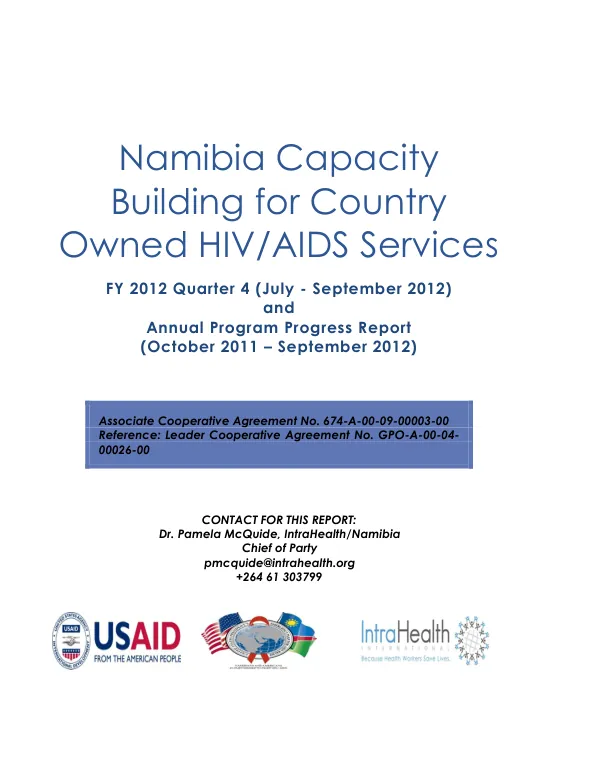
Namibia AA FY12 Q4 Quarterly and Annual Report - July-September 2012; October 2011-September 2012
Sign inINTRAHEALTH
Namibia AA FY12 Q4 Quarterly and Annual Report - July-September 2012; October 2011-September 2012
The Namibia Capacity Building for Country Owned HIV/AIDS Services program is a collaborative effort between IntraHealth and the Government of Namibia.
2012 · 56 pages
Sign in to readA free account is required to download.
Abstract
The program aims to strengthen the country's capacity to provide comprehensive HIV/AIDS services. IntraHealth is the lead implementing partner, with the Government of Namibia as the host country. The program is supported by the United States Agency for International Development (USAID) through a cooperative agreement. The program's overall goal is to reduce the burden of HIV/AIDS in Namibia by improving the quality and accessibility of HIV/AIDS services. The program focuses on several key areas, including prevention of mother-to-child transmission of HIV, maternal, newborn, and child health, voluntary medical male circumcision, post-exposure prophylaxis, and counseling and testing. In the prevention of mother-to-child transmission of HIV and maternal, newborn, and child health program area, significant progress was made in 2012. The program achieved a 95% coverage rate for antenatal care services, and 90% of pregnant women received HIV testing. The program also supported the establishment of 15 new health facilities, which increased access to HIV/AIDS services in rural areas. In the voluntary medical male circumcision program area, the program achieved a 90% coverage rate for male circumcision services among eligible men. The program also supported the training of 200 health care workers in male circumcision procedures. The post-exposure prophylaxis program area saw significant progress in 2012, with a 25% increase in the number of individuals receiving post-exposure prophylaxis services. The program also supported the establishment of a post-exposure prophylaxis hotline, which increased access to emergency HIV prevention services. The counseling and testing program area achieved a 95% coverage rate for HIV testing services among individuals at high risk of HIV infection. The program also supported the establishment of 10 new counseling and testing sites, which increased access to HIV testing services in rural areas. The program also made significant progress in the area of human resources for health capacity building. The program supported the training of 500 health care workers in HIV/AIDS care and treatment, and 200 health care workers in counseling and testing. The program also supported the establishment of a human resources information system, which improved the management of health care worker data. In terms of challenges, the program faced difficulties in maintaining data quality, particularly in the area of HIV testing. The program also faced environmental challenges, including a shortage of electricity and water in some health facilities. Overall, the Namibia Capacity Building for Country Owned HIV/AIDS Services program made significant progress in 2012 in improving the quality and accessibility of HIV/AIDS services in Namibia. The program's achievements are a testament to the strong partnership between IntraHealth and the Government of Namibia, and the commitment of the program's staff and partners to reducing the burden of HIV/AIDS in Namibia.
Related documents