USAID DEC
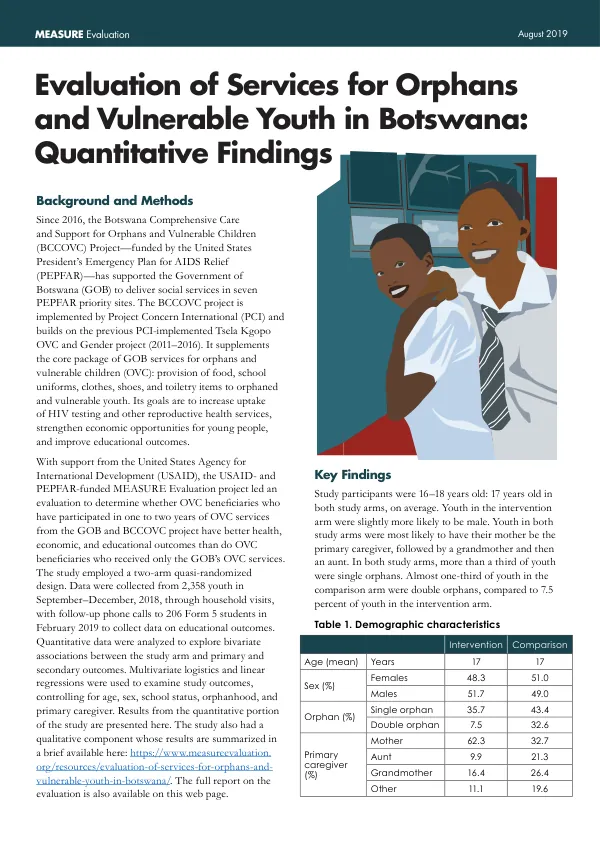
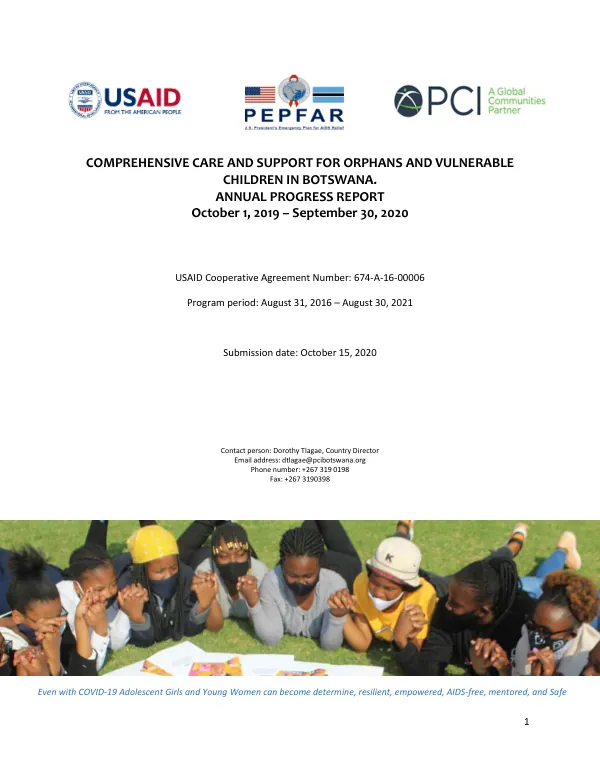
Comprehensive Care and Support for Orphans and Vulnerable Children in Botswana. Annual Progress Report October 1, 2019 – September 30, 2020
Sign inHUMANA PEOPLE TO PEOPLE
Comprehensive Care and Support for Orphans and Vulnerable Children in Botswana. Annual Progress Report October 1, 2019 – September 30, 2020
The Comprehensive Care and Support for Orphans and Vulnerable Children in Botswana project aims to strengthen community agency to seek, support, and provide HIV/AIDS-related services to OVC and their parents/caregivers.
2020 · 40 pages
Sign in to readA free account is required to download.
Abstract
The project is implemented in seven high-priority districts and collaborates with six national and one international non-governmental organizations. At the national level, the project collaborates with various government ministries and departments. The project uses the Comprehensive Family Care model, the Women Empowered program, and other economic strengthening interventions and comprehensive sexuality/life skills education to achieve project goals. Implementing Partners continue to improve financial literacy for youth through Aflateen and Ready to Work Evidence-Based Interventions. The project integrates HIV prevention, care, and support services into all programmatic strategies. The project has four Intermediate Results: IR1, IR2, IR3, and IR4. IR1 aims to strengthen community and household structures to support OVC, while IR2 focuses on increasing uptake of HIV/AIDS prevention, care, and treatment services among OVC households. IR3 aims to improve policy implementation for the delivery of coordinated social services, and IR4 seeks to strengthen the capacity of local organizations to sustain program delivery and outcomes. The project is funded by the President's Emergency Plan for AIDS Relief (PEPFAR) through the United States Agency for International Development (USAID). The project period is from August 31, 2016, to August 30, 2021. Strengthening Household and Community Structures to Support OVC The project has made significant progress in strengthening household and community structures to support OVC. The OVC Comprehensive program has been implemented in 15 communities, reaching over 2,500 OVC households. The program has provided training on child safeguarding and protection, health and wellness, household economic strengthening, and school performance management. The DREAMS program has mobilized communities for change using the SASA approach, while the FCI Justice for Children program has reached faith and community leaders through the SASA! Faith initiative. The Coaching Boys into Men program has been implemented in 10 communities, reaching over 1,000 boys. Increase Uptake of HIV Prevention, Care, and Treatment Services among OVC The project has made significant progress in increasing uptake of HIV prevention, care, and treatment services among OVC. The OVC Comprehensive program has provided HIV prevention services during home visits, while the OVC Preventive program has provided life skills education to adolescents aged 9-14 years through schools. The DREAMS program has provided HIV and violence prevention education for Adolescent Girls and Young Women (AGYW), while the Empowering AGYW and Reducing Risk program has provided structured safe spaces for AGYW. The Getting AGYW Ready to Work program has provided vocational training to AGYW, while the Strengthening Families program has provided family strengthening services to OVC households. Improve Policy Implementation for Delivery of Coordinated Social Services The project has made significant progress in improving policy implementation for the delivery of coordinated social services. The project has worked with the Department of Social Protection (DSP) to strengthen social protection services for OVC, while the project has worked with the Ministry of Health and Wellness (MOHW) to strengthen health services for OVC. The project has also worked with the Ministry of Education and Skill Development (MOESD) to strengthen education services for OVC, while the project has worked with the Ministry of Youth Empowerment Sport and Cultural Development (MYESCD) to strengthen youth services for OVC. The project has also worked with the National Health Promotion Agency (NAHPA) to strengthen health promotion services for OVC. Organizational Capacity Strengthening The project has made significant progress in strengthening the capacity of local organizations to sustain program delivery and outcomes. The project has provided training and technical assistance to local organizations, while the project has supported the development of organizational capacity assessment tools. The project has also supported the development of a transition plan for local organizations, while the project has provided funding to support the implementation of the transition plan. The project has also supported the development of a monitoring and evaluation system for local organizations, while the project has provided technical assistance to support the implementation of the monitoring and evaluation system. Challenges, Solutions, and Action Taken The project has faced several challenges, including limited resources and capacity constraints. However, the project has taken several actions to address these challenges, including providing training and technical assistance to local organizations and supporting the development of organizational capacity assessment tools. Activities Planned for Next Fiscal Year The project plans to continue implementing the Comprehensive Care and Support for Orphans and Vulnerable Children in Botswana project in the next fiscal year. The project will continue to strengthen household and community