USAID DEC
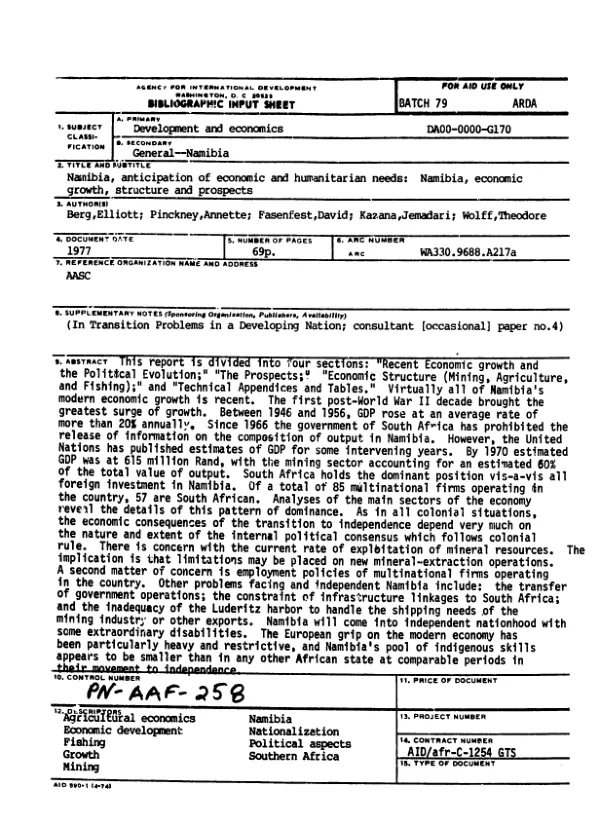
Namibia, anticipation of economic and humanitarian needs : US policy choices in Namibia
Sign inAFRICAN-AMERICAN SCHOLARS COUNCIL
Namibia, anticipation of economic and humanitarian needs : US policy choices in Namibia
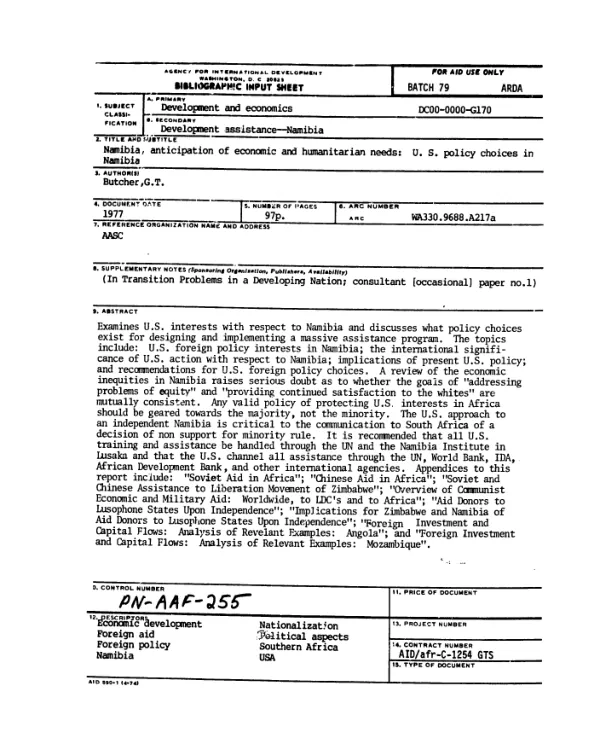
Examines U.S.
Butcher, G. T. · 1970
Sign in to readA free account is required to download.
Abstract
interests with respect to Namibia and discusses what policy choices exist for designing and implementing a massive assistance program. The topics include: U.S. foreign policy interests in Namibia; the international significance of U.S. action with respect to Namibia; implications of present U.S. policy; and recommendations for U.S. foreign policy choices. A review of the economic inequities in Namibia raises serious doubt as to whether the goals of "addressing problems of equity" and "providing continued satisfaction to the whites" are mutually consistent. Any valid policy of protecting U.S. interests in Africa should be geared towards the majority, not the minority. The U.S. approach to an independent Namibia is critical to the communication to South Africa of a decision of non support for minority rule. It is recommended that all U.S. training and assistance be handled through the UN and the Namibia Institute in Lusaka and that the U.S. channel all assistance through the UN, World Bank, IDA, African Development Bank, and other international agencies. Appendices to this report include: "Soviet Aid in Africa"; "Chinese Aid in Africa"; "Soviet and Chinese Assistance to Liberation Movement of Zimbabwe"; "Overview of Communist Economic and Military Aid: Worldwide, to LDC"s and to Africa"; "Aid Donors to Lusophone States Upon Independence"; "Implications for Zimbabwe and Namibia of Aid Donors to Lusophone States Upon Independence"; "Foreign Investment and Capital Flows: Analysis of Relevant Examples: Angola"; and "Foreign Investment and Capital Flows: Analysis of Relevant Examples: Mozambique".
Related documents