USAID DEC
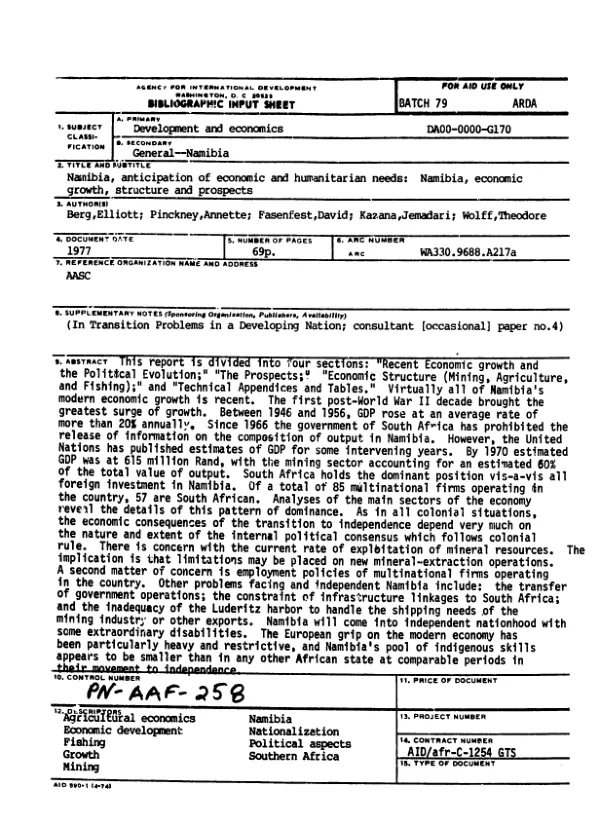
Namibia, anticipation of economic and humanitarian needs : Namibia, politics, ecology, and society
Sign inAFRICAN-AMERICAN SCHOLARS COUNCIL
Namibia, anticipation of economic and humanitarian needs : Namibia, politics, ecology, and society
Describes and analyses how Namibia is organized politically and socially and how it came to be that way.
Rotberg, R. I. · 1970
Sign in to readA free account is required to download.
Abstract
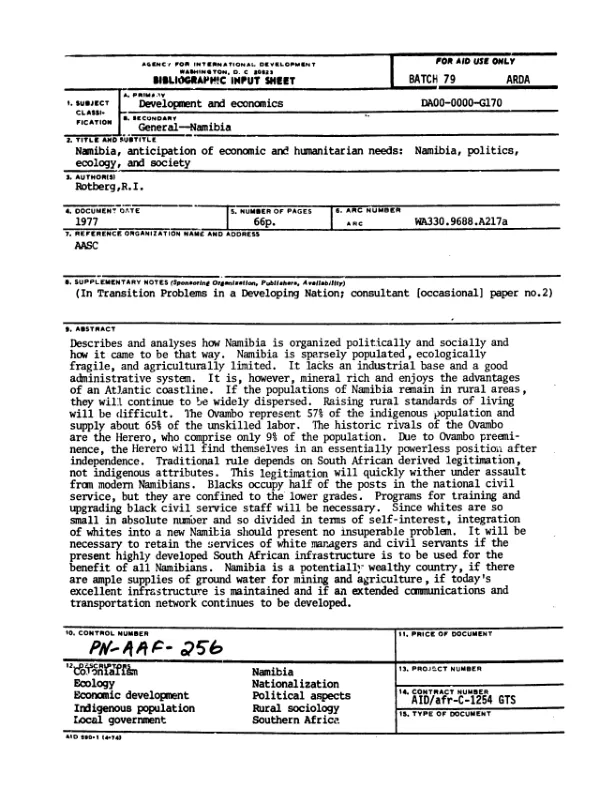
Namibia is sparsely populated, ecologically fragile, and agriculturally limited. It lacks an industrial base and a good administrative system. It is, however, mineral rich and enjoys the advantages of an Atlantic coastline. If the populations of Namibia remain in rural areas, they will continue to be widely dispersed. Raising rural standards of living will be difficult. The Ovambo represent 57% of the indigenous population and supply about 65% of the unskilled labor. The historic rivals of the Ovambo are the Herero, who comprise only 9% of the population. Due to Ovambo preeminence, the Herero will find themselves in an essentially powerless position after independence. Traditional rule depends on South African derived legitimation, not indigenous attributes. This legitimation will quickly wither under assault from modern Namibians. Blacks occupy half of the posts in the national civil service, but they are confined to the lower grades. Programs for training and upgrading black civil service staff will be necessary. Since whites are so small in absolute number and so divided in terms of self-interest, integration of whites into a new Namibia should present no insuperable problem. It will be necessary to retain the services of white managers and civil servants if the present highly developed South African infrastructure is to be used for the benefit of all Namibians. Namibia is a potentially wealthy country, if there are ample supplies of ground water for mining and agriculture, if today"s excellent infrastructure is maintained and if an extended communications and transportation network continues to be developed.