GOVERNMENT OF UGANDA
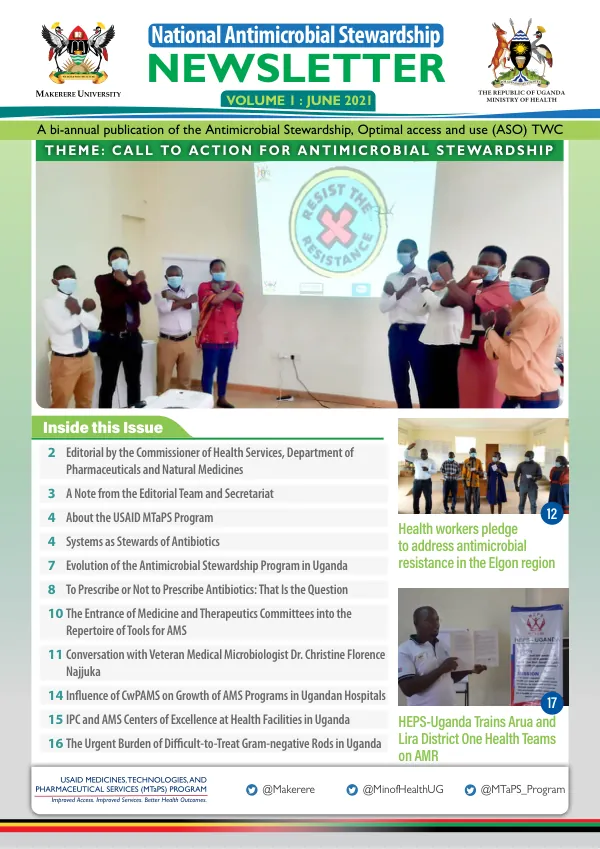
National Antimicrobial Stewardship Newsletter
The Antimicrobial Stewardship initiative in Uganda aims to address the growing problem of antimicrobial resistance (AMR).
2021 · 20 pages
Sign in to readA free account is required to download.
Abstract
The initiative is led by the Antimicrobial Stewardship, Optimal access and use (ASO) Technical Working Committee (TWC), a multisectoral and multidisciplinary body established by the national AMR sub-committee (NAMRSC). The ASO TWC coordinates the implementation of strategic objective 3 of the Uganda National Action Plan for AMR, which focuses on promoting optimal access and use of antimicrobials. The foundation of antimicrobial stewardship is teamwork, and the ASO TWC is working with various stakeholders, including the Ministry of Health, the Ministry of Agriculture, Animal Industry, and Fisheries, and the Uganda Wildlife Authority, to improve the use of antimicrobials in Uganda. The initiative is also supported by the USAID Medicines, Technologies, and Pharmaceutical Services (MTaPS) Program, which has provided crucial support in setting up multisectoral coordinating bodies, including the NAMRSC and the ASO TWC. The ASO TWC has identified several key areas for improvement in antimicrobial use in Uganda, including the unnecessary use of antibiotics for viral upper respiratory tract infections, the wrong antibiotic prescribed for urinary tract infections, and prolonged use of antibiotics for surgical prophylaxis. To address these issues, the ASO TWC is promoting the responsible use of antimicrobials through education, training, and awareness-raising activities. The Uganda National AMR-NAP, launched in 2018, provides a framework for implementing antimicrobial stewardship in the country. The plan emphasizes the importance of teamwork and collaboration among various stakeholders to address the AMR problem. The ASO TWC is working to implement the plan's strategic objectives, including promoting public awareness, training, and education on antimicrobial use. The ASO TWC is also working to establish and sustain Centers of Excellence for Antimicrobial Stewardship and Infection Prevention and Control (IPC) at selected health facilities across the country. These centers will provide training and capacity-building activities for healthcare workers and will serve as models for antimicrobial stewardship practices in Uganda. In addition to these efforts, the ASO TWC is working to bolster the governance structures for One Health at the local government level by implementing capacity-building activities for district One Health task forces. This will help to ensure that antimicrobial stewardship practices are integrated into the broader One Health approach in Uganda. The ASO TWC is committed to working with various stakeholders to address the AMR problem in Uganda. The initiative recognizes that antimicrobial stewardship is a universal issue that affects everyone, and it is working to promote the responsible use of antimicrobials through education, training, and awareness-raising activities. The ASO TWC invites and welcomes submissions for consideration to publish in future issues of the newsletter, which will continue to provide updates on the antimicrobial stewardship initiative in Uganda.
Related documents