USAID DEC
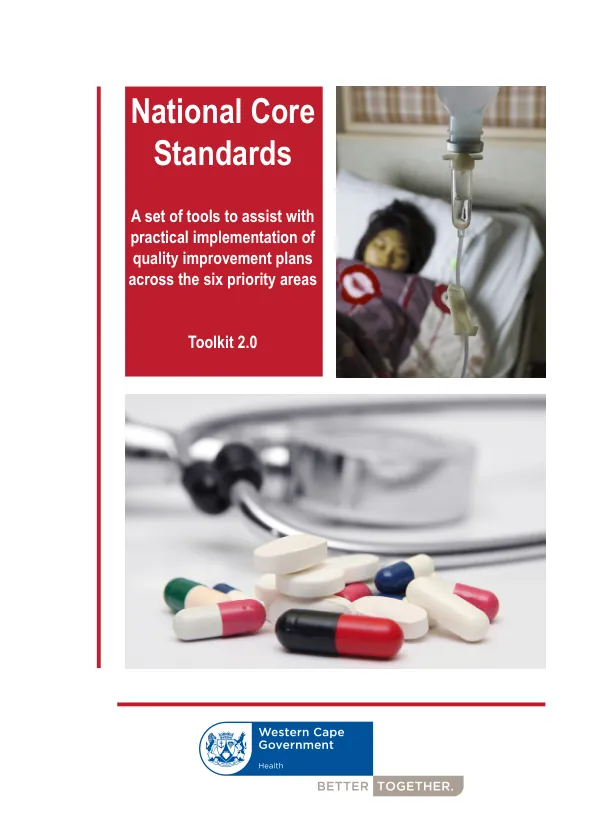
National Core Standards Toolkit 2.0
Values and Attitudes is one of the six priority areas addressed by the National Core Standards (NCS) toolkit.
2015 · 124 pages
Sign in to readA free account is required to download.
Abstract
This priority area focuses on ensuring that patients are treated with respect and dignity by healthcare establishment personnel. The toolkit provides a series of tools to assist with practical implementation of quality improvement plans across the six priority areas. The toolkit includes a Patients' Rights Poster and Patient Rights leaflets, which are designed to provide patients with information on their rights and responsibilities within a health establishment. The poster and leaflets are intended to be displayed in waiting rooms and made available to patients, respectively. The operational manager is responsible for ensuring that the poster is displayed and the leaflets are available. The Patients' Rights Poster and Patient Rights leaflets are linked to three NCS measures, including assessing whether patients feel treated in a respectful and caring manner, observing staff members demonstrating courtesy, patience, empathy, and tolerance, and providing patients with information on their rights and responsibilities. The checklist for assessing patient respect reported includes seven questions, such as whether staff treat patients politely and with respect, whether patients' illnesses or injuries are clearly explained, and whether staff voluntarily inform patients about where to go for treatment or to collect their medicine. The checklist is designed to be completed by interviewing three random patients to determine whether they feel treated in a respectful and caring manner. Cleanliness is another priority area addressed by the NCS toolkit. This priority area focuses on ensuring that healthcare facilities maintain a clean and safe environment for patients and staff. The toolkit provides a series of tools to assist with practical implementation of quality improvement plans across the six priority areas. The toolkit includes a Tobacco Control Policy, which is designed to provide health establishments with a guideline that regulates smoking and ensures that staff and patients/visitors have a healthy environment. The policy is linked to three NCS measures, including having a no smoking policy applicable to patients, visitors, and staff, displaying notices prohibiting smoking inside buildings, and providing smoking areas for staff, visitors, and patients. The checklist for assessing cleanliness includes several questions, such as whether there is a no smoking policy applicable to patients, visitors, and staff, and whether notices are prominently displayed prohibiting smoking inside buildings. The checklist is designed to be completed by observing healthcare facilities and assessing their cleanliness. Waiting Times is another priority area addressed by the NCS toolkit. This priority area focuses on ensuring that patients are seen in a timely manner and that waiting times are minimized. The toolkit provides a series of tools to assist with practical implementation of quality improvement plans across the six priority areas. The toolkit includes laminated signs for different services, which are designed to provide healthcare facilities with clear signage to specific service areas. The signs are linked to one NCS measure, which requires clear signage to the different service areas in the health establishment. Patient Safety is a critical priority area addressed by the NCS toolkit. This priority area focuses on ensuring that patients receive safe and effective care. The toolkit provides a series of tools to assist with practical implementation of quality improvement plans across the six priority areas. The toolkit includes essential guidelines and policies, which are designed to provide health establishments with up-to-date guidelines and policies. The guidelines and policies are linked to several NCS measures, including having the most up-to-date guidelines on national strategic priority programmes or health initiatives available, conducting clinical audits of each priority programme/health initiative, and having a protocol regarding the safe administration of medicines to patients. Infection Prevention and Control is another priority area addressed by the NCS toolkit. This priority area focuses on ensuring that healthcare facilities maintain a safe and clean environment to prevent the spread of infections. The toolkit provides a series of tools to assist with practical implementation of quality improvement plans across the six priority areas. The toolkit includes a standard precautions policy, which is designed to provide health establishments with a comprehensive policy covering standard precautions in healthcare facilities. The policy is linked to several NCS measures, including having comprehensive procedures covering standard precautions, providing appropriate types of respirators to staff who are at risk of contracting TB or exposed to serious contagious respiratory infections, and educating healthcare personnel on PPE and use of respirators. Availability of Medicines and Supplies is a critical priority area addressed by the NCS toolkit. This priority area focuses on ensuring that healthcare facilities have adequate supplies of medicines and other essential items. The toolkit provides a series of tools to assist with practical implementation of quality improvement plans across the six priority areas. The toolkit includes a standard operating procedure for PHCs and CHCs, which is designed to provide health establishments with an SOP that describes the management of schedule 5 and 6 medication. The SOP is linked to several NCS measures, including having a standard operating procedure available which indicates how schedule 5 and 6 medicines are stored, controlled, and distributed, and ensuring that all medication is received as prescribed.