MANAGEMENT SCIENCES FOR HEALTH
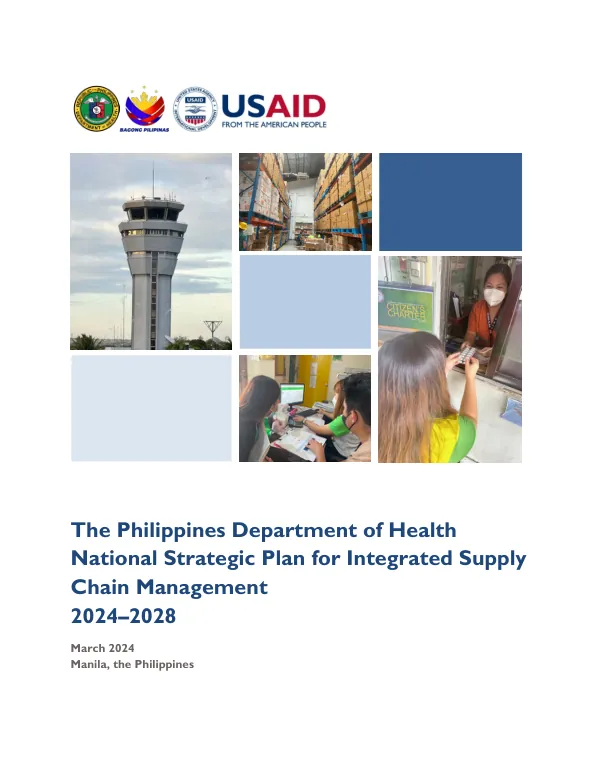
National Strategic Plan for Integrated Supply Chain Management 2024–2028
The National Strategic Plan for Integrated Supply Chain Management 2024–2028 is a comprehensive plan developed by the Philippines Department of Health to strengthen the country's supply chain management system.
2024 · 72 pages
Sign in to readA free account is required to download.
Abstract
The plan aims to improve the efficiency, effectiveness, and sustainability of the supply chain, ensuring that essential health products and services are available to all Filipinos. The plan is built on the successes of the previous National Strategic Plan for Supply Chain Management 2019–2023, which achieved significant improvements in supply chain performance. Key achievements include a 25% increase in the percentage of public health facilities with no stockouts, and a 30% reduction in the average lead time for the delivery of essential health products. The new plan identifies several key issues that need to be addressed, including the need to strengthen end-to-end and sustainable supply chain governance and stewardship, enhance supply chain institutions and human resources capacity, and streamline and standardize end-to-end supply chain systems and processes. The plan also recognizes the importance of leveraging multi-sectoral supply chain partnerships, capabilities, and resources to achieve its objectives. The plan outlines five strategic objectives, each with specific expected results, key interventions, and performance indicators. Strategic Objective 1 aims to strengthen end-to-end and sustainable supply chain governance and stewardship, while Strategic Objective 2 focuses on enhancing supply chain institutions and human resources capacity. Strategic Objective 3 seeks to streamline and standardize end-to-end supply chain systems and processes, while Strategic Objective 4 aims to integrate, modernize, and scale up supply chain information systems and advanced data use for decision-making. Strategic Objective 5 leverages multi-sectoral supply chain partnerships, capabilities, and resources to achieve the plan's objectives. The plan also identifies opportunities, risks, and mitigation measures, and outlines an implementation framework that includes a high-level implementation framework, a supply chain management stewardship and oversight council, and a management information system for integrated supply chain management. The plan is supported by the American people through the US Agency for International Development (USAID) contract no. 7200AA18C00074, and is the responsibility of Management Sciences for Health. The plan's development was guided by a theory of change that outlines the expected outcomes and impact of the plan's interventions. The implementation of the plan will require significant resources and efforts from various stakeholders, including the Department of Health, local government units, and private sector partners. The plan's success will depend on the effective coordination and collaboration of these stakeholders, as well as the availability of necessary resources and funding. Overall, the National Strategic Plan for Integrated Supply Chain Management 2024–2028 is a critical document that outlines the Department of Health's vision and strategy for improving the country's supply chain management system. The plan's implementation will have a significant impact on the availability and accessibility of essential health products and services in the Philippines, and will contribute to the achievement of the country's health and development goals.
Related documents