USAID DEC
Avoiding conflict and balancing trade-offs: Biodiversity Conservation in the context of Competing Land Uses
Sign inAFRICAN BIODIVERSITY COLLABORATIVE GROUP
Avoiding conflict and balancing trade-offs: Biodiversity Conservation in the context of Competing Land Uses
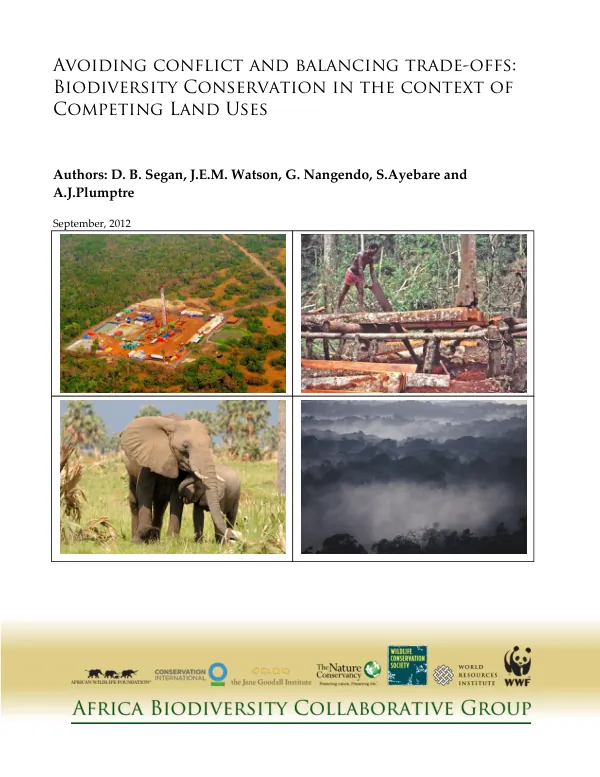
The Murchison-Semliki Landscape is one of six key landscapes identified for conservation in the Albertine Rift region of Africa.
2012 · 30 pages
Sign in to readA free account is required to download.
Abstract
This landscape is characterized by competing land uses, including biodiversity conservation, tourism in parks and forest reserves, small-scale agriculture, large-scale agriculture, carbon sequestration, timber extraction, and oil mining. The landscape is home to several endangered and threatened species, including the Rothschild giraffe and the lion. Conservation planning methods have been developing rapidly over the past 20 years to address the realities of a world with competing land uses. These methods allow for careful planning of resource allocation, exploration of trade-offs between different interest groups, and promotion of thoughtful and informed land-use decisions. They also provide a framework to ensure conservation objectives are achieved while minimizing the cost to other stakeholders. A conservation planning decision support tool, such as Marxan, can be used to examine trade-offs in land use in the Murchison-Semliki Landscape. Marxan is a spatial optimization tool that helps identify priority areas for conservation by minimizing the opportunity cost to other stakeholders and land uses. A workshop held in Kampala in late August 2012 demonstrated the Marxan tool and solicited input from attendees on conservation objectives for the landscape. The preliminary analysis used Marxan to develop six scenarios to demonstrate how the tool could be used to identify priority areas for conservation in the landscape. These scenarios help identify which areas of the landscape are non-negotiable and which areas are potentially up for discussion and could potentially be switched with another area if it minimizes conflict between the land use options. The preliminary results indicate that areas where exploration for oil is currently taking place are critical for the achievement of conservation objectives. The overlap between areas of high conservation importance and oil exploration highlights the need for careful planning of extractive activities to ensure the long-term conservation of species important for the tourism industry. The framework presented here provides an objective and transparent way of analyzing and documenting how decisions are made. It also outlines how an inclusive decision-making process can incorporate the interests of multiple stakeholders and provide feedback on how preferences for one stakeholder group will impact the interests of others. The Murchison-Semliki Landscape is characterized by a mix of forest and grassland habitats, with several protected areas, including national parks and forest reserves. The landscape is home to a diverse range of species, including the Rothschild giraffe, the lion, and several endemic and threatened species. The landscape is also an important area for carbon sequestration, with forests playing a critical role in storing carbon. The use of Marxan in the Murchison-Semliki Landscape has identified areas of high conservation importance, including corridors that would best be conserved or restored to maintain connectivity between forest blocks and improve the viability of landscape species. The analysis has also identified areas where exploration for oil is currently taking place, highlighting the need for careful planning of extractive activities to ensure the long-term conservation of species important for the tourism industry. The results of the Marxan analysis indicate that areas where exploration for oil is currently taking place are critical for the achievement of conservation objectives. The overlap between areas of high conservation importance and oil exploration highlights the need for careful planning of extractive activities to ensure the long-term conservation of species important for the tourism industry. The framework presented here provides an objective and transparent way of analyzing and documenting how decisions are made.
Related documents
Documents in this collection
 2011
2011USAID DEC
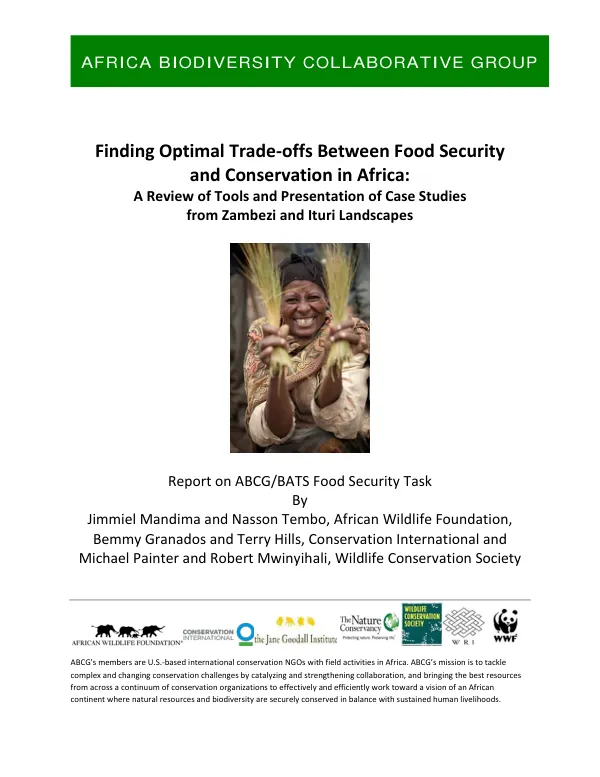
Finding Optimal Trade-offs Between Food Security and Conservation in Africa: A Review of Tools and Presentation of Case Studies from Zambezi and Ituri Landscapes
Open record 2012
2012USAID DEC