RTI INTERNATIONAL
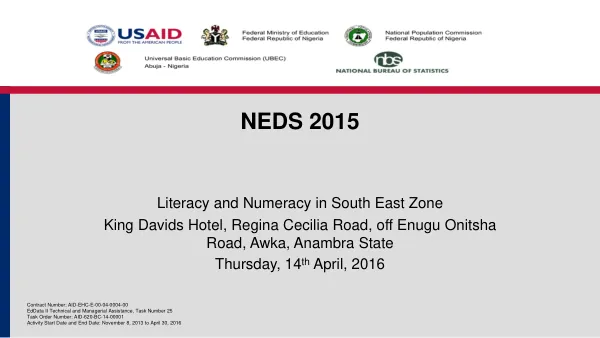
NEDS 2015: Literacy and Numeracy in South East Zone
The Literacy and Numeracy in South East Zone report focuses on the educational status of children in the region.
2016 · 20 pages
Sign in to readA free account is required to download.
Abstract
The report presents data on literacy levels among children aged 5-16, with a specific emphasis on the South East Zone of Nigeria. The data is based on the 2015 survey, which aimed to assess the educational progress of children in the region. The report defines literacy as the ability to read and understand written words, with examples of Level 1 literacy words provided, including "Hat, Sit, Room" and "Ife, Ebi, Eran". Comprehension sentences are also given as examples, such as "Do you hear with your arms?" and "Mutane na bacci a ruwa?". These examples illustrate the basic reading skills required for literacy. The report also presents examples of Level 2 math problems, including simple arithmetic operations such as 5 - 3 and 9 - 5. These examples demonstrate the basic math skills required for numeracy. The report provides data on literacy levels among children aged 5-16, with a breakdown by schooling status, zone, state, and over time. The data shows that the percentage of children who are literate varies significantly depending on these factors. For example, the report shows that the percentage of children who are literate by schooling status in 2015 was 63.4% for children who attended formal school, compared to 21.1% for children who did not attend formal school. The report also presents data on literacy levels by residence, wealth quintile, and class. These data show that literacy levels vary significantly depending on these factors, with children from wealthier households and those who attend formal school showing higher literacy levels. The report provides a comprehensive overview of literacy levels among children in the South East Zone of Nigeria, highlighting the need for targeted interventions to improve educational outcomes in the region. The data presented in the report can be used to inform policy and programmatic decisions aimed at improving literacy levels among children in the region.
Related documents