RTI INTERNATIONAL
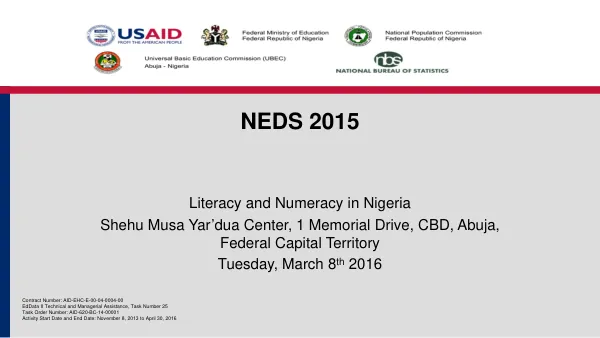
NEDS 2015: Literacy and Numeracy in Nigeria
Literacy in Nigeria among children aged 6-16 has shown improvement between 2010 and 2015.
2016 · 20 pages
Sign in to readA free account is required to download.
Abstract
According to data, 10% of children in this age group were literate in 2010, while this number increased to 54% in 2015. The literacy rate varies by schooling status, with 23% of children with no schooling being literate in 2015, compared to 48% of those with primary education and 54% of those with junior secondary school and higher education. The literacy rate also differs by residence, with urban areas showing higher literacy rates compared to rural areas. In 2015, 40% of children in urban areas were literate, while this number was 20% in rural areas. The literacy rate also varies by wealth quintile, with 80% of children from the highest wealth quintile being literate in 2015, compared to 10% from the lowest wealth quintile. Literacy rates also vary by zone, with the North East and North West zones showing the lowest literacy rates in 2015. The North East zone had a literacy rate of 10% in 2015, while the North West zone had a literacy rate of 20%. The South West zone had the highest literacy rate of 80% in 2015. The literacy rate also varies by state, with some states showing significant improvements between 2010 and 2015. For example, the literacy rate in the Federal Capital Territory (FCT) increased from 10% in 2010 to 60% in 2015. The literacy rate in some states, such as Kano and Kano, also showed significant improvements between 2010 and 2015. Literacy rates among children attending formal education have also shown improvement between 2010 and 2015. According to data, the percentage of children who can read one or more words increased from 10% in 2010 to 90% in 2015. The literacy rate varies by class, with early childhood education (ECE) showing the lowest literacy rate of 0% in 2010, compared to 100% in 2015. The literacy rate also varies by class, with primary 1 (P1) showing a literacy rate of 20% in 2010, compared to 80% in 2015. The data also shows that the literacy rate among children attending formal education has increased over time. For example, the percentage of children who can read one or more words increased from 10% in 2010 to 90% in 2015. The literacy rate also varies by class, with ECE showing the lowest literacy rate of 0% in 2010, compared to 100% in 2015.
Related documents