MINISTRY OF EDUCATION
Nepal Country Profile
Nepal, a landlocked country in the Himalaya mountain range, faces significant development challenges.
2013 · 2 pages
Sign in to readA free account is required to download.
Abstract
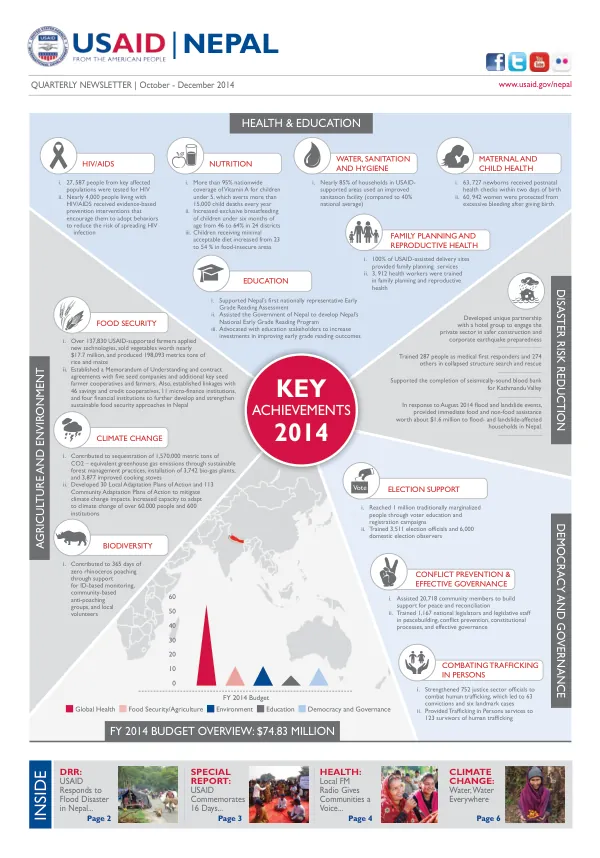
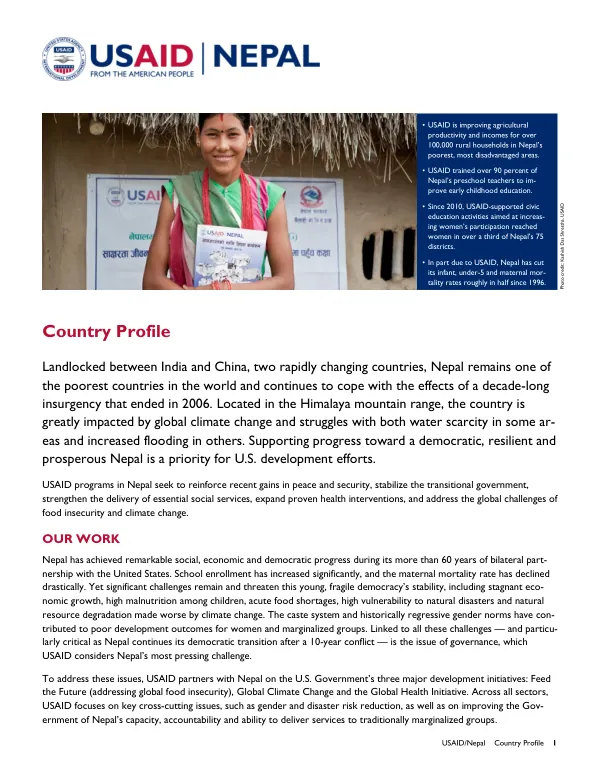
The country has made progress in peace and security, social services, and health, but remains one of the poorest in the world. Nepal's population of over 30 million people relies heavily on agriculture, with more than 75% of the population depending on it for their livelihoods. However, low productivity and limited market access hinder economic growth, leading to the outmigration of young men. USAID's efforts in Nepal focus on addressing these challenges through the Feed the Future initiative, which aims to sustainably improve agricultural productivity and nutrition for over 1 million vulnerable Nepalis. The initiative targets key areas, including improving access to quality seeds, credit, and other inputs, increasing incomes, enhancing market linkages, and improving nutrition, hygiene, and sanitation, particularly among women and children under 5. Additionally, USAID works to address agriculture policy reform and the trade and investment climate to improve Nepal's business enabling environment. In the health sector, USAID supports Nepal's efforts to provide quality basic health services to its citizens, particularly those living in poverty. The agency's assistance focuses on proven interventions to reduce deaths of mothers, infants, and children, and expands these practices to all 75 districts in the country, with a focus on the most remote areas. USAID's programs reach an estimated 7.1 million people with direct services, including nutrition, family planning and reproductive health, maternal, neonatal, and child health, water and sanitation, HIV/AIDS, support for disabled people, and disaster preparedness. USAID also works to increase consumer awareness and demand for quality health products and supports Nepalese businesses that seek to manufacture and sell these products. In education, the agency places new emphasis on improving primary grade reading as the foundation for future learning, working together with the Ministry of Education to help young children acquire strong reading skills in grades one to three. Furthermore, USAID promotes good governance by helping key institutions, such as the Election Commission and political parties, become more democratic, effective, and inclusive of all citizens. USAID's efforts in Nepal have achieved significant results, including a 27% increase in household income among program participants compared to the control group. Additionally, USAID's support for the National Vitamin A Supplementation campaign has reached 3.6 million children ages 6 months to 5 years, averting roughly 15,000 deaths each year.