GOVERNMENT OF SENEGAL
USAID Commemorates 16 Days of Activism Against Gender-Based Violence in Nepal
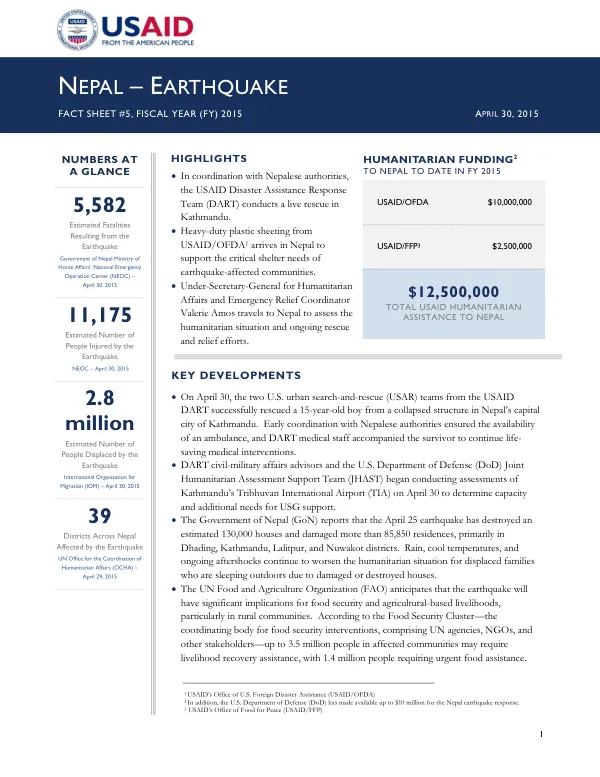
Disaster Risk Reduction: USAID Responds to Flood Disaster in Nepal The torrential mid-summer monsoon rains triggered massive floods and landslides in Nepal, affecting an estimated 200,000 people.
2014 · 8 pages
Sign in to readA free account is required to download.
Abstract
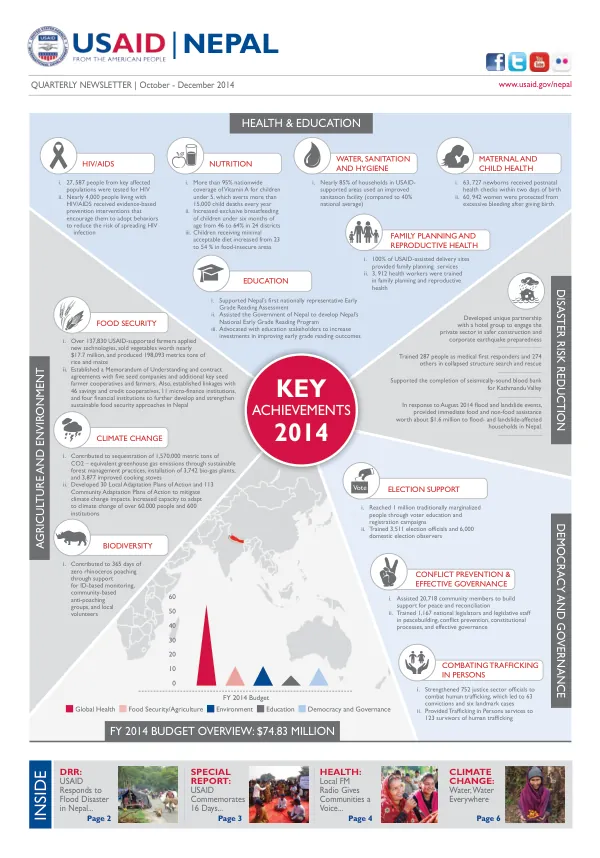
The Red Cross estimated that approximately 150,000 people were displaced, with many families losing their homes and food supplies. In response, USAID provided immediate food and non-food assistance worth about $1.6 million to flood- and landslide-affected households in Nepal. Food Assistance: USAID provided food assistance through the UN World Food Program (WFP), distributing locally procured food to over 150,000 flood-affected people in the most severely flooded districts of Bardiya, Banke, Surkhet, and Dang. The contribution also supported targeted food or cash for work that promoted early recovery in the affected areas. WFP worked under the Government of Nepal's Disaster Response Committees and with the Nepal Red Cross Society to ensure timely distributions to the most needy. Non-Food Assistance: As part of its ongoing Disaster Risk Reduction effort, USAID pre-positioned emergency relief supplies that were immediately distributed to flood-affected households. These included plastic tarpaulins, blankets, clothes, and kitchen and household utensils. USAID contributed about $540,000 in non-food assistance. Protecting Vulnerable Women and Children: USAID provided an additional $190,000 to increase protection for vulnerable women and children in three flood-affected districts of Nepal: Banke, Bardiya, and Surkhet. USAID supported Save the Children in Nepal to provide psycho-social support to vulnerable women and children, identify and reunite or refer unaccompanied minors, and train health and education providers and communities on how to respond to abuse, exploitation, and psycho-social distress. Helping Flood-Affected Farmers: The landslides and floods affected an estimated 844 hectares of crops upon which 2,929 households in the six Mid- and Far-Western districts depend. In response, USAID purchased 73.65 tons of wheat seed from two Nepal-based companies and delivered it to 2,929 farmers. This action allowed these farmers to plant commercial wheat crops and rebuild their livelihoods for the next agriculture season. An Early Warning System to Protect Communities from Floods: USAID announced a project titled 'Strengthening Flood Resilience in Kankai River Basin' to establish an innovative early warning system in Nepal's eastern flood-prone areas. The project will benefit over 5,600 people in the region and address the lack of systematic flood forecasting systems in the Kankai River Basin. The project will establish a community-centered flood early warning system that integrates Flood Forecasting Guidance System technologies, train communities and other stakeholders on early warning and response to floods, and develop new flood and rainfall monitoring stations. Key Achievements in 2014: USAID contributed to sequestration of 1,596,000 metric tons of CO2 – equivalent greenhouse gas emissions through sustainable forest practices, installation of 3,742 bio-gas systems, and 3,877 improved cooking stoves. USAID also developed 46 Local Adaptation Plans of Action and 113 Community Adaptation Plans of Action to mitigate climate change impacts, increasing the capacity to adapt to climate change of over 60,000 people and 600 institutions. Health: USAID supported the development of Nepal's National Early Grade Reading Assessment and assisted the Government of Nepal to develop Nepal's National Early Grade Reading Program. USAID also trained 3,912 health workers in family planning and reproductive health. Education: USAID supported Nepal's first nationally representative Early Grade Reading Assessment and assisted the Government of Nepal to develop Nepal's National Early Grade Reading Program. USAID also advocated with education stakeholders to increase investments in improving early grade reading outcomes. Conflict Prevention and Effective Governance: USAID supported the development of Nepal's National Early Grade Reading Assessment and assisted the Government of Nepal to develop Nepal's National Early Grade Reading Program. USAID also trained 1,597 national legislators and legislative staff in peacebuilding, conflict prevention, and effective governance. Combating Trafficking in Persons: USAID supported the development of Nepal's National Early Grade Reading Assessment and assisted the Government of Nepal to develop Nepal's National Early Grade Reading Program. USAID also trained 1,597 national legislators and legislative staff in peacebuilding, conflict prevention, and effective governance. Maternal and Child Health: USAID supported the development of Nepal's National Early Grade Reading Assessment and
Related documents