USAID DEC
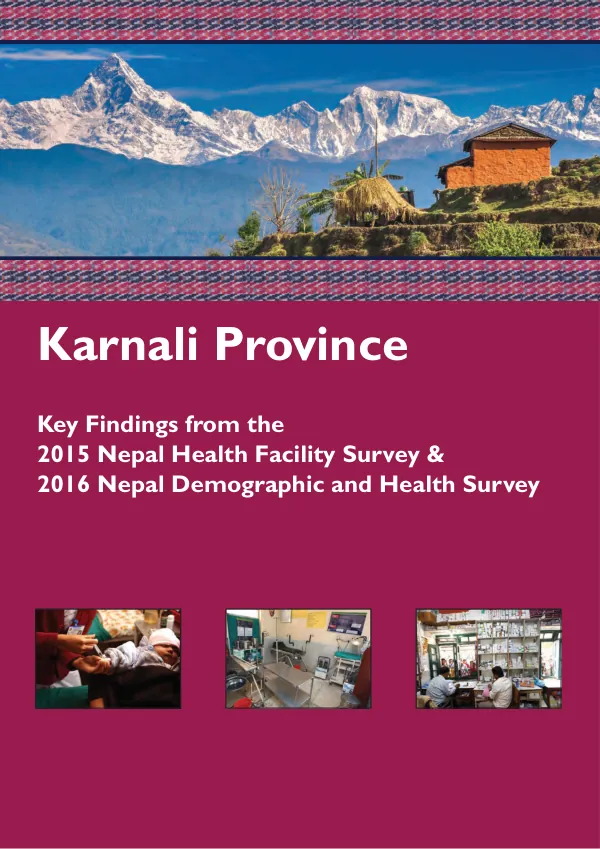
Karnali Province - Key Findings from the 2015 Nepal Health Facility Survey & 2016 Nepal Demographic and Health Survey
Sign inDEPARTMENT FOR INTERNATIONAL DEVELOPMENT
Karnali Province - Key Findings from the 2015 Nepal Health Facility Survey & 2016 Nepal Demographic and Health Survey
The 2015 Nepal Health Facility Survey (NHFS) and the 2016 Nepal Demographic and Health Survey (NDHS) were conducted to provide data for planning, monitoring, and evaluating population and health programs in Nepal.
2019 · 80 pages
Sign in to readA free account is required to download.
Abstract
The surveys were designed to be representative at the national level, as well as for 3 ecological regions, 14 highly earthquake-affected districts, and 13 eco-development zones. The 2015 NHFS sampled 1,000 facilities throughout Nepal, while the 2016 NDHS interviewed a nationally representative sample of 12,862 women age 15-49 and 4,063 men age 15-49. The 2015 NHFS collected information from formal-sector health facilities on the delivery of health care services and examined the preparedness of facilities to provide quality health services. The survey used five types of questionnaires, including a facility inventory questionnaire, health provider interview questionnaire, observation protocol of consultations of sick children, antenatal care, and family planning clients, client exit interview questionnaires, and health facility operation and management committee/hospital development committee member interview questionnaire. The survey was designed to be representative for the 13 eco-development zones, thus all indicators are also representative at the provincial level. In Karnali Province, data were successfully collected from a weighted total of 74 facilities, of which 72 were public facilities and 2 were private/other facilities. The 2016 NDHS was designed to provide data for monitoring the population and health situation in Nepal. The survey used five types of questionnaires, including a household questionnaire, woman's questionnaire, man's questionnaire, biomarker questionnaire, and verbal autopsy questionnaire. In Karnali Province, data were collected from 619 households, 724 women age 15-49, and 203 men age 15-49. The 2015 NHFS found that the number of health facilities surveyed in Nepal was 963, with 871 public facilities and 92 private/other facilities. In Karnali Province, the number of health facilities surveyed was 74, with 72 public facilities and 2 private/other facilities. The 2016 NDHS found that the number of households surveyed in Nepal was 11,040, with 619 households in Karnali Province. The survey also found that the number of women age 15-49 interviewed in Nepal was 12,862, with 724 women in Karnali Province. The 2015 NHFS collected data on the delivery of health care services, including antenatal care, family planning, and curative care for sick children. The survey found that 2,186 sick children, 772 family planning clients, and 1,509 antenatal care consultations were observed. The 2016 NDHS collected data on fertility levels and preferences, marriage, sexual activity, family planning methods, breastfeeding practices, nutrition, anemia, childhood and maternal mortality, maternal and child health, HIV/AIDS and other STIs, women's empowerment, domestic violence, and hypertension. The 2015 NHFS found that the preparedness of health facilities to provide quality health services was a major concern. The survey found that many health facilities lacked essential equipment and supplies, and that many health workers were not trained to provide quality health services. The 2016 NDHS found that fertility levels and preferences were a major concern in Nepal. The survey found that many women in Nepal were not using modern family planning methods, and that many women were experiencing high levels of domestic violence. The 2015 NHFS recommended that the government of Nepal should prioritize the strengthening of health facilities and the training of health workers. The survey also recommended that the government should increase funding for health care services and provide essential equipment and supplies to health facilities. The 2016 NDHS recommended that the government of Nepal should prioritize the reduction of fertility levels and the promotion of modern family planning methods. The survey also recommended that the government should increase funding for programs that address domestic violence and women's empowerment.
Related documents
![Changes in Service Availability, Readiness, Process of Care, and Client Satisfaction with Family Planning Services: A Comparison between the 2015 and 2021 Nepal Health Facility Surveys (FA147) - Analysis Brief [AB41]](https://covers.devme.ai/gen/138852.webp)
![Changes in Service Availability, Readiness, Process of Care, and Caregiver Satisfaction with Child Curative Services: A Comparison between the 2015 and 2021 Nepal Health Facility Surveys (FA146) - Analysis Brief [AB39]](https://covers.devme.ai/gen/145170.webp)