GOVERNMENT OF SENEGAL
Nepal Health Sector Programme-II (NHSP-II)
The Nepal Health Sector Programme-II (NHSP-II) was implemented from 2010 to 2015.
2010 · 160 pages
Sign in to readA free account is required to download.
Abstract
The programme aimed to improve the health status of the Nepalese population, with a focus on reducing mortality and morbidity rates. The programme was led by the Ministry of Health and Population, Government of Nepal, with funding and technical assistance from various international partners. The NHSP-II built on the successes of the previous programme, NHSP-I, which had achieved significant improvements in health outcomes. However, the new programme identified several challenges that needed to be addressed, including the need to increase access to and utilization of essential health care services, decentralize management of health facilities, and strengthen public-private partnerships. The programme's vision was to create a healthy and productive population, with a focus on improving the health status of women, children, and marginalized communities. The mission was to provide accessible, equitable, and quality health care services to all citizens, with a focus on reducing health inequities. The programme's strategies included increasing access to essential health care services, improving the quality of care, and strengthening the health system. The programme also focused on improving the health status of women, children, and marginalized communities, with a focus on reducing maternal and child mortality rates. The programme's key interventions included the provision of essential health care services, including family planning, safe motherhood, adolescent sexual and reproductive health, newborn care, child health, communicable disease control, non-communicable disease control, health education and communication, oral health care, environmental health and hygiene, and curative services. The programme also included humanitarian response and emergency and disaster management, as well as the promotion of Ayurvedic and alternative medicine. The programme recognized the important role of non-state actors, including the private for-profit sector and the not-for-profit non-state sector, in improving health outcomes. The programme sought to strengthen partnerships with these actors, with a focus on improving the quality and accessibility of health care services. The programme's structure and systems were designed to support the implementation of its strategies and interventions. The programme established a strong governance framework, with clear roles and responsibilities for different stakeholders. The programme also established a robust financial management system, with a focus on transparency and accountability. The programme's impact was significant, with improvements in health outcomes and increased access to health care services. The programme's success was attributed to its strong governance framework, its focus on improving the health status of marginalized communities, and its commitment to strengthening partnerships with non-state actors.
Related documents
Documents in this collection
 2021
2021USAID DEC
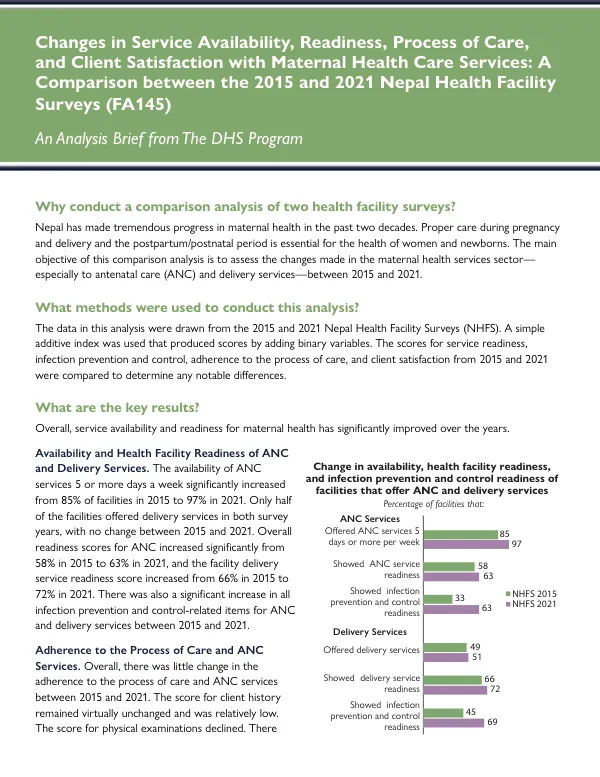
Changes in Service Availability, Readiness, Process of Care, and Client Satisfaction with Maternal Health Care Services: A Comparison between the 2015 and 2021 Nepal Health Facility Surveys (FA145) - Analysis Brief
Open record 2021
2021USAID DEC
![Changes in Service Availability, Readiness, Process of Care, and Client Satisfaction with Family Planning Services: A Comparison between the 2015 and 2021 Nepal Health Facility Surveys (FA147) - Analysis Brief [AB41]](https://covers.devme.ai/gen/138852.webp)
![Changes in Service Availability, Readiness, Process of Care, and Caregiver Satisfaction with Child Curative Services: A Comparison between the 2015 and 2021 Nepal Health Facility Surveys (FA146) - Analysis Brief [AB39]](https://covers.devme.ai/gen/145170.webp)