NORC AT THE UNIVERSITY OF CHICAGO
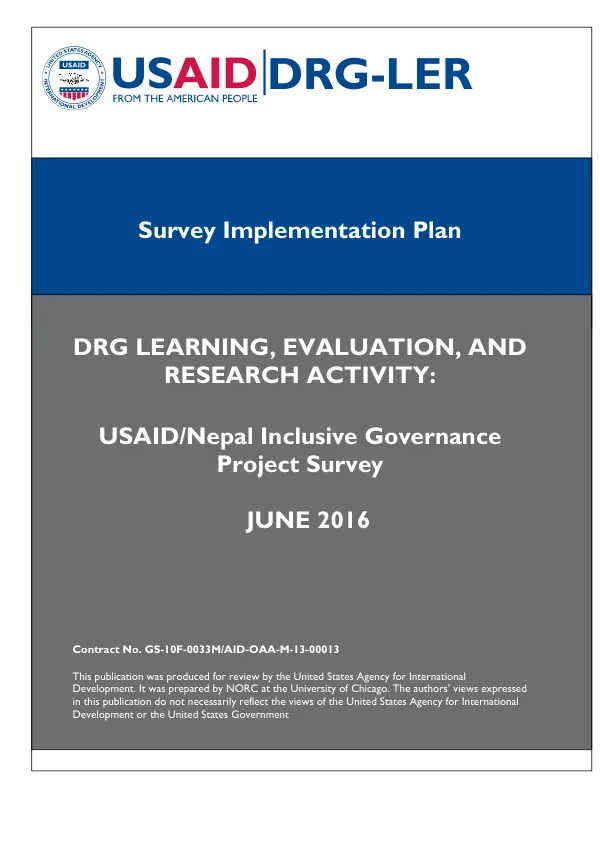
Nepal IGP Survey Implementation Plan
The USAID/Nepal Inclusive Governance Project Survey was conducted to assess the effectiveness of USAID programs in increasing inclusion of Nepalis in political life and improving the government's ability to respond to their needs and demands.
2016 · 10 pages
Sign in to readA free account is required to download.
Abstract
The survey was an extensive individual interview, conducted in person, and comprised scaled opinion questions on various topics. The baseline round of the survey was conducted between November 28, 2015, and January 5, 2016, with the bulk of interviews taking place in December. The survey was designed to assess the extent to which USAID programs had effectively increased inclusion of Nepalis in political life and improved the government's ability to respond to their needs and demands, with particular focus on marginalized groups like women, youth, certain castes, and inhabitants of the Terai region. The survey used a household-based cluster sampling method to select the required sample from among the total population. The sampling frame was the list of all wards in Nepal from the 2011 population census. Primary sampling units (PSUs) or wards (clusters) were selected using probability proportional to size, where the chosen measure of size was the number of households in each ward. The sample size was determined based on various factors, including expected precision, probability of chosen error, and expected prevalence rate. The required sample size for the national study was 768 households, but it was proposed to split the country into representative sub-national levels or strata based on administrative region and geo-climatic region. The sample was split into strata based on two criteria: administrative region (Eastern, Central, Western, Mid- and Far Western), and geo-climatic region (Terai, hills and mountains). A three-stage stratified sampling procedure was proposed to select the sample. In the first stage, wards/clusters were selected independently in each stratum using probability proportional to size. In the second stage, a location was randomly selected within the ward using election polling booth as the reference point. In the final stage, 15 households were randomly selected from each penultimate sampling unit. Quota selection within a household was based on a practical method of quota sampling. A common approach was to interview a female in half of all households and a male in the other half. Age-based quotas were also applied to ensure a good balance of old and young people. A simple method of interviewing the oldest person (male or female based on first selection criteria) in the household and the youngest eligible person in the other half of the households provided for best possible representation across age groups and gender. The questionnaire development and pilot test involved using a structured English questionnaire draft provided by USAID to collect data. Apart from demographic information of the respondents, the instrument included questions on their perception on inclusive and effective governance, current political environment, opinions on current peace process/local conflict, electoral process, accountability of various government institutions, and other related topics. The proposed timeline for the survey implementation was presented on page 8 of the report. The baseline survey was conducted between November 28, 2015, and January 5, 2016, with the bulk of interviews taking place in December. The survey was implemented by Solutions Consultant, a data collection subcontractor. The survey reliability was improved by selecting a larger number of PSUs with smaller cluster sizes. The distribution of clusters based on the population is given in the following table: Cluster Allocation based on the population distribution for national survey | Region | Mountain | Hill | Terai | Total | | --- | --- | --- | --- | --- | | Far Western Region | 1 | 2 | 2 | 5 | | Mid-Western Region | 1 | 3 | 3 | 7 | | Western Region | 1 | 5 | 4 | 10 | | Central Region | 1 | 9 | 9 | 19 | | Eastern Region | 5 | 22 | 25 | 52 | The survey was designed to assess the effectiveness of USAID programs in increasing inclusion of Nepalis in political life and improving the government's ability to respond to their needs and demands. The survey results will provide valuable insights into the current state of inclusive governance in Nepal and inform future programming and policy decisions.