USAID DEC
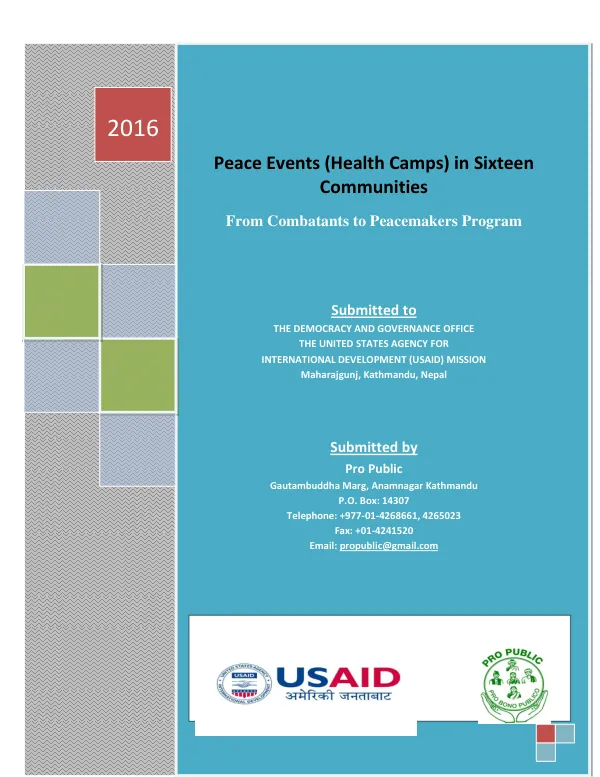
Peace Events (Health Camps) in Sixteen Communities: From Combatants to Peacemakers Program
Sign inUSAID
Peace Events (Health Camps) in Sixteen Communities: From Combatants to Peacemakers Program
The Combatants to Peacemakers Program, implemented by Pro Public in collaboration with the United States Agency for International Development (USAID), aimed to promote peace and reconciliation in Nepal.
2016 · 45 pages
Sign in to readA free account is required to download.
Abstract
The program focused on organizing peace events, including health camps, in 16 communities across 12 districts. The health camps were designed to provide medical services, psychosocial support, and create opportunities for community members to interact and foster social harmony. The health camps were organized in collaboration with local government bodies, health offices, national medical colleges, and other stakeholders. A total of 4996 individuals, including 1033 males and 3963 females, received services from the health camps under various categories. The program was successful in engaging women and marginalized groups, with a high participation rate from these demographics. The health camps provided services in three major categories: general, gynecological, and psychosocial. In addition to providing medical services, the events created opportunities for community members to interact with each other, fostering social harmony and peace. Feedback from participants indicated that the program was well-organized and beneficial, with 80% of respondents rating the overall performance of the health camps as excellent or good. The program's effectiveness in creating a space for people to meet and enhance relationships was also evident, with 81% of respondents indicating that the health camps were effective in bridging gaps among people in society. The high degree of effectiveness of the health camp aspect of the program demonstrates its potential as a tool for promoting peace and reconciliation in Nepal. The program's success can be attributed to the collaboration with local stakeholders, including local government bodies, health offices, national medical colleges, and community organizations. The program's focus on engaging women and marginalized groups also contributed to its success, as these demographics were actively involved in the program. The health camps were organized in various locations, including Nepalgunj Medical College, Kohalpur; Universal Medical College, Birgunj; National Medical College, Bhairahawa; B.P. Koirala Institute of Health Sciences, Dharan; and Chitwan Medical College, Bharatpur. The program's success was also facilitated by the support of district health offices, health posts, pharmaceutical companies, and associations of medicine suppliers. The program's impact was not limited to providing medical services, but also created opportunities for community members to interact and foster social harmony. The feedback from participants indicated that the program was well-organized and beneficial, with a high degree of effectiveness in creating a space for people to meet and enhance relationships. The program's success can be replicated in other communities, with the potential to promote peace and reconciliation in Nepal. The program's focus on engaging women and marginalized groups, as well as its collaboration with local stakeholders, contributed to its success. The program's effectiveness in creating a space for people to meet and enhance relationships demonstrates its potential as a tool for promoting peace and reconciliation in Nepal. The program's impact was also evident in the feedback from participants, with 80% of respondents rating the overall performance of the health camps as excellent or good. The program's effectiveness in creating a space for people to meet and enhance relationships was also evident, with 81% of respondents indicating that the health camps were effective in bridging gaps among people in society.