FUTURES GROUP INTERNATIONAL, LLC
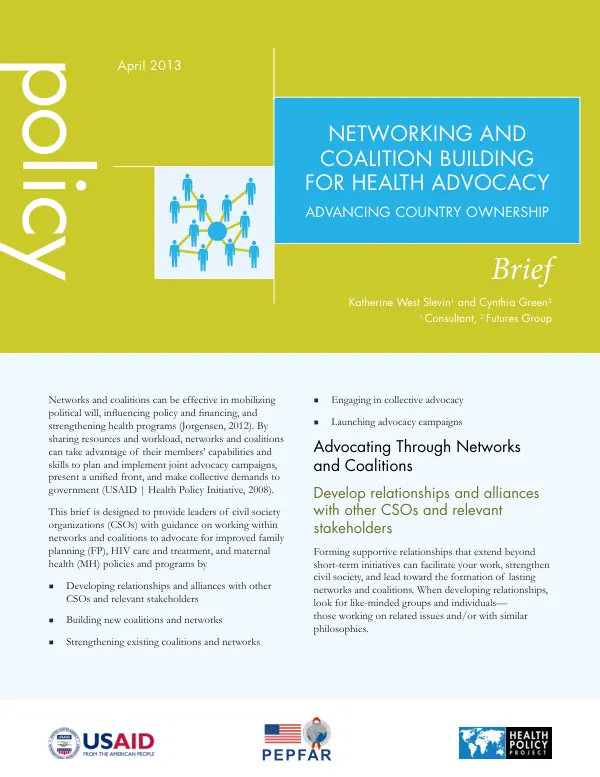
Networking and Coalition Building for Health Advocacy
Networking and coalition building are essential strategies for health advocacy, particularly in advancing country ownership.
2013 · 11 pages
Sign in to readA free account is required to download.
Abstract
Effective networks and coalitions can mobilize political will, influence policy and financing, and strengthen health programs. By sharing resources and workload, networks and coalitions can take advantage of their members' capabilities and skills to plan and implement joint advocacy campaigns, present a unified front, and make collective demands to government. Developing relationships and alliances with other civil society organizations (CSOs) and relevant stakeholders is crucial for building strong networks and coalitions. This involves forming supportive relationships that extend beyond short-term initiatives, facilitating work, strengthening civil society, and leading toward the formation of lasting networks and coalitions. When developing relationships, it is essential to look for like-minded groups and individuals working on related issues and/or with similar philosophies. Exploring the landscape is the first step in building networks and coalitions. This involves mapping out the organizations already working on the issue and identifying potential groups and allies. Talking with partners, reviewing websites of possible partners, and conducting stakeholder analysis can help determine the interests of various groups and gauge their potential impact on the issue. Meeting key stakeholders, introducing oneself and one's organization to networks and coalitions, and discussing what can be gained and offered are also essential steps. Joining existing networks and coalitions can help capitalize on previously mobilized groups of credible operators that can help move the agenda forward, establish trust, and introduce new stakeholders to the issue. Cultivating relationships with decisionmakers, such as policymakers and technical advisors, can also facilitate engagement and influence policy and financing. Building new networks and coalitions requires identifying key stakeholders and organizations that should be included, approaching potential members, and demonstrating the benefits of working together. Bringing together people from different sectors and topic areas can broaden support for the issue, ensure work is informed by diverse perspectives, and leverage a greater number of resources and skills. Establishing a common purpose, setting priorities, and clarifying expectations is essential for the success of any coalition. Strong leadership, diplomatic leaders who can bridge power structures and bring together stakeholders with diverse views, is also critical. Operating systems, such as communication, decision-making, and monitoring systems, are necessary to ensure the group functions smoothly and in a transparent manner. Involving disadvantaged, vulnerable, and marginalized populations in coalitions and networks can help build their skills and better understand their issues. Participatory methods, such as incorporating representatives from these groups into forums and meetings, can also encourage broad participation. The Global Forum on MSM & HIV is an example of a successful coalition that has organized a diverse range of stakeholders around a common cause. The forum has established a governance structure, supports networking opportunities, implements capacity-building initiatives, and publishes individual country information. Strengthening existing networks and coalitions requires ongoing capacity building, exploring and addressing barriers to participation, partnering with experienced groups, and continuously seeking out opportunities to connect with other CSOs. Promoting active participation, communicating with members, and exploring what facilitates and hinders their participation are essential steps in maintaining momentum and relevance.
Related documents