USAID DEC
Newborn Health and Survival: The adaptation and implementation of updated newborn guidelines to the Myanmar context
Sign inGOVERNMENT OF INDONESIA
Newborn Health and Survival: The adaptation and implementation of updated newborn guidelines to the Myanmar context
The Maternal & Child Survival Program (MCSP) worked closely with the government of Myanmar to adopt and implement updated guidelines for improving newborn health and survival in Myanmar.
2018 · 7 pages
Sign in to readA free account is required to download.
Abstract
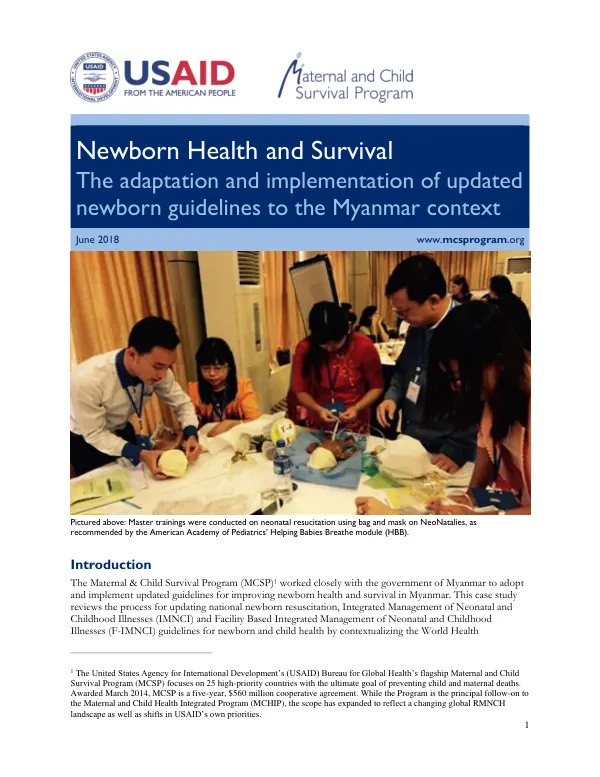
The program focused on adapting and implementing updated newborn guidelines to the Myanmar context, with a particular emphasis on reducing the neonatal mortality rate (NMR). Myanmar has the second-highest under-five mortality rate (U5MR) among ASEAN countries, and significant strides have been made in halving the under-five mortality rate and infant mortality rate (IMR) over the past 15 years. However, progress on reducing the NMR has been much slower. The contribution of newborn deaths to under-five deaths increased from 47% in 2011 to 53% in 2015, according to Countdown to 2015's reports in 2013 and 2015. Causes of newborn deaths contributed to about 48% of causes of under-five deaths in Myanmar, with 89% of the causes being preventable and treatable. The coverage of many basic, essential interventions for newborns in Myanmar is not universal, with rates of institutional delivery, exclusive breastfeeding, and skilled birth attendant varying across different regions. To address these challenges, the Myanmar government developed and formulated the Myanmar Every Newborn Action Plan (MENAP) 2014-2020, which led to the modification of existing interventions and the introduction of new interventions. The use of bag and mask for neonatal resuscitation and the application of chlorhexidine on the umbilical cord were two particularly notable interventions introduced through MENAP. The Ministry of Health and Sports (MOHS) approved and launched a package of high-impact evidence-based interventions for implementation to address high neonatal mortality in Myanmar. The package included interventions such as immediate thermal care, early initiation of exclusive breastfeeding, hygienic cord and skin care, and neonatal resuscitation. To implement these interventions, the capacity of health care providers to provide quality services using various training packages was built, based on different levels of the health system. The process used to adapt these packages involved a review and revision process of contextualizing global modules for Myanmar, led by the Lead Child Health Working Group (LCHWG) in Myanmar, alongside neonatologists, the Expanded Program on Immunization (EPI), WHO, UNICEF, and 3MDGs. The rollout of national newborn packages and effective rollout of Training of Trainers (TOTs) involved international consultants from AAP, Save the Children, and Laerdal conducting a training of master trainers, which included pediatricians from tertiary level hospitals and doctors from state and regional health departments. These master trainers then conducted multiplier trainings for pediatricians and public health representatives at the district levels. Neonatal resuscitation trainings, with bag and mask, were also conducted for midwives at the township level. The government procured and provided neonatal resuscitation bag and mask devices to all midwives at Sub-Rural Health Centers (SRHCs) and Rural Health Centers (RHCs) in the first year of implementation. For monitoring purposes, Midwives for Continuous Medical Education (CME) used performance assessment checklists to assess the performance of neonatal resuscitation, and township departments were directed to work on these assessments until all midwives could perform neonatal resuscitation skillfully. In addition, information related to neonatal resuscitation was collected from each township quarterly. The Learning and Performance Improvement Centers (L&PICs) were established in Ayeyarwaddy, Magway, Rakhine, Southern and Northern Shan states, with BHS from six selected townships in these states and regions being trained with updated day-of-birth modules. A post-training follow-up plan was also developed to ensure the effectiveness of these training. Currently, capacity-building plans to train BHS on updated IMNCI are being scaled-up with support from the World Bank.