USAID DEC
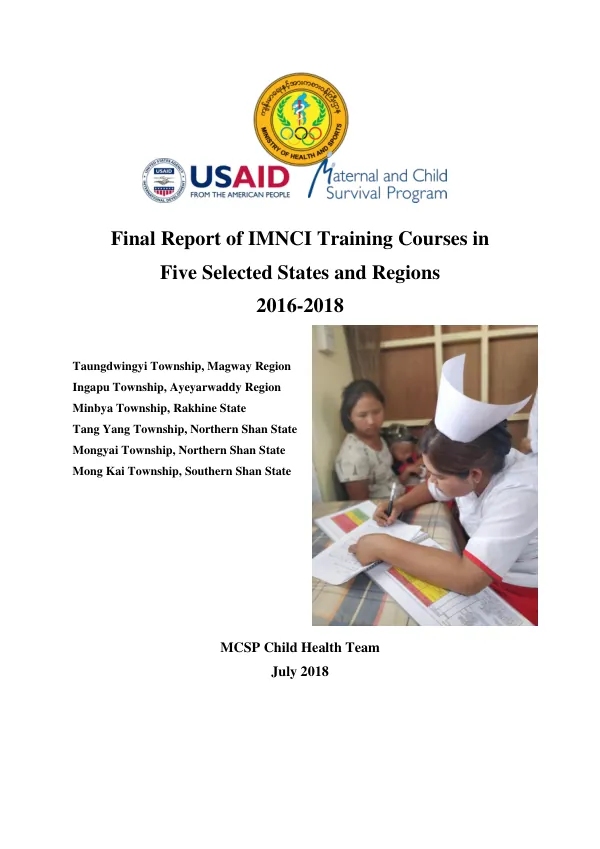
Final Report of IMNCI Training Courses in Five Selected States and Regions 2016-2018
Sign inUNITED NATIONS CHILDREN'S FUND
Final Report of IMNCI Training Courses in Five Selected States and Regions 2016-2018
The Integrated Management of Neonatal and Childhood Illness (IMNCI) strategy was introduced in Myanmar in 1999, with the neonatal component formally incorporated as IMNCI in 2011.
2018 · 79 pages
Sign in to readA free account is required to download.
Abstract
The IMNCI modules used in Myanmar training were updated in 2017, based on the updated WHO IMNCI guidelines. The IMNCI strategy aims to give under 5 children a better quality of life by promoting both preventive and curative child care, and is implemented by the Basic Health Staff (BHS), in partnership with the families and community. The strategy also includes improvement of health infrastructure, such as drugs and commodity management, patient data recording, documentation and reporting systems. In the Myanmar National Demographic Health Survey (2015-16), the under-5 mortality rate was reported as 50/1000 live births, infant mortality rate was 40/1000 live births, and neonatal mortality rate was 25/1000 live births. The Millennium Development Goal No. 4 aimed to reduce under-5 mortality to 37 per 1000 live births and infant mortality to 28 per 1000 live births by 2015 in Myanmar. However, in 2016, both U5MR and infant mortality rate in Myanmar were higher than the global rates of 40.8 per 1000 live births for U5MR and 30.5 per 1000 live births, although all three mortality rates (under-5, infant, and neonatal) declined in Myanmar from 2011 to 2016. The IMNCI strategy is an integrated approach to child health that intends to reduce death, illness, and disabilities and promote proper growth and development among under 5 children through both preventive and curative activities. The approach is mainly focused on improving case management skills of health care providers, improving family and community health practices, and improving overall health systems. Since 2007, neonatal health has been added to the IMCI approach as one of the essential components to address overall mortality and morbidity of under 5 children. The IMNCI strategy is implemented in Myanmar through a training cascade, which includes Central Master Training of Trainers (MTOT), State and Regional ToT training, Township-level multiplier training, and post-training supervision visits. The training focuses on improving the skills of Basic Health Staff (BHS) in the management of childhood illnesses, including neonatal care. The training also includes the use of updated IMNCI guidelines and the implementation of the IMNCI strategy in the community. The training was conducted in five selected states and regions, including Magway Region, Ayeyarwaddy Region, Rakhine State, Northern Shan State, and Southern Shan State. The training was attended by Basic Health Staff (BHS) from the selected states and regions, and the training was conducted by Master Trainers from the Central MTOT. The training included both theoretical and practical components, and the participants were assessed through pre- and post-test scores. The post-training supervision visits were conducted to assess the implementation of the IMNCI strategy in the community. The supervision visits included assessment of clinical skills management, infrastructure, and drug stock management. The results of the post-training supervision visits showed that the Basic Health Staff (BHS) had improved their skills in the management of childhood illnesses, including neonatal care. The supervision visits also showed that the IMNCI strategy was being implemented in the community, and the health infrastructure was being improved. The IMNCI strategy is a key component of the Maternal and Child Survival Program (MCSP) in Myanmar, which aims to reduce child and maternal mortality through the implementation of high-impact health interventions. The IMNCI strategy is being implemented in partnership with the Ministry of Health and Sports (MOHS) and the Child Health Development Division (CHD). The strategy is being implemented in all states and regions of Myanmar, and the training cascade is being conducted to ensure that all Basic Health Staff (BHS) are trained in the IMNCI strategy.