GOVERNMENT OF INDONESIA
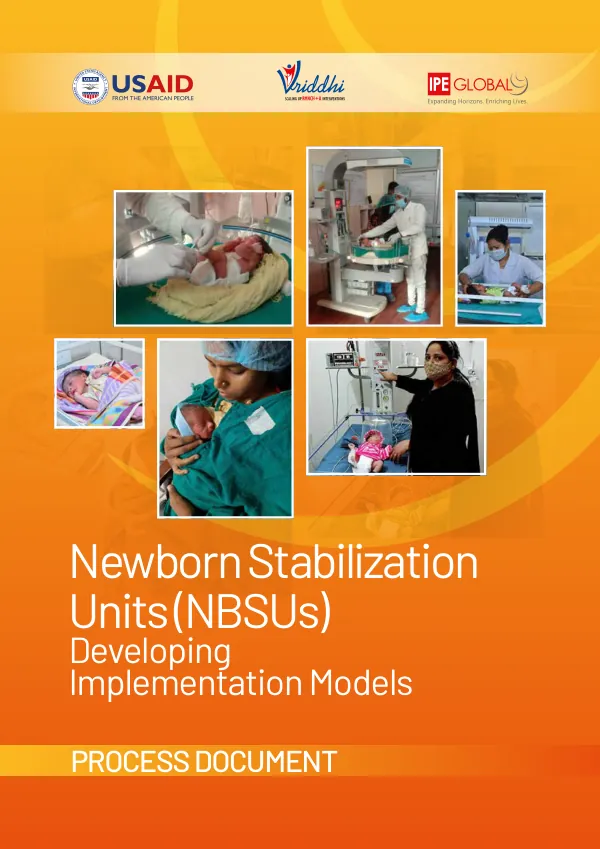
Newborn Stabilization Units (NBSUs) Developing Implementation Models
Newborn Stabilization Units (NBSUs) are public health facilities that provide intermediary care for newborns at the sub-district level.
2021 · 38 pages
Sign in to readA free account is required to download.
Abstract
These units are crucial in improving newborn survival and decongesting Special Newborn Care Units (SNCUs) at district hospitals by freeing up space for more severe cases. However, NBSUs have remained poorly operational due to a lack of training guidelines, human resources, and equipment. The Vriddhi project demonstrated an implementation model to revitalize NBSUs in aspirational districts of four states: Jharkhand, Uttarakhand, Punjab, and Haryana. A rapid gap assessment of NBSUs was conducted in the first quarter of 2018, which formed the basis of selecting 15 NBSUs for the intervention. The state governments were then provided with the necessary human resources, equipment, and infrastructure as per the Government of India's operational guidelines. A three-day training package was developed for NBSU staff by the project in collaboration with the Ministry of Health and Family Welfare, Government of India. The training package included manuals for participants and facilitators, and staff from the selected 15 NBSUs received training consisting of interactive lectures, skill stations, and clinical visits to newborn units. As the NBSUs became operational, they started admitting newborns for phototherapy and graduated to admitting newborns for feeding and warmer support over time. The NBSUs began stabilizing newborns before referral to higher centers or SNCUs. Vriddhi District Technical Officers followed up and handed over support to NBSU staff. In Jharkhand state, mentors from the Maternal and Newborn Health Resource Center established at RIMS, Ranchi, supported NBSUs to improve their performance. During the COVID-19 pandemic, digital platforms such as Zoom and WhatsApp were used to continue providing support to the NBSUs. State governments of Jharkhand and Haryana requested Vriddhi's technical support for scaling up NBSUs to other First Referral Units (FRUs). Vriddhi's support mainly included trainings and documentation. Responding to a request from the National Health Mission - Government of Assam, Vriddhi conducted a rapid assessment of NBSUs in the state in the last quarter of 2020, and trainings are planned in the first quarter of 2021. Increasing awareness of newborn care resulted in a rise in newborn hospitalization. Often, SNCUs are filled with sick but stable newborns who could be managed at NBSUs. Thus, it is imperative to operationalize NBSUs in all districts to decongest SNCUs, assess, triage, and stabilize newborns before referral, and thereby improve survival of newborns. The Government of India has adopted Vriddhi's training package for NBSUs with minor modifications. Most states have included NBSUs in their annual Program Implementation Plans (PIP) and have started mobilizing resources through the PIPs. Newborn care is a national priority, reflected in the Government of India's efforts to strengthen newborn care and accelerate the pace of reducing Newborn Mortality Rate (NMR). The Facility-Based Newborn Care (FBNC) guidelines introduced by the Government of India in 2011 provided directions on the appropriate management of small and sick newborns at District Hospitals (DH) and all delivery points. A three-tier structure was proposed; the first level of care called Newborn Care Corners (NBCCs) is located in every Labor Room (LR) and maternity Operation Theatre (OT) and aims to provide immediate care to all newborns who require basic resuscitation and thermal care. The second level of care called Newborn Stabilization Units (NBSU) is located at the block level facilities to manage newborns who are sick but stable. NBSUs are responsible for stabilizing a sick baby before referring to a higher care center, and being located at block level brings care nearer to homes/villages of sick babies. The third level of care, the Special Newborn Care Units (SNCUs), located in district hospitals, targets Very Low Birth Weight (VLBW) newborns below 1800 grams and/or those suffering from other serious conditions. In India, NBSUs have remained the weak link in the continuum of facility-based newborn care from NBCCs at delivery points to the SNCUs at district hospitals. Various assessments by the Government of India and others have shown that while operationalizing NBCCs and SNCUs was prioritized, NBSUs were neglected during planning and thus poorly implemented. The challenges in strengthening NBSUs were inadequate and untrained human resources, equipment, and monitoring & review mechanisms, further complicated by a lack of understanding of the significance of NBSUs in a scenario where both NBCCs and SNCUs are functioning properly. The launch of the India Newborn Action Plan (INAP) and subsequent state-specific newborn action plans has changed this by emphasizing the importance of strengthening the N
Related documents