COLORADO STATE UNIVERSITY
NEWSLETTER OF THE GLOBAL LIVESTOCK COLLABORATIVE RESEARCH SUPPORT PROGRAM
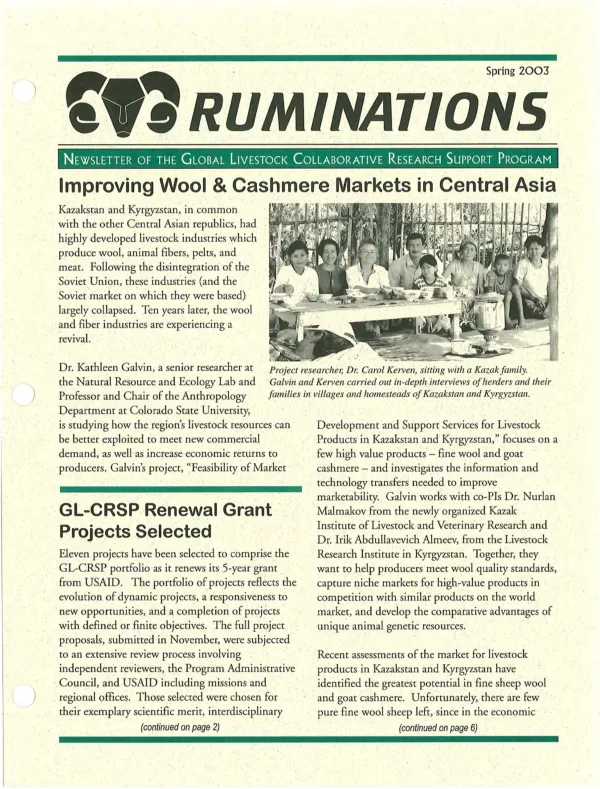
Improving Wool & Cashmere Markets in Central Asia Kazakhstan and Kyrgyzstan, in common with the other Central Asian republics, had highly developed livestock industries which produce wool, animal fibers, pelts, and meat.
2015 · 16 pages
Sign in to readA free account is required to download.
Abstract
Following the disintegration of the Soviet Union, these industries (and the Soviet market on which they were based) largely collapsed. Ten years later, the wool and fiber industries are experiencing a revival. Dr. Kathleen Galvin, a senior researcher at the Natural Resource and Ecology Lab and Professor and Chair of the Anthropology Department at Colorado State University, is studying how the region's livestock resources can be better exploited to meet new commercial demand, as well as increase economic returns to producers. Galvin's project, "Feasibility of Market Development and Support Services for Livestock Products in Kazakhstan and Kyrgyzstan," focuses on a few high-value products - fine wool and goat cashmere - and investigates the information and technology transfers needed to improve marketability. Recent assessments of the market for livestock products in Kazakhstan and Kyrgyzstan have identified the greatest potential in fine sheep wool and goat cashmere. Unfortunately, there are few pure fine wool sheep left, since in the economic approach, policy relevance, and potential impacts and benefits to the US as well as their appropriateness to the GL-CRSP and USAID goals. The project aims to help producers meet wool quality standards, capture niche markets for high-value products in competition with similar products on the world market, and develop the comparative advantages of unique animal genetic resources. Galvin works with co-PIs Dr. Nurlan Malmakov from the newly organized Kazakh Institute of Livestock and Veterinary Research and Dr. Irik Abdullavevich Almeev, from the Livestock Research Institute in Kyrgyzstan. Together, they want to improve the marketability of fine wool and goat cashmere by providing information and technology transfers to producers. The project will also investigate the information and technology transfers needed to improve marketability, with a focus on fine wool and goat cashmere. The project's research area is a critical one, as the livestock industry is a significant contributor to the economies of Kazakhstan and Kyrgyzstan. The project's findings will have important implications for the development of the livestock industry in the region, and will contribute to the improvement of marketability of fine wool and goat cashmere. The project's results will also be relevant to the broader livestock industry in Central Asia, and will contribute to the development of the region's livestock resources. The project's methodology will involve in-depth interviews with herders and their families in villages and homesteads of Kazakhstan and Kyrgyzstan. The project will also collect data on the market for fine wool and goat cashmere, and will investigate the information and technology transfers needed to improve marketability. The project's results will be disseminated through a variety of channels, including academic publications, policy briefs, and presentations at conferences and workshops. The project's expected outcomes include improved marketability of fine wool and goat cashmere, increased economic returns to producers, and improved access to information and technology for producers. The project's results will also contribute to the development of the livestock industry in the region, and will have important implications for the broader livestock industry in Central Asia. The project's geographic focus is on Kazakhstan and Kyrgyzstan, with a focus on the livestock industry in these countries. The project's timeframes are not specified, but the project is expected to be completed within a few years. The project's recommendations will be based on the project's findings, and will be relevant to policymakers, producers, and other stakeholders in the region. The project's collaboration with local institutions, including the Kazakh Institute of Livestock and Veterinary Research and the Livestock Research Institute in Kyrgyzstan, will ensure that the project's results are relevant and applicable to the local context. The project's use of in-depth interviews and data collection will provide a rich understanding of the market for fine wool and goat cashmere, and will contribute to the development of the livestock industry in the region. The project's methodology will involve a combination of qualitative and quantitative research methods, including in-depth interviews, data collection, and analysis. The project's results will be disseminated through a variety of channels, including academic publications, policy briefs, and presentations at conferences and workshops. The project's geographic focus is on Kazakhstan
Related documents