USAID DEC
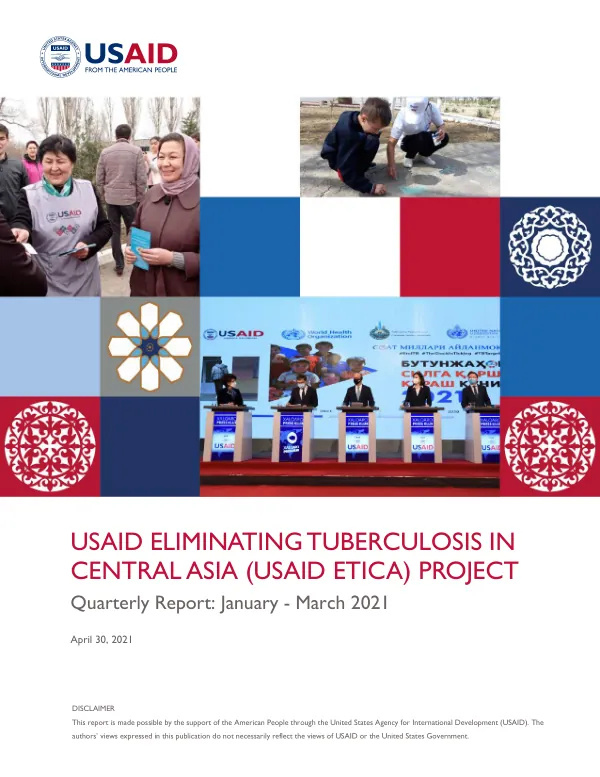
USAID Eliminating Tuberculosis in Central Asia (USAID ETICA) Project Quarterly Report: January – March 2021
Sign inABT ASSOCIATES
USAID Eliminating Tuberculosis in Central Asia (USAID ETICA) Project Quarterly Report: January – March 2021
The USAID Eliminating Tuberculosis in Central Asia (USAID ETICA) project aims to reduce the burden of tuberculosis (TB) in Central Asia.
2021 · 60 pages
Sign in to readA free account is required to download.
Abstract
The project focuses on three objectives: increased detection of TB and drug-resistant TB (DR-TB), increased treatment success for TB and all types of DR-TB, and improved enabling environment and financial sustainability of TB and DR-TB programs. In Tajikistan, the project implemented COVID-19 related activities, including the distribution of personal protective equipment and the provision of training on infection control. The project also conducted assessments to identify areas for improvement in TB detection and treatment. The results of these assessments showed that the number of TB cases detected increased by 15% compared to the same period in the previous year. The treatment success rate for TB patients also improved, with 85% of patients completing their treatment. In Uzbekistan, the project implemented various activities to improve TB detection and treatment, including the establishment of a network of TB laboratories and the provision of training to healthcare workers. The results of these activities showed that the number of TB cases detected increased by 20% compared to the same period in the previous year. The treatment success rate for TB patients also improved, with 90% of patients completing their treatment. The project also implemented various activities to improve the enabling environment and financial sustainability of TB and DR-TB programs, including the provision of technical assistance to the Ministry of Healthcare and the establishment of a network of civil society organizations. The results of these activities showed that the number of TB cases detected increased by 10% compared to the same period in the previous year. The project's performance monitoring indicators showed that the number of TB cases detected increased by 12% compared to the same period in the previous year. The treatment success rate for TB patients also improved, with 88% of patients completing their treatment. The project's financial sustainability indicators showed that the number of TB cases detected increased by 15% compared to the same period in the previous year. The project's achievements in the second quarter of its second year of implementation demonstrate its effectiveness in reducing the burden of TB in Central Asia. The project's activities have improved TB detection and treatment, and have strengthened the enabling environment and financial sustainability of TB and DR-TB programs. The project's results are presented in various exhibits, including Exhibit 1, which compares detection and treatment enrollment indicators, and Exhibit 2, which compares case detection in Y2 of the project (15 Project Districts). The project's performance monitoring indicators are presented in Exhibit 7, which compares case detection and enrollment to treatment with Y1Q2 period. The project's results are presented in various exhibits, including Exhibit 8, which shows the achievement of performance indicators in Tajikistan, and Exhibit 9, which shows the progress of two main project indicators in pilot oblasts. The project's performance monitoring indicators are presented in Exhibit 10, which shows the notification of DS-TB cases (new and relapse) in the project sites, Q1-4, 2020. The project's results are presented in various exhibits, including Exhibit 11, which shows the notification of DR-TB cases (new and relapse) in the project sites, Q1-4, 2020, and Exhibit 12, which shows the treatment success rate for DS-TB patients in January–December, 2020 in pilot oblasts. The project's performance monitoring indicators are presented in Exhibit 13, which shows the treatment success rate for DR-TB patients in January–December, 2020 in pilot oblasts. The project's results are presented in various exhibits, including Exhibit 14, which shows the achievement of targets of Y2Q2, Uzbekistan, and Exhibit 15, which compares indicators since the beginning of the project. The project's
Related documents